

French botanist Théodore Leschenault travelled to Australia in 1800-1803. His recently recovered journal contains a wealth of intriguing information
- Written by Paul Gibbard, Senior Lecturer in French Studies, The University of Western Australia
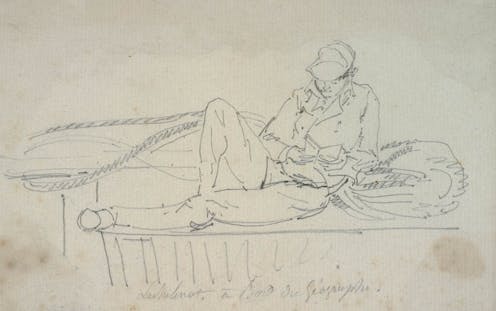
Content warning: this article describes outdated and potentially offensive terminology when referring to First Nations people.
In the storeroom of a square-towered château in Burgundy, my genial hosts gestured towards a large, wooden chest of drawers. I pulled open a compartment and began sorting through bundles of old papers – house records from the 18th and 19th centuries. I was there, in 2015, on the trail of Théodore Leschenault, a botanist who had travelled to Australia in the years 1800 to 1803 with the expedition of discovery led by Nicolas Baudin.
The château belonged to Leschenault’s descendants, who had invited me to explore the family archives. There was a register detailing his divorce from his young wife Marguerite due to their “incompatible temperaments”. There were shells and rocks bearing faded ink labels. And there was a printed invitation to a funeral service held for him at the Madeleine church in Paris in 1826 after he died of a stroke.
All this was valuable research material but I felt a slight sense of disappointment. The original manuscript journal of his voyage to Australia was not there.
Read more: Friday essay: the voyage of Nicolas Baudin and 'art in the service of science'

Prior to this I had been working on a translation of the only version of the journal thought to exist, an incomplete copy made for the navy by an unknown hand. But then, in late 2016, out of the blue, the original journal in Leschenault’s own handwriting was put up for auction in Royan on the west coast of France. Where the journal had been for the previous 200 years was not revealed.
After bidding closed at €110,000 ($A180,500), the French government stepped in, seizing the journal as its own property, on the grounds that it had funded the original expedition. The journal was deposited with the National Archives of France, which in 2020 provided me with scans to use as the basis for a new translation that appears in my book The French Collector.
This journal contains a store of fascinating new information. Two previously unknown chapters describe the first part of Leschenault’s journey from Paris to Le Havre and onward via the Canary Islands and Mauritius to the west Australian coast. They offer much else besides, including insights into his fears and ambitions, an array of scientific observations, and impassioned discussions of slavery and the treatment of Indigenous peoples.
A collecting frenzy
Leschenault was 26 when he set out from France with the Baudin expedition to explore the “unknown coasts” of New Holland. Sociable by nature, with a head of blond curls, he came from a wealthy legal family and had been imprisoned during the French Revolution. A child of the Enlightenment, with an anti-religious and empirical cast of mind, he hoped to forge a career as a botanist.
When Leschenault went ashore for the first time on the Australian coastline in June 1801, at Geographe Bay in the south-west, he immediately went into a collecting frenzy, picking up so many shells, pebbles and plants he couldn’t carry them all back to the boat.
Here he saw grass trees and tuart trees, black swans and a dingo, and had a much anticipated first encounter with some Wardandi Noongar men. Over the next two years, Leschenault collected thousands of plant and animal specimens as the expedition explored three sides of the continent.
 In June 1801, Leschenault saw grass trees for the first time.
Shutterstock
In June 1801, Leschenault saw grass trees for the first time.
Shutterstock
Read more: Friday essay: a rare bird — how Europeans got the black swan so wrong
All the officers and scientists on the voyage were required to keep a record of their experiences. Some are terse maritime affairs – lists of bearings, wind directions and similar data. Leschenault’s is among the most eloquent and wide-ranging. These writings all supplement the official record of the expedition, the Voyage de découvertes aux terres australes, published by François Péron and Louis Freycinet between 1807 and 1816.
 Journal of Théodore Leschenault, 1800-1802.
Archives Nationales (France): MAR/5JJ/56/B.
Journal of Théodore Leschenault, 1800-1802.
Archives Nationales (France): MAR/5JJ/56/B.
Leschenault’s original journal is a battered-looking object, a large notebook with torn cloth covers, muddy-brown in colour, with the words “private journal” written on the front. Inside, the paper is well preserved and his handwriting spills in neat, brown ink along hand-ruled lines.
The two previously unknown chapters contain an invaluable ragbag of materials about the voyage. Into these chapters he copied a whole sheaf of loose-leaf jottings he had done earlier: private letters, interviews with travellers, short essays on different phenomena (atmospheric humidity, sea temperatures and phosphorescence), philosophical reflections, descriptions of plants and animals, alongside a more conventional daily narrative.
The emotional register of these early chapters shifts according to his imagined audience. When he sees the sea for the first time at Le Havre, for example, he describes for friends and family his terror at the thought that he might drown beneath the waves. But his language becomes more austere when detailing natural phenomena for scientific readers.
Colonisation and slavery
Some of the most unexpected passages in the new chapters relate to slavery and the effects of colonisation. In Australia, he quickly came to the conclusion that the local peoples, “far from a state of civilisation” and prone to treachery, disproved the idea of the “noble savage”. But the early chapters reveal that he arrived with sympathetic preconceptions.
While on Tenerife, one of the Canary Islands, he learnt about the fate of the island’s original Guanche inhabitants – which gave him reason for concern. Spanish invaders had come with firearms and confronted a peaceful community of farmers. “Oppression and despair drove this people to extinction,” he writes. “Now we are setting out to visit unknown peoples; perhaps the moment of their discovery will be the start of their misfortune”.
Read more: Explainer: the myth of the Noble Savage
Leschenault contemplates the bleakest of fates for Indigenous Australians, before changing his mind: “But no, that can’t be true, today governments are more enlightened, they will be just […]”
 Inside the journal.
Archives Nationales (France): MAR/5JJ/56/B.
Inside the journal.
Archives Nationales (France): MAR/5JJ/56/B.
Leschenault also takes an interest in a marginal figure among the scientific staff, the teenage assistant gardener and former slave who was referred to by the derisive nickname Merlot (“little blackbird”). He sympathetically recovers the youth’s original name, Bognam-Nonen-Derega (meaning “everlasting happiness”), copies down details about life in his home village (in what is perhaps now eastern Nigeria) and records the story of how he was kidnapped at the age of 12 and sold to English slavers. Later, on Mauritius, Leschenault directly addresses moral questions around slavery.
It is, he declares, “an outrage against nature” but he understands why, for economic reasons, it cannot be abolished immediately. His sympathies are prone to fluctuation though: when he interviews an albino Mauritian slave girl, his manner seems much less compassionate.
The recently recovered journal traces Leschenault’s travels over the course of two years but comes to an abrupt end in Sydney, at the half-way point of the expedition. What happened afterwards – did he start to write a second volume, now lost?
When he abandoned the expedition due to illness at Timor in June 1803, he gave all his papers to Baudin: drawings, botanical notebooks, possibly even a sequel to the journal. But the whole bundle of papers disappeared without a trace. Perhaps they linger in some storeroom, awaiting their moment to re-emerge into the light …
Authors: Paul Gibbard, Senior Lecturer in French Studies, The University of Western Australia

















