

AUKUS is supposed to allow for robust technology sharing. The US will need to change its onerous laws first
- Written by Lauren Sanders, Senior Research Fellow on Law and the Future of War, The University of Queensland
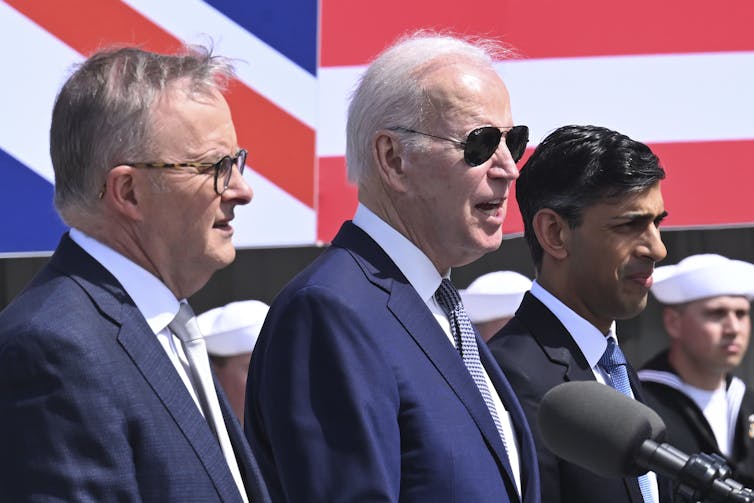
The AUKUS partnership between Australia, the US and the UK isn’t just about nuclear-propelled submarines.
It also includes an information exchange agreement related to a number of new advanced technologies. These include cyber capabilities, electronic warfare, quantum technology, hypersonics, artificial intelligence and autonomous military capabilities.
Although the partners committed to sharing these technologies and information, there’s a problem. The US has strict trade control restrictions that impede certain technologies from being easily exported to Australia, or sold elsewhere by Australian companies after being incorporated into other items.
The restrictions on military items that would fall under the AUKUS agreement are spelled out in the United States’s International Traffic of Arms Regulations (ITAR).
The controls apply to military and dual-use technologies, as well as the information and skills needed to build them – and they are important. The US has international obligations to prevent the proliferation of weapons and military technology globally. It also has domestic concerns about which countries can access US military technology and information.
Australian companies wanting to import US technologies on the International Traffic of Arms Regulations list need to meet certain conditions to obtain a license. This can include vetting their staff, limiting access to the information or technology, and agreeing to onerous monitoring and reporting requirements.
They could be exposed to US criminal laws if they fail to meet these obligations after being granted a licence.
Are changes to the US restrictions on the way?
Since the AUKUS agreement was announced, a number of American think tanks, export control experts and senators have spoken out about these onerous requirements.
They have expressed a need to make US and Australian defence trade easier so the AUKUS deal can work as intended.
In late May, US President Joe Biden responded to these calls. In a joint statement with Prime Minister Anthony Albanese, he announced the US will take steps to amend its laws to streamline the sharing of technologies with Australia.
This change would deem Australia a “domestic source” in the Defence Production Act of 1950, alongside the US and Canada.
There is a separate proposal before Congress to give effect to this change. Named the TORPEDO Act, it would not only designate Australia a “domestic source”, but also ease restrictions for technology-sharing with Australia and the UK.
In addition, it would create a general license for the export, re-export or transfer of certain defence articles to Australia and the UK under the International Traffic of Arms Regulations.
Meanwhile, another bill, the AUKUS Undersea Defence Act, was introduced in June to facilitate the transfer of nuclear submarines from the US to Australia and the training of Australian personnel on the vessels, as well as proposing other exemptions.
Other experts have called for a US presidential executive order to give Australia an exemption under the regulations.
Whichever path the US takes, it could take years for any of these legislative changes to be accepted and implemented.
What would this mean for Australia?
The proposed change announced by Biden mirrors the exemption Canada currently enjoys with the US government. Canadian arms manufacturers and researchers can now access US technologies and information without going through the onerous licensing requirements under the International Traffic of Arms Regulations.
This would be a boon for the Australian defence industry, boosting our competitiveness in the global market. Trade to the US and Canada would be also be simplified, with much greater opportunity to export goods back to the those countries.
If passed, however, this change would not amount to an arms trade free-for-all.
US trade controls would still apply to any technologies not included in a pre-approved list, as well as to the trade of equipment or technologies beyond the AUKUS partners.
Other requirements, like security vetting and data protection requirements, would also still apply. Australia’s own export laws will also still be in effect.
Read more: Fears AUKUS will undermine Australia's defence sovereignty are misplaced
Does Australia need to change its own laws?
Although Australia has not exactly followed the American model of defence export controls, our system is quite similar. Australia currently requires licences to allow items or information on the Defence and Strategic Goods List to be supplied, published or brokered for sale to another country.
However, Australia doesn’t have the same ongoing monitoring obligations the US has. The US system requires that any sales to third countries of equipment containing US controlled technology are still subject to the stringent International Traffic of Arms Regulations.
This is meant to prevent a country from buying military equipment from the US and then reselling it to a third country, like Russia. Russia has been circumventing international sanctions by buying military equipment like this from third-party states.
Australia’s end-use monitoring is much more limited than this often-criticised feature of the US controls.
Australia also doesn’t have country-specific bans for the trade of defence items. Rather, each export application is dealt with on a case-by-case basis. Australia, for instance, has not replicated the US ban on selling semiconductors to China. This reflects Australia’s different trade policies and relationship with China, compared to the US relationship with China.
Because Australia has less stringent rules (in some respects), the US may expect Canberra to strengthen its regulations when it comes to trading technologies or sharing information.
The AUKUS Undersea Defence Act before Congress, for instance, proposes Australia would first need to be assessed as having a “comparable” export control system to the US in order to qualify for the proposed exemptions. What that means, however, is not clearly defined.
Australia is still drafting updates to its Defence Trade Controls Act to address a host of deficiencies with its export control system, including how to accommodate new technologies like artificial intelligence.
While the US expectations for parity in defence control systems are important, they must be balanced carefully with our independence to manage our own trade partnerships and build a sovereign defence industry.
One can surmise the impending updates to the Australian Defence Trade Controls Act will reveal exactly how this balance will be established.
Authors: Lauren Sanders, Senior Research Fellow on Law and the Future of War, The University of Queensland

















