

Modern Australian
The Times

A mysterious interstellar radio signal has been blinking on and off every 22 minutes for over 30 years

  • Written by Natasha Hurley-Walker, Radio Astronomer, Curtin University
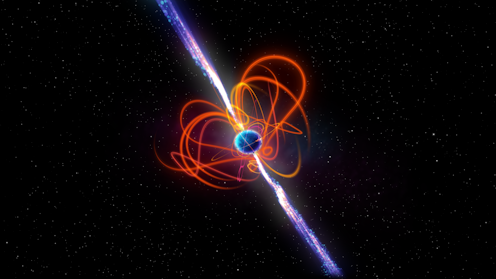
A mysterious interstellar radio signal has been blinking on and off every 22 minutes for over 30 years

Last year, we made an intriguing discovery – a radio signal in space that switched on and off every 18 minutes.

Astronomers expect to see some repeating radio signals in space, but they usually blink on and off much more quickly. The most common repeating signals come from pulsars, rotating neutron stars that emit energetic beams like lighthouses, causing them to blink on and off as they rotate towards and away from the Earth.

A rotating pulsar
Pulsars emit powerful beams of radio waves from their poles, which sweep across our line of sight like a lighthouse. Joeri van Leeuwen

Pulsars slow down as they get older, and their pulses become fainter, until eventually they stop producing radio waves altogether. Our unusually slow pulsar could best be explained as a magnetar – a pulsar with exceedingly complex and powerful magnetic fields that could generate radio waves for several months before stopping.

Unfortunately, we detected the source using data gathered in 2018. By the time we analysed the data and discovered what we thought might be a magnetar it was 2020, and it was no longer producing radio waves. Without additional data, we were unable to test our magnetar theory.

Nothing new under the sun

Our Universe is vast, and so far every new phenomenon we’ve discovered has not been unique. We knew that if we looked again, with well-designed observations, we had a good chance of finding another long-period radio source.

So, we used the Murchison Widefield Array radio telescope in Western Australia to scan our Milky Way galaxy every three nights for several months.

Spider-like dipole antennas in front of a breakaway in the outback
A single tile of the hundreds that make up the Murchison Widefield Array, a radio telescope in outback Western Australia. Natasha Hurley-Walker

We didn’t need to wait long. Almost as soon as we started looking, we found a new source, in a different part of the sky, this time repeating every 22 minutes.

At last, the moment we had been waiting for. We used every telescope we could find, across radio, X-ray, and optical light, making as many observations as possible, assuming it would not be active for long. The pulses lasted five minutes each, with gaps of 17 minutes between. Our object looked a lot like a pulsar, but spinning 1,000 times slower.

The newly discovered mystery object emits pulses of radio waves in a 22-minute cycle.

Hiding in plain sight

The real surprise came when we searched the oldest radio observations of this part of the sky. The Very Large Array in New Mexico, United States, has the longest-running archive of data. We found pulses from the source in data from every year we looked – the oldest one in an observation made in 1988.

Observing over three decades meant we could precisely time the pulses. The source is producing them like clockwork, every 1,318.1957 seconds, give or take a tenth of a millisecond.

Image of a radio transient switching on and off
Radio images taken with the MeerKAT radio telescope in South Africa, showing one of the pulses, sped up by a factor of 20. The other nearby radio sources remain constant. Natasha Hurley-Walker

According to our current theories, for the source to be producing radio waves, it should be slowing down. But according to the observations, it is not.

In our article in Nature, we show that the source lies “below the death line”, which is the theoretical limit of how neutron stars generate radio waves; this holds even for quite complex magnetic field models. Not only that, but if the source is a magnetar, the radio emission should only be visible for a few months to years – not 33 years and counting.

So when we tried to solve one problem, we accidentally created another. What are these mysterious repeating radio sources?

What about ET?

Of course, it’s very tempting at this point to reach to extraterrestrial intelligence as an option. The same thing happened when pulsars were discovered: astrophysicist Jocelyn Bell Burnell and her colleagues, who found the first pulsar, nicknamed it “LGM 1”, for “Little Green Men 1”.

A chart recorder image of the first pulsar
Observation of pulses from the first pulsar to be discovered, CP 1919. The chart recorder shows regular deflections every 1.3 seconds. Jocelyn Bell Burnell and Anthony Hewish

But as soon as Bell and her colleagues made further detections, they knew it could not be aliens. It would be incredibly unlikely for so many similar signals to be coming from so many different parts of the sky.

The pulses, similar to those of our source, contained no information, just “noise” across all frequencies, just like natural radio sources. Also, the energy requirements to emit a signal at all frequencies are staggering: you need to use, well, a neutron star.

While it’s tempting to try to explain a new phenomenon this way, it’s a bit of a cop out. It doesn’t encourage us to keep thinking, observing and testing new ideas. I call it the “aliens of the gaps” approach.

Fortunately, this source is still active, so anyone in the world can observe it. Perhaps with creative follow-up observations, and more analysis, we’ll be able to solve this new cosmic mystery.

Authors: Natasha Hurley-Walker, Radio Astronomer, Curtin University

Read more https://theconversation.com/a-mysterious-interstellar-radio-signal-has-been-blinking-on-and-off-every-22-minutes-for-over-30-years-205237

Where to Enjoy Your Off-Road Caravan on the Gold Coast

With a caravan, you can travel anywhere and everywhere without battling the rush of the peak holiday season or last-minute reservations. While the r...

How Osteopathy Supports Recovery from Sciatica and Nerve Pain

Sciatica isn't just annoying. It's genuinely painful. It sits deep in your glute and shoots straight down the back of your leg. It turns something as...

The Winter Jewellery Edit: Five Pieces You'll Wear All Season

As wardrobes shift to cosy knits, tailored coats and rich seasonal textures, jewellery becomes the finishing touch that pulls every winter outfit to...

7 Signs It's Time to Upgrade Your Piston Air Compressor

If you run a workshop, panel shop, or fabrication business anywhere around Perth, you already know what heat and dust do to equipment over a few sum...

How Long Do Bathroom Renovations Melbourne Take? Step-by-Step Process Explained

Planning a bathroom renovation is exciting, but one of the biggest questions homeowners ask is, "How long will it take?" While every project is uniq...

Why Your Skin Breaks Out: The Science of Acne Explained

Acne is the most common skin condition in the world. An estimated 85% of people experience it at some point between the ages of 12 and 24, and a gro...

10 Swimwear Trends Australian Women Are Wearing This Summer

Every Australian summer brings a fresh wave of swimwear trends, but some styles have much greater staying power than others. While fashion constantly ...

Why Regular Skills Updates Are Essential for Licensed Security Officers

A guard at a Brisbane shopping centre gets a call about a shoplifter who's turned aggressive.  They’ve done the job for six years. But their de-...

10 Benefits of Choosing Professional Tutoring Penrith Services

Every student has unique learning strengths, challenges, and academic goals. While classroom teaching provides essential knowledge and structure, so...

Sunshine Coast Baby Classes Prove Big Hit Among First-Time Mums

There's a movement gaining traction on the Sunshine Coast, providing a village of support, socialisation and relief for first-time mothers and babie...

Father's Day Gift Ideas for Men Who Are Hard to Buy For

Some dads are easy to buy for. Others do not want anything, already have everything, or give you the classic "don't worry about me" answer every yea...

Top 5 Mistakes That Wear Out Your Brakes Faster

Brakes don't need frequent replacements like oil changes do.   But a lot of the wear happens quietly, over months, because of habits most drivers...

Plantation Shutters vs Curtains: Which Is Better for Your New Home?

Moving into a new home is an exciting opportunity to personalise your space and make it your own. While many homeowners focus on furniture, flooring...

Celebration of Life vs Traditional Funeral: What's the Difference?

When saying goodbye to someone you love, there is no single way to honour their life. Every family has different traditions, beliefs, and preference...

Building Approval for Roofing Projects: What Homeowners Need to Know

Roofing projects are an important part of maintaining and protecting your home. Whether you're repairing storm damage, replacing an ageing roof, or ...

Chatswood Tutoring And Its Role In Academic Achievement

Academic success often requires more than classroom attendance alone. Students face increasing expectations as they progress through school, particu...

Why Laser Hair Removal Treatments Continue Growing In Popularity

Managing unwanted hair can become time-consuming and frustrating for many people, especially when shaving, waxing, and other temporary methods requi...

Choosing the Right Devices for a Flexible Workplace

For IT leaders managing large fleets, the device layer is where workforce productivity and security policy meet. The shift towards flexible and hybrid...















