

We see a great deal of the Albanese government, but we don't know much about what goes on behind the scenes
- Written by Michelle Grattan, Professorial Fellow, University of Canberra
Andrew Leigh won’t have made himself many friends in Labor with his attack this week on the stifling power of the party’s factions.
Then again, when it comes to political advancement, Leigh’s non-factional status has, in opposition and government, left the well-credentialed Assistant Minister for Competition, Charities, Treasury and Employment relatively friendless. To ascend to the higher reaches of the ladder in Labor, you need to march in either the right or left battalion.
Leigh’s Wednesday speech, denouncing the factional “duopoly” and pointing to its downsides, received little attention among colleagues. The system suits very well those it benefits.
Labor has a long history of factions. What is distinctive about them now is how professionally they operate, as two powerful machines of control in an alliance of mutual convenience.
Under a proportional representation system, the factions carve up all the spoils – ministries, seats, trips. In the federal caucus, they keep the troops in line, so there are few notable breakouts.
That (as Leigh says) such an arrangement can undermine democracy within the party, suppress internal policy debate, and make it harder to attract and advance good candidates – who cares? That’s the way politics works, isn’t it?
It may be. But that doesn’t mean it should be, at least to the extent that it is.
Factions within broad-based political parties have their place in bringing together people with common views, playing an organising role, managing conflict.
But when they become over-tight, as in Labor, they can eventually corrode democracy more generally. Or where, as in the Liberals, they are warring fiefdoms, resorting to “whatever it takes” behaviour (as in the NSW division), they are seriously dangerous to their host party. “Community candidates” are attractive to some voters fed up with over-factionalised parties.
Currently, Labor’s factional system works very nicely for Prime Minister Anthony Albanese (who hails from the left). In contrast, factions in the Liberal Party are a nightmare for Peter Dutton, trying to keep together a party split on fundamentals.
In Labor, right and left have converged on the centre as they have become less ideological and found common interest in an orderly sharing of spoils. In the Liberals, the factions have increasingly diverged and formalised, with the right becoming more assertive and ideological and the moderates losing ground in most parts of the party.
Read more: Word from The Hill: On ditching the Commonwealth Games, the Voice pamphlet, Labor's factions
Within the federal Labor caucus, not only is everyone factionalised apart from Leigh and fellow ACT MP Alicia Payne, but as they have become all-pervasive, the factions have been tamed. Debates in caucus over policy are virtually non-existent; a few questions to the frontbench can be seen as a lively caucus meeting.
Leigh argues the factionalism at the party’s grass roots risks forcing recruits into an “uncomfortable choice”. Uncomfortable or not, the members make that choice, at least when it comes to the party’s national conference.
Voting for delegates to the conference, to be held in Brisbane on August 17-19, has just finished. There’ll be 402 delegates, half of whom are chosen directly by the rank and file. Of the 402, only about 20 are unaligned with either broad faction.
For the first time since the 1980s, the left will be the largest faction at the conference, with 49% of the total delegates, compared to the right’s 45%. In theory, this gives the unaligned delegates a balance of power. In practice, the factional chiefs will wrangle deals and trade offs. The debate about AUKUS is set to be a major test at the conference, but the factional heavyweights will manage it in a way that ensures it doesn’t embarrass Albanese (one insider makes the point this isn’t new, but how successful conferences have operated historically).
Labor’s blanket factionalism, with its modus operandi, is part of a wider development – the extensive professionalisation of modern politics generally, and the priority it gives to control. This has been a creeping phenomenon.
The government has an army of propagandists (titled “media advisers”) in ministerial officers to control and promote its messages, which are crystallised into comprehensive “talking points” (or swot sheets) for frontbenchers and backbenchers. Ministers are deployed with military precision to occupy the daily media landscape. No trench is left without a soldier.
The sheer volume of the government’s media presence (mainstream and social) disguises the large void in our current knowledge of what is happening behind the scenes.
Once, the media had much more access to the public service to discuss policy (we’re talking about background information, not “leaks”). Governments shut this down, as far as they could, years ago. Ministerial offices jealously guard the flow of information; if public servants are called in to do any media briefing, it is strictly overseen.
There is access to material through freedom of information, but this has its strict limits and needs reform.
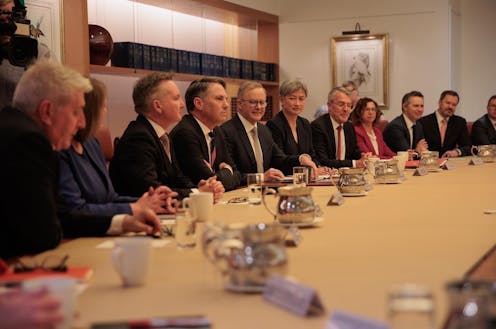
The media know very little about the internal dynamics of the Albanese cabinet. From Albanese’s point of view, this is a triumph. It is a product of a high degree of genuine unity, but it is also a mark of iron discipline.
Sometimes, when journalists hear what’s said in a cabinet, it’s a sign of leadership destabilisation. Remember the spectacular leaks from Tony Abbott’s cabinet, driven by the Turnbull camp’s (successful) undermining. It was the same in the latter days of Bob Hawke.
At other times during the Hawke government, there was a steady flow of information about ministers’ positions on issues and the arguments they were putting, which told a lot about the policy-making process and relations among ministers. For example, from early on in that government, much was known about the relationship between treasurer Paul Keating and Hawke.
We have little insight into the dynamic between the current PM and Treasurer Jim Chalmers. We do know they differed over the Stage 3 tax cuts. But that was early – what about other issues? We’re aware there’ve been strains between Resources Minister Madeleine King and Industry Minister Ed Husic, but they haven’t been given much media attention.
Significantly at the moment: what, if any, cabinet debate is going on about the strategy to boost the Voice, now its support is flagging? If there is not that debate, this says something about the cabinet. In general, we have minimal detail about the Albanese cabinet’s remit. For instance, what was the degree and timing of the full cabinet’s involvement in the planned AUKUS spend? Is the government’s decision-making effectively done in the expenditure review committee and the national security committee, as well as at leadership level?
Of course we can’t put all our ignorance down to control – we, as media, are not marshalling our own forces sufficiently.
It’s an irony. The PM and his ministerial team swarm into every corner of the media. But the media know less about the entrails of decision-making than we often did before the 24-hour news cycle.
Authors: Michelle Grattan, Professorial Fellow, University of Canberra

















