

Modern Australian
Times Advertising

what does a nuclear bomb actually do?

  • Written by Kaitlin Cook, DECRA Fellow, Department of Nuclear Physics and Accelerator Applications, Australian National University
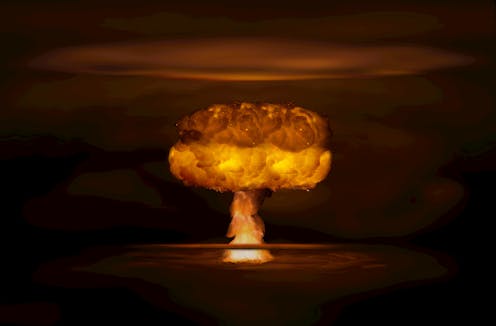
what does a nuclear bomb actually do?

I would like to know what a nuclear bomb actually does – Rafael, age 11, Melbourne

Hi Rafael!

A nuclear bomb, like any bomb, makes an explosion by releasing an enormous amount of energy at once. Nuclear bombs just use a different process from other bombs.

You may have heard of atoms. These are the super-tiny particles that make up matter – which in turn makes everything around us (and us).

Nuclear bombs work by changing the cores of atoms to turn them into other types of atoms. This process releases a lot of heat energy, which quickly gets converted into a big wave of pressure: an explosion!

What are nuclei?

Nuclear bombs release much more energy than normal bombs that use chemicals such as TNT. This is because the cores of atoms are held together very strongly. But before I get into that, let me explain some of the basics.

Atoms themselves are made up of even smaller particles called protons, neutrons and electrons. A cloud of electrons surrounds a tiny inner core made of protons and neutrons. This core is called the nucleus, and more than one nucleus are called nuclei.

Diagram of an atom, showing electrons surrounding a core of protons and neutrons.
An atom is made up of electrons surrounding a central core of protons and neutrons. The core is about one-hundred thousand times smaller than the atom. AG Caesar/Wikimedia Commons

Chemical reactions happen when electrons are rearranged, whereas nuclear reactions happen when protons and neutrons inside the nucleus are rearranged.

There are two types of nuclear bombs. In the case of “fission” bombs, nuclei that have a lot of protons and neutrons – such as those in a very dense metal called uranium – are split apart.

Uranium is a chemical element with the atomic number 92. It has 92 protons and electrons. Shutterstock

In another type of nuclear bomb called a “fusion” bomb, two very small nuclei – such as the cores of two hydrogen atoms – are stuck together.

But fission bombs are simpler and more common, so let’s talk about those.

Chain reactions

Some nuclei don’t take very much energy at all to split apart, such as those in some types of uranium or plutonium atoms (plutonium is another dense metal which has 94 protons in its nuclei).

These nuclei will sometimes fission even when they’re just sitting around. When a nucleus fissions, it turns into two smaller nuclei and spits out a few neutrons.

However, one nucleus doing this isn’t a big deal. To make an explosion, you need to have a certain amount of uranium together in one spot.

For instance, a fission bomb would usually use a very purified sphere of uranium weighing about 52kg. Even this would have to use certain types of uranium in which the atoms have a specific number of neutrons.

If you have enough of these atoms together in one spot, the neutrons that are spit out during fission will hit other nuclei, which then also fission and spit out more neutrons – and so it continues in a chain reaction that sets off a massive explosion.

Diagram of one atom fissioning, showing two smaller nuclei and three neutrons, which cause two more nuclei to fission producing neutrons in a chain reaction
A nuclear chain reaction happens when one nucleus fissions, releasing neutrons which cause another nucleus to fission, and so on. Adapted from MikeRun/Wikimedia Commons

An unexploded fission bomb will usually be holding separate pieces of uranium (or plutonium) that are too small to start the chain reaction on their own. A chemical explosive is used to smash the pieces together – triggering the chain reaction that sets the bomb off.

Two different types of fission bombs -- one where two small pieces of uranium are pushed together by a chemical explosive, and another where plutonium is compressed by a chemical explosive.
Fission bombs work by taking pieces of uranium or plutonium that are too small to make a chain reaction on their own, and using a chemical explosive to push them together until a chain reaction starts. Adapted from Fastfission/Wikimedia Commons

Fallout

After fission happens, the two smaller nuclei that are left over are radioactive. Having enough of them in one spot can be very harmful to human health.

These leftovers after a nuclear explosion are called “fallout”. Besides the huge size of the explosion itself, the fallout in particular is what makes nuclear bombs more dangerous than other bombs. The technology used to make nuclear weapons is some of the most secret information in the world.

Nuclear bombs have only ever been used twice. Both of these bombs were detonated during World War II, by the United States against Japan. People around the world are working hard to make sure they are never used again.

Authors: Kaitlin Cook, DECRA Fellow, Department of Nuclear Physics and Accelerator Applications, Australian National University

Read more https://theconversation.com/curious-kids-what-does-a-nuclear-bomb-actually-do-208475

Winter Sanitation Gaps in Parramatta Kitchens: A Hidden Pest Risk

Winter brings a host of changes to our homes, from the chill in the air to the cozy warmth indoors. However, this season also introduces sanitation ch...

When to Seek Advice from Employment Lawyers in Melbourne

Australian employment law is detailed and, at times, complex, with rights and obligations that aren't always obvious to employees or employers witho...

7 Benefits of Professional Gutter Cleaning for Australian Homeowners

Gutters aren't exactly glamorous. They sit up there on the edge of your roof, doing their job quietly - until they stop working. Clogged, overflowing ...

Pipe Floats Strengthening Pipeline Performance In Demanding Environments

Pipelines often travel through environments that are anything but predictable, water currents shift, terrain changes, and materials keep moving unde...

Why Ceiling Fans Are Essential For Comfort, Efficiency, And Modern Living

Creating a comfortable indoor environment is not just about temperature; it is about how air moves, how a room feels, and how efficiently energy is ...

Why Duct Cleaning In Melbourne Is A Smart Investment For Healthier Living Spaces

Behind your walls, ceilings, and vents lies a network quietly working every day to keep your home comfortable. Yet over time, this system can become...

Disability Service Providers Supporting Inclusive And Independent Living

Finding the right support system can feel like assembling a puzzle where every piece must fit just right. For individuals and families navigating di...

A Beginner's Guide to Owning a Caravan in Australia

Owning a caravan opens up a style of travel that's hard to match for freedom and flexibility. However, for those just starting out, the process of c...

Preparing Your Air Conditioner for Summer: What Most Homeowners Overlook

As temperatures rise, many homeowners switch on their air conditioning for the first time in months — only to find it’s not performing the way i...

What Actually Adds Value to Properties in Newcastle

Newcastle has seen steady growth over the past few years, with more buyers looking beyond Sydney for lifestyle, space, and long-term value. As dema...

What is Design and Build in Construction?

Imagine you’re about to start a new construction project, maybe it’s a custom home or a commercial building. You’ve got the idea, the land, an...

Commercial roof leak detection: why early action protects your building

Water ingress is one of the most disruptive and costly issues facing commercial properties. For property managers and facilities teams, even a minor...

Custom Photo Frames: Turning Everyday Moments into Lasting Displays

Photos capture moments, but how you display them determines how they’re experienced every day. A meaningful photograph deserves more than a generi...

Managed IT Services: A Smarter, More Predictable Way to Run Your Business Technology

If you’ve ever had your systems go down in the middle of a busy day, you’ll know how quickly things can unravel. Phones stop ringing, emails sto...

Landscaping Geelong — Coastal Elegance Meets Practical Design

A Landscape Shaped by Location Geelong occupies a unique position within Victoria’s broader landscape. It carries the energy of a growing city, y...

Electric Adjustable Beds: A Simpler Way To Sleep Better

Sleep should feel natural. It should come easily, without discomfort, without constant repositioning, and without waking up feeling sore. But for ma...

Healthy Snacking Sorted: Premium Beef Jerky

In today's fast-paced world, finding a snack that's both satisfying and genuinely good for you can feel like a mission. Many readily available optio...

What to Know Before Getting Dental Implants: A Guide for First-Time Patients

Dental implants Perth patients often look for a long-term solution for missing teeth without the hassle of dentures or bridges. If you are thinking ...















