

Mining the seabed for clean-tech minerals could destroy ecosystems. Will it get the green light?
- Written by: Claudio Bozzi, Lecturer in Law, Deakin University
A little-known organisation is meeting this week in a conference centre in Jamaica. The rules the International Seabed Authority (ISA) are drafting could have immense impact.
That’s because this United Nations body has the power to permit – or deny – mining on the deep seabed, outside any nation’s exclusive economic zones. Boosters say the billions of tonnes of critical minerals like nickel, manganese, copper and cobalt lying in metal-dense nodules on the seabed could unlock faster decarbonisation and avoid supply shortages.
Developing Pacific nation Nauru has led the charge to open up the seabed for mining, seeing it as a new source of income. (Ironically, Nauru itself was strip-mined for guano, leaving a moonscape and few resources.)
But researchers warn the mining could trash entire ecosystems, by ripping up the sea floor or covering creatures with sediment. Early indications from trial mining efforts suggest the process is worse than expected, with long-lasting impact on sealife.
Almost 20 governments are calling for a moratorium or slowdown on mining. But China, Russia and South Korea are pushing for mining to begin.
The ISA has already missed its July 9 deadline to produce regulations governing seabed mining. That could mean we’re heading for a deep-sea free-for-all.

Why mine the deep sea at all?
Because no one owns it, and because parts of it are rich in easily accessible metals (once you get to the bottom, that is). Land-based mining usually involves processing vast volumes of rock, taking out the minerals you want and leaving the tailings behind. But on the seabed, things are different.
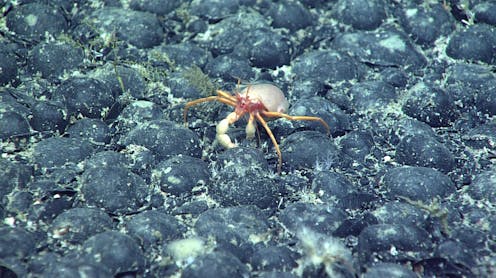
The main area prospectors are eyeing off is the Clarion-Clipperton Zone, an abyssal plain 4,000–5,000 metres deep east of Hawaii. Here, plate tectonics and underwater volcanoes have produced huge numbers of polymetallic nodules, accretions of minerals about 10-15 centimetres wide. They grow glacially slowly, about one centimetre every million years. But there are a lot of them – an estimated 21 billion tonnes in this zone alone, according to the ISA.
 Fields of polymetallic nodules are strewn on abyssal plains.
NOAA Office of Ocean Exploration and Research
Fields of polymetallic nodules are strewn on abyssal plains.
NOAA Office of Ocean Exploration and Research
By 2050, demand for nickel and cobalt to make electric vehicle batteries could grow by up to 500%, according to the World Bank. That’s why companies like Nauru’s partner, The Metals Company, are investing in this type of mining.
Seabed mining, they argue, is an environmentally better option than expanding land-based mining into more challenging locations, mining low-grade ore bodies and risking contaminating waterways.
Boosters say seabed mining in international waters avoids the risk of dominance by a few countries or suppliers. For instance, the Ukraine-Russia war has hit battery grade nickel availability, as Russia is the primary global supplier.
Read more: A rush is on to mine the deep seabed, with effects on ocean life that aren't well understood
But what about the environment?
This is the sticking point. The seabed in question is a pristine environment. While fishing trawlers already tear up large areas of seafloor to devastating effect, mining would open up even more of the seabed.
Opposition has come from many conservation organisations, civil society representatives, governments like Canada, Germany, Fiji and Papua New Guinea. They want a moratorium on seabed mining based on the precautionary principle – not acting until we know what impact it will have. They argue we lack the technology to monitor the seabed and knowledge of the ecosystems of the deep, meaning we cannot be certain seabed mining can proceed without causing serious and long lasting harm. Early research shows this type of mining can be destructive.
 Tethered to nodules: This species of cnidarian attaches itself to polymetallic nodules by sponge stalks. It lives in the Clarion-Clipperton Zone.
Craig Smith and Diva Amon, ABYSSLINE Project.
Tethered to nodules: This species of cnidarian attaches itself to polymetallic nodules by sponge stalks. It lives in the Clarion-Clipperton Zone.
Craig Smith and Diva Amon, ABYSSLINE Project.
Should the ISA have the power to decide this?
It took 25 years for the UN to negotiate the law of the sea treaty. The treaty is clear about how we should protect and use the seabed, as part of the “common heritage of mankind”. The ISA was created to steward these commons, with the power to make rules in international waters. These cover two-thirds of the world’s oceans and 90% of known polymetallic nodule deposits.
The problem is many governments and organisations don’t think it’s fit for purpose.
The ISA is, like some other UN bodies, a complex bureaucracy and has been criticised for lacking transparency. Even though all 167 nations which signed the law of the sea treaty are automatically ISA members, critical decisions can be made with far fewer.
Applications to mine the seabed are approved or denied by the ISA’s council, which has 36 members. Council decisions stem from recommendations by a legal and technical commission, made up of 30 members appointed by the council. Dominated by lawyers and geologists, this commission, according to NGOs and governments, has ignored comments and critique. Only a handful of the members have environmental expertise.
The council is also geared towards mineral extraction, with many members elected on the basis they already export minerals like nickel and manganese, have invested heavily in seabed mining technology, and already use significant volumes of these minerals.
The ISA’s secretary general Michael Lodge was earlier this year criticised by the German government for allegedly pushing to permit mining, an accusation Lodge rejected.
So is it a done deal?
Ideally, the authority would have more time to develop rigorous rules based on good environmental assessments.
But time is up. Two years ago, Nauru triggered a clause giving the ISA two years to produce a mining code and rules – a feat it had not previously managed. Those two years were up on July 9th and the code isn’t out. That means it’s now legally possible to lodge mining applications.
So because of the delays, we may be heading for a future where seabed mining becomes legal by default – without rules to govern it at all.
Authors: Claudio Bozzi, Lecturer in Law, Deakin University


















