

Modern Australian
The Times

Cheap shots aside, Chalmers has work to do to improve his new 'wellbeing' framework

  • Written by John Hawkins, Senior Lecturer, Canberra School of Politics, Economics and Society, University of Canberra
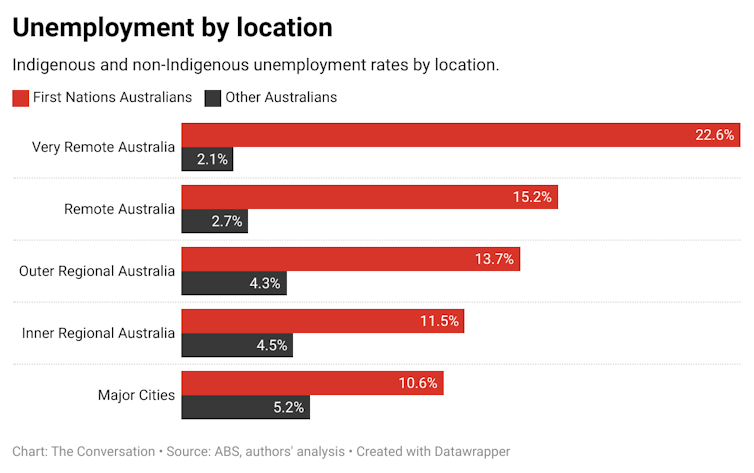
Indigenous and non-Indigenous unemployment rates by location.

The Albanese government’s new “Measuring What Matters” framework for a wellbeing economy has been criticised for relying on out-of-date data in several crucial measures. But that’s an easy and somewhat cheap criticism to make.

Notably, the Treasury document reports “little change” in overall life satisfaction based on statistics from 2020, and “stable” psychological distress, based on statistics from 2018.

As The Australian newspaper has editorialised, this old data “fails to reflect the COVID-19 pandemic, billions of dollars in extra NDIS spending, and the most aggressive series of interest rate hikes in a generation”.

True, but given these are the most recent years on which the Australian Bureau of Statistics has published data, that’s a relatively cheap shot. It’s as if the newspaper wants to find fault with the document, labelling it “a pitch to progressives” and a “fad”.

The document is more than that. It should be acknowledged as a significant and positive step in the right direction by Australia’s Treasury, in keeping with international best practice.

At the same time, it should be recognised that the measures being used need improvement, both in terms of regularity and how much they capture differences masked by national averages

Read more: Chalmers 'measures what matters' – tracking our national wellbeing in 50 indicators

We’re late to this party

When the then shadow Treasurer Jim Chalmers outlined his plan for a wellbeing budget in 2020, his opposite number Josh Frydenberg mocked it as a “yoga mat and beads” approach to economic management.

But the need to shift away from using the blunt instruments of national income or gross domestic product (GDP) to measure progress has long been recognised. Even the inventor of GDP, Simon Kuznets, said a nation’s welfare can “scarcely be inferred from a measurement of national income”.

New Zealand, Wales, the United Kingdom, India and Canada are all ahead of Australia in adopting wellbeing frameworks to shape their budget decisions. International institutions such as the OECD and United Nations are working along similar lines.

The new statement is in some ways a restoration of the Treasury’s wellbeing framework developed in the early 2000s under the Howard government, championed by department head Ken Henry and inspired by the work of Nobel prizewinner Amartya Sen. It was quietly dropped in 2016 under the Turnbull government.

The problem with ‘average’ Australians

There are various approaches to measuring wellbeing. One way is to amend GDP by taking out “bad things” (pollution, loss of biodiversity, smoking) and include “good things” not currently included (such as unpaid caring work done in the home).

The approach of Measuring What Matters is to use a “dashboard” of 50 indicators of inclusion, fairness and equity over five areas: health, security, sustainability, cohesion and prosperity. The measures for health, for example, include life expectancy, mental health, prevalence of chronic conditions, and access to health and support services.

For these measures to be meaningful and useful to the budget process, they need to be both timely and capture differences in experiences between different groups – not just the “average”.

Averages can mask significant inequalities. As Paul Krugman put it, if Elon Musk walks into a bar then the average person there becomes a billionaire.

The unemployment rate is at a 50-year low, and average household income and wealth at record levels. But not all Australians are sharing in this. The Indigenous unemployment rate, for example, is still about three times the national average.

Indigenous and non-Indigenous unemployment rates by location.
CC BY As the statement notes, “the whole of population indicators outlined in this Framework are not an accurate measure of First Nations wellbeing”. Many wellbeing surveys show the importance of understanding the wellbeing of specific groups. For example, the national Carer Wellbeing Survey shows that unpaid carers have much lower wellbeing compared to the average Australian. Regional wellbeing Another area where average indicators may be inaccurate is in capturing the experience of people living in rural and remote areas. Some aspects of wellbeing – such as social connection – are often higher in rural areas. But others are much poorer, such as access to health and social services. People in rural and remote areas are also more affected by drought, flood, fires and storms – events increasing in frequency and severity. For example, the University of Canberra’s Regional Wellbeing Survey, conducted since 2013, has consistently shown that Australians living in outer regional and remote areas report poorer access to many services, including health, mobile phone and internet access. Measuring What Matters shows they wait longer to see a doctor and have less trust in institutions. But many other indicators don’t have specific data for rural regions, and don’t provide insight into the often large differences in wellbeing of different rural communities. Without measures to see how they are faring, we risk leaving rural areas behind. Read more: Australians' national wellbeing shows a glass half full: Measuring What Matters report The importance of up-to-date data Chalmers has rightly referred to the new framework as an “iterative process”. Yes, the data in some areas is outdated, such as the cost of rent or mortgages and financial security, which come from 2020 – predating the surge in rents and higher interest rates. The only way to fix this is to provide the resources needed to collect more detailed information more often. This should include ensuring a sample of the many groups known to be at higher risk of low wellbeing but often under-represented in national data collections. When seeking to move from simplistic to more complex ways of measuring social progress, it is easy to criticise gaps in data, or to suggest that it’s all too hard and we should default back to easier numbers and measures. But while Measuring What Matters is limited by the scope of the data available, it is a step in the right direction. Read more: Australia's first wellbeing framework is about to measure what matters – but it's harder than counting GDP

Authors: John Hawkins, Senior Lecturer, Canberra School of Politics, Economics and Society, University of Canberra


Read more https://theconversation.com/cheap-shots-aside-chalmers-has-work-to-do-to-improve-his-new-wellbeing-framework-207324

Your Baby's First Year: A Local Guide to Feeding, Sleep, and When to Get Extra Support

Ask ten parents in a Brisbane mothers' group how their baby is feeding or sleeping, and expect ten different answers.  Someone's baby sleeps throu...

Kitchen and Laundry Makeover Ideas That Don't Require a Full Renovation

Full kitchen renos are expensive — and most people don't actually need one.  They need the kitchen to stop looking like it's stuck in 2009, or t...

How Technology Is Reshaping the Modern Australian Commercial Kitchen

The commercial kitchen has always been shaped by technology. Refrigeration changed how ingredients could be stored, modern ventilation transformed k...

The Number on a Roller Blind Fabric That Nobody Explains

Somewhere in the fabric book, next to the colour name, there is a percentage. Three per cent. Five per cent. Ten per cent. Nobody explains it, most c...

What’s Trending in Men’s Jewellery This Father’s Day!

Finding a Father’s Day gift that feels personal, stylish and genuinely wearable is not always easy. While socks and novelty mugs have traditionall...

Road Signs: Understanding Their Role in Clear and Effective Signage

Effective signage and display hardware can help businesses communicate information, promote products and organise customer or visitor movement. Road...

Bottle Label Printing: Key Factors to Consider Before Your Next Packaging Run

Effective packaging begins with understanding the product, bottle material, artwork and production requirements when planning bottle label printing. H...

Planning a Long-Distance Move With Interstate Movers Melbourne

Moving between states involves more planning than a typical local relocation. Along with packing and transporting household belongings, you need to...

Understanding the Role of an I/O Controller in Industrial Automation

Modern industrial systems depend on accurate communication between sensors, machines and control systems. An I/O controller can help manage this commu...

How the Right Mining Hose Supports Demanding Operations

Mining environments place considerable demands on equipment used for material transfer, water management and processing. Hoses operating in these co...

Simple Ideas for Making Social Gatherings More Memorable

We have all been to those parties where everyone just stands around the kitchen island, staring at their phones, waiting for someone else to make a mo...

Outdoor Wall Lights: Improving Exterior Lighting Around Your Home

Lighting can influence how a room looks, feels and functions, so the right fitting should be selected according to both appearance and practical req...

Commercial Office Cleaning: Combining Routine Office Cleaning With Melbourne Service

Keeping a workplace clean requires a service that can accommodate everyday tasks as well as the particular needs of the business. Professional comme...

Caravan Sales in Queensland: How to Find the Right Caravan for Sale QLD

Caravan ownership is about more than having somewhere to sleep while travelling. For many Queenslanders, it is one of the best ways to explore regio...

What Sir Walter Buffalo Turf Actually Costs in 2026 (And Why Quotes Vary So Much)

Two quotes landed on a Hills District homeowner's kitchen table last spring for the exact same 80-square-metre backyard. One said $12 a metre. The o...

Nearly 1,300 NSW Hospital Beds Are Occupied By People Who Are Ready To Go Home

1,276 people in NSW hospitals have been medically cleared for discharge but remain in hospital because they're still waiting for NDIS or aged care sup...

National Survey Launched to Measure Operational Impacts of Federal NDIS Policy Reforms

The effects of recent NDIS reforms are beginning to move beyond policy papers and into day to day service delivery. A new national survey is asking ...

Beyond the Nappy Cake: Baby Shower Gifts That Get Used

What new Australian parents unwrap, keep, and quietly thank you for months later. Six weeks after my daughter was born, I did an audit of the baby sh...














