

Cambodian strongman Hun Sen wins another 'landslide' election. Will succession to his son be just as smooth?
- Written by Lee Morgenbesser, Griffith University
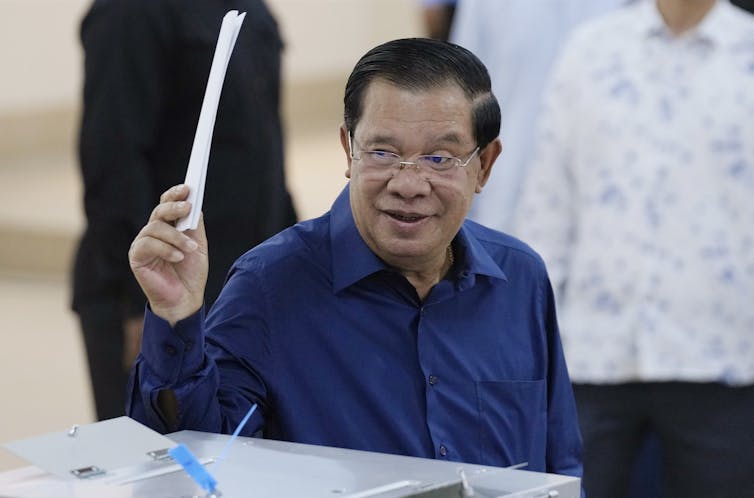
On December 24, 2021, Cambodian Prime Minister Hun Sen, 70, chaired a meeting of the Cambodian People’s Party, which has ruled the Southeast Asian country since 1979. The meeting saw his eldest son, Hun Manet, 45, unanimously selected to be the future prime minister.
After years of speculation over the identity of the strongman’s political successor, it was both an unsurprising and uninspiring choice.
A similar lack of surprise and inspiration encapsulates Cambodia’s general election this past Sunday. Even by the low standards of Southeast Asia, it was one of the worst sham votes in living memory. Up against a mix of 17 emasculated, feeble and grovelling opposition parties, Hun Sen’s party quickly boasted it had won in a “landslide”.
The entire event amounted to nothing more than a gigantic confidence trick designed to foist a political reality on repressed citizens – formulated without their consent and enforced without their approval.
Hun Sen’s transition of power to his son is now assured. The only question is when. The strongman said last week it could happen in a matters of weeks.
Preparing for a sham election
The campaign period for this year’s election featured the usual dose of manipulation and misconduct – all of which was aimed at guaranteeing few, if any, surprises at the ballot box.
In May, the National Election Committee barred the leading opposition Candlelight Party from competing in the election because it had failed to provide the necessary documentation. This documentation, ironically, had been taken in a police raid years earlier.
In early June, the National Assembly amended the election law to bar non-voters from ever running for office, as well as penalise anyone who calls for election boycotts. For the fledgling opposition, boycotts were a new and desperate tactic aimed at discrediting the electoral process.
In late June, Hun Sen also had a very public spat with Meta, Facebook’s parent company, after its oversight board recommended his account be suspended for threatening political opponents with violence.
And last week, the government blocked the websites of several news organisations, including Radio Free Asia. It was all just business as usual in Hun Sen’s Cambodia.
The uncomfortable truth is such elections have never been more than a means for Hun Sen to hold onto power with an ever-tightening grip, as opposed to an opportunity for his opponents to ever gain power.
Since the occupying Vietnamese forces installed him as leader in January 1985, the ageing strongman has slowly but methodologically bent the political system to his will.
How do dictators stay in power?
How has he accomplished this feat over the past 38 years? Based on my research in the field of authoritarian politics, two significant factors stand out.
The first thing Hun Sen did was personalise power by following the “playbook” of other strongmen like Paul Biya in Cameroon, Saddam Hussein in Iraq and Idi Amin in Uganda. Among his actions across four decades of authoritarianism:
he acted as a gatekeeper of the process by which people are appointed to high office
appointed relatives to high-level posts in the party, military and government
took control of the state security apparatus and created his own paramilitary group outside the normal chain of military command
and monopolised the decision-making process within the ruling party, while also controlling who enters and exits its executive committee.
By 2005, Hun Sen alone had discretion over personnel policy and the distribution of rewards throughout Cambodia’s political system.
The second thing Hun Sen did was entrench a harsher form of dictatorship in Cambodia, transforming the country in recent years into a genuine one-party state.
In July 2015, the government rammed through a bill designed to suppress civil society groups. The law used arcane compliance requirements related to funding, reporting, registration and political neutrality to limit their operations.
Then, in August 2017, the Finance Ministry went after the independent English-language newspaper, The Cambodia Daily, for a decade’s worth of alleged back taxes. It was merely the start of sustained campaign aimed at ridding the country of an independent media.
The Supreme Court then dissolved the Cambodia National Rescue Party, the only serious challenger to the ruling party, on the fictitious grounds it was trying to topple the government in a “colour revolution.” Hun Sen has repeatedly rolled out this allegation against anyone who disagrees with him.
How does one dictator pass the reins to another?
It was against this backdrop that Hun Sen spent Sunday going through the motions of sanctioning one last sham election, at least as prime minister.
Having used his personal power to banish political opponents, monopolise the media landscape, disempower civil society organisations, crush mass protests and arbitrarily rescind the political rights and civil liberties of citizens, the path is now clear for Hun Manet to succeed him. So, what will happen next?
Leadership succession can be the Achilles heel of dictatorships. The process can sometimes encourage infighting among political elites and potentially plunge a country into chaos. The evidence suggests strongmen are more likely to give up power when they satisfy four preconditions:
1) Immunity: they can ensure legal protection for any alleged crimes committed while in office.
2) Security: they have a paramilitary force or formal position at the apex of the security apparatus.
3) Wealth: they have a stash of cash and/or a portfolio of properties to fund their retirement.
4) Trust: they appoint someone to take over who can protect their immunity, security and wealth.
Having so far satisfied all but the need for immunity, Hun Sen is now well-positioned to pass power onto his son.
Typically, when political succession occurs in dictatorships, the new strongman receives the benefit of the doubt from a slew of hopeful foreign states and optimistic foreign journalists. This comes from a place of exhaustion and exasperation: surely he can’t be worse?
Hun Manet, who was trained at the United States Military Academy at West Point and received a PhD in Economics from the University of Bristol, will be yet another beneficiary of this mindset.
But like the sons of other strongmen, such as Ilham Aliyev (the son former Azerbaijani leader Heydar Aliyev), Bashar al-Assad (son of Hafez al-Assad in Syria), Joseph Kabila (son of Laurent Kabila in Congo) and Kim Jong Un (son of Kim Jong Il in North Korea), Hun Manet has been groomed in the image of his father.
There is nothing to suggest Cambodia’s next prime minister won’t also have a sham election up his sleeve.
Authors: Lee Morgenbesser, Griffith University

















