

Puppy yoga? Goat meditation? An animal welfare scientist explores what these activities might mean for the cute creatures
- Written by: Mia Cobb, Research Fellow, Animal Welfare Science Centre, The University of Melbourne
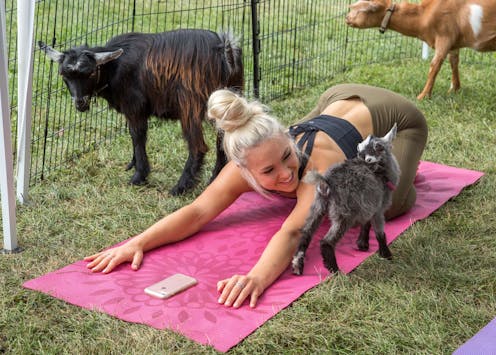
Puppies! Goats! Kittens! A quick online search suggests you can take a yoga class with just about any cute animal you like.
Operators provide the animals, room and an instructor – people pay to come and enjoy. Don’t forget the obligatory cute post to your socials, or it didn’t happen.
So far, so good. But what do the animals make of it?
As an animal welfare scientist, yoga with animals rings some alarm bells for me: it often seems to be focused on human wellbeing, with animal welfare an afterthought. But research shows how animal-assisted activities like this can be improved, and how we can all play a role in making animal welfare a higher priority.
Ethical issues exposed
The ethics of animal yoga have been a hot topic since a a recent investigation in the United Kingdom exposed distressing practices.
Puppies as young as six weeks old were denied sleep and water while working in puppy yoga sessions. Classes took place in hot rooms for hours at a time, with no capacity for the young pups to opt out of interactions.
People attending the classes were given no guidance on safely handling puppies, and video footage shows squirming young puppies dropping awkwardly to the ground.
Early socialisation can build dogs’ long-term confidence in interactions with people and the world. Bad experiences during this time can influence them to be anxious or fearful.
Similar practices appear to be common in the growing yoga-with-animals industry. An Australian friend told me about a recent goat yoga session:
it left me feeling awful for those poor goats, being grabbed at, chased around the room, and cuddled against their will.
How can science help?
My research centres around understanding the animal experience and using this evidence to inform good practice and policies.
It’s widely agreed animals such as dogs, goats and birds are sentient, which means they experience good and bad feelings – and that matters to their individual wellbeing.
Read more: Here's what the science says about animal sentience
With that understanding comes a moral obligation for us to care for animals in a way that includes their mental experiences as well as their physical needs.
Social licence pressure
In modern societies we often expect the animals we rely on will have good lives, not just protection from harm and suffering. When we learn people are failing to safeguard animal wellbeing (for example, through media investigations), there is a public reaction.
These reactions can affect entire industries. A recent example in Australia and New Zealand is the interruption to live export of sheep by sea.
The impact of community attitudes is sometimes called “social licence pressure”. When communities trust and accept that an operator is acting ethically and responsibly, the industry or individual has a “social licence to operate”.
This isn’t a physical licence that can be granted legally or politically. It’s a term from industries such as forestry and mining, where community approval underpins their ongoing operations.
Increasingly, the idea of social licence is becoming relevant to our interactions with animals in contexts such as racing, farming, and now animal yoga.
In many ways, concerns about puppy yoga align with those observed in other animal-assisted practices, such as education, therapy and other allied health settings. Rapidly growing but minimally regulated, these practices generally claim to have positive impacts on people’s lives.
However, the need for animal welfare to be monitored, evaluated and prioritised is often overlooked.
Animal welfare assurance
One approach to make animal-assisted activities more ethical is through “one health” and “one welfare” initiatives, which focus on the interconnectedness of human, animal and environmental wellbeing.
For animal-reliant operations to be sustainable, they need be transparent and proactive in assuring the public that animal wellbeing is a priority. This may require considerable change to historical practices.
Research on human–animal interactions is often limited by a lack of funding for studies of animal experience, which can be used to inform regulation and policy.
The five domains of animal welfare
When assessing indicators of animal welfare, scientists increasingly use the “five domains” framework.
The first four domains are nutrition, physical environment, health, and behavioural interactions (with people, other animals and the environment). All of these directly influence the fifth domain: the animal’s mental state.
For example, a puppy deprived of water in a hot room may feel thirsty, tired and dizzy. A young animal whose sleep is interrupted may feel worried, have reduced concentration, and be more prone to illness. The risk of illness is greater if they are not fully vaccinated, or are exposed to a place visited by many animals. A dropped or mishandled puppy may feel pain and fear, and learn that people should be avoided.
Animals should also have agency – the ability to choose their actions, including whether to interact with people or withdraw.
How to make change
In the UK, the ITV News investigation has led to a rapid escalation of the issue. The Royal Society for the Prevention of Cruelty to Animals and the Kennel Club have condemned the yoga classes, and called on the parliamentary group that monitors animal welfare to ban the practice.
This shows the power of social licence pressure. Closer to home, we can all exert this kind of pressure through the choices we make.
By staying informed about what makes a good life for animals, and not supporting practices that fail to align with it, we can fulfil our moral obligation to animals that rely on us.
Authors: Mia Cobb, Research Fellow, Animal Welfare Science Centre, The University of Melbourne


















