

why we need to rethink European honeybees
- Written by: Amy-Marie Gilpin, Research Fellow, Ecology, Western Sydney University
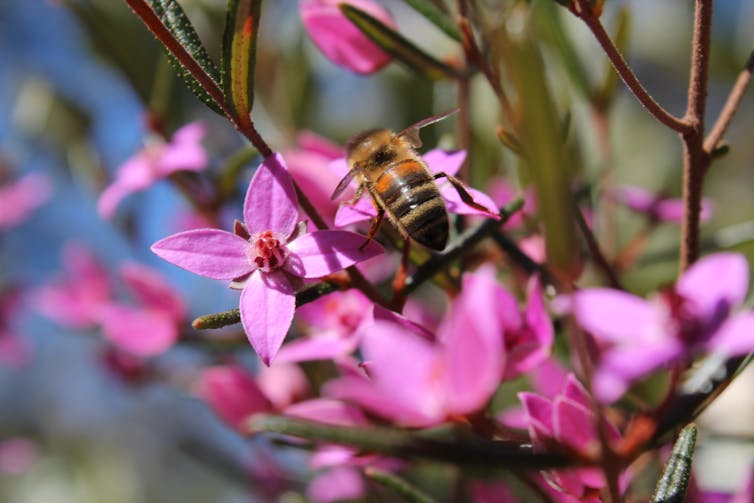
Australia’s national parks, botanic gardens, wild places and green spaces are swarming with an invasive pest that is largely flying under the radar. This is yet another form of livestock, escaped from captivity and left to roam free.
Contrary to popular opinion, in Australia, feral colonies of the invasive European honeybee (Apis mellifera) are not “wild”, threatened with extinction or “good” for the Australian environment. The truth is feral honeybees compete with native animals for food and habitat, disrupt native pollination systems and pose a serious biosecurity threat to our honey and pollination industries.
As ecologists working across Australia, we are acutely aware of the damage being done by invasive species. There is rarely a simple, single solution. But we need to move feral bees out of the “too hard” basket.
The arrival and spread of the parasitic Varroa mite in New South Wales threatens to decimate honeybee colonies. So now is the time to rethink our relationship with the beloved European honeybee and target the ferals.
Read more: Buzz off honey industry, our national parks shouldn’t be milked for money
What makes a hive feral?
European honeybees turn feral when a managed hive produces a “swarm”. This is a mass of bees that leaves the hive seeking a new nest. The swarm ultimately settles, either in a natural hollow or artificial structure such as a nesting box.
With up to 150 hives per square kilometre, Australia has among the highest feral honey bee densities in the world. In NSW, feral honeybees are listed as a “key threatening process”, but they lack such recognition elsewhere.
Feral honeybees have successfully invaded most land-based ecosystems across Australia, including woodlands, rainforests, mangrove-salt marsh, alpine and arid ecosystems.
They can efficiently harvest large volumes of nectar and pollen from native plants that would otherwise provide food for native animals, including birds, mammals and flower-visiting insects such as native bees. Their foraging activities alter seed production and reduce the genetic diversity of native plants while also pollinating weeds.
Unfortunately, feral honeybees are now the most common visitors to many native flowering plants.
Are feral bees useful in agriculture?
Feral honeybees can pollinate crops. But they compete with managed hives for nectar and pollen. They can also be an reservoir of honeybee pests and diseases such as the Varroa mite, which ultimately threaten crop production. That’s because many farms rely on honeybees from commercial hives to pollinate their crops.
So reducing feral honeybee density would benefit both honey production and the crop pollination industry, which is worth A$14 billion annually.
Improved management of feral honeybees would not only help to limit the biosecurity threat, but increase the availability of pollen and nectar for managed hives. It would also increase demand for managed honeybee pollination services for pollinator dependent crops.
What are our current options?
Tackling this issue will not be straightforward, due to the sheer extent of feral colony infestation and limited tools at the disposal of land managers.
If the current parasitic Varroa mite infestation in NSW spins out of control, it may reduce the number of feral hives, with benefits for the environment. Fewer feral hives would be good for the honey industry too.
Targeted strategies to remove feral colonies on a small scale do exist and are being applied in the Varroa mite emergency response. This includes the deployment of poison (fipronil) bait stations in areas exposed to the mite.
While this method seems to be effective, the extreme toxicity of fipronil to honeybees limits its use to areas that do not contain managed hives. In addition, the possible effects on non-target, native animals that feed on the bait, or poisoned hive remains, is still unstudied and requires careful investigation.
Where feral hives can be accessed, they can be physically removed. But in many ecosystems feral colonies are high up in trees, in difficult to access terrain. That, and their overwhelming numbers, makes removal impractical.
Another problem with hive removal is rapid recolonisation by uncontrolled swarming from managed hives and feral hives at the edges of the extermination area.
Taken together, there are currently no realistic options for the targeted large-scale removal of feral colonies across Australia’s vast natural ecosystems.
Where to now?
For too long, feral honeybees have had free reign over Australia’s natural environment. Given the substantial and known threats they pose to natural systems and industry, the time has come to develop effective and practical control measures.
Not only do we need to improve current strategies, we desperately need to develop new ones.
One promising example is the use of traps to catch bee swarms, and such work is underway in Victoria’s Macedon Ranges. However, this might be prohibitively expensive at larger scales.
Existing strategies for other animals may be a good starting place. For example, the practice of using pheromones to capture cane toad tadpoles might be applied to drones (male bees) and swarms. Once strategies are developed we can model a combination of approaches to uncover the best one for each case.
Developing sustainable control measures should be a priority right now and should result in a win-win for industry, biosecurity and native ecosystems.
If there is something to learn from the latest Varroa incursion, it is that we cannot ignore the risks feral honeybees pose any longer. We don’t know how to control them in Australia yet, but it is for lack of trying.
We would like to acknowledge the substantial contribution made by environmental scientist and beekeeper Cormac Farrell to the development of this article.
Read more: A new $2 coin features the introduced honeybee. Is this really the species we should celebrate?
Authors: Amy-Marie Gilpin, Research Fellow, Ecology, Western Sydney University


















