

Tourists flock to the Mediterranean as if the climate crisis isn't happening. This year's heat and fire will force change
- Written by Susanne Becken, Professor of Sustainable Tourism, Griffith Institute for Tourism, Griffith University
Thousands of people on the beach. Children reportedly falling off evacuation boats. Panic. People fleeing with the clothes on their backs. It felt like “the end of the world”, according to one tourist.
The fires sweeping through the Greek islands of Rhodes and Corfu are showing us favourite holiday destinations are no longer safe as climate change intensifies.
For decades, tourists have flocked to the Mediterranean for the northern summer. Australians, Scandinavians, Brits, Russians all arrive seeking warmer weather. After COVID, many of us have been keen to travel once again.
But this year, the intense heatwaves have claimed hundreds of lives in Spain alone. Major tourist drawcards such as the Acropolis in Athens have been closed. Climate scientists are “stunned by the ferocity” of the heat.
This year is likely to force a rethink for tourists and for tourism operators. Expect to see more trips taken during shoulder seasons, avoiding the increasingly intense July to August summer. And expect temperate countries to become more popular tourist destinations. Warm-weather tourist destinations will have to radically change.

What will climate change do to mass tourism?
Weather is a major factor in tourism. In Europe and North America, people tend to go from northern countries to southern regions. Chinese tourists, like Australians, often head to Southeast Asian beaches.
In Europe, the north-south flow is almost hardwired. When Australians go overseas, they often choose Mediterranean summers. Over the last decade, hotter summers haven’t been a dealbreaker.
But this year is likely to drive change. You can already see that in the growing popularity of shoulder seasons (June or September) in the traditional Northern Hemisphere summer destinations.
Many of us are shifting how we think about hot weather holidays from something we seek to something we fear. This comes on top of consumer shifts such as those related to sustainability and flight shame.
Read more: European heatwave: what’s causing it and is climate change to blame?
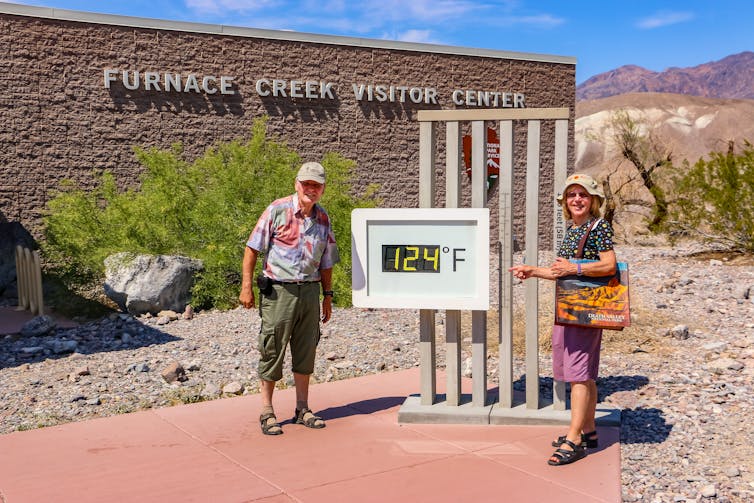
What about disaster tourism? While thrillseekers may be flocking to Death Valley to experience temperatures over 50℃, it’s hard to imagine this type of tourism going mainstream.
What we’re more likely to see is more people seeking “last-chance” experiences, with tourists flocking to highly vulnerable sites such as the Great Barrier Reef. Of course, this type of tourism isn’t sustainable long-term.
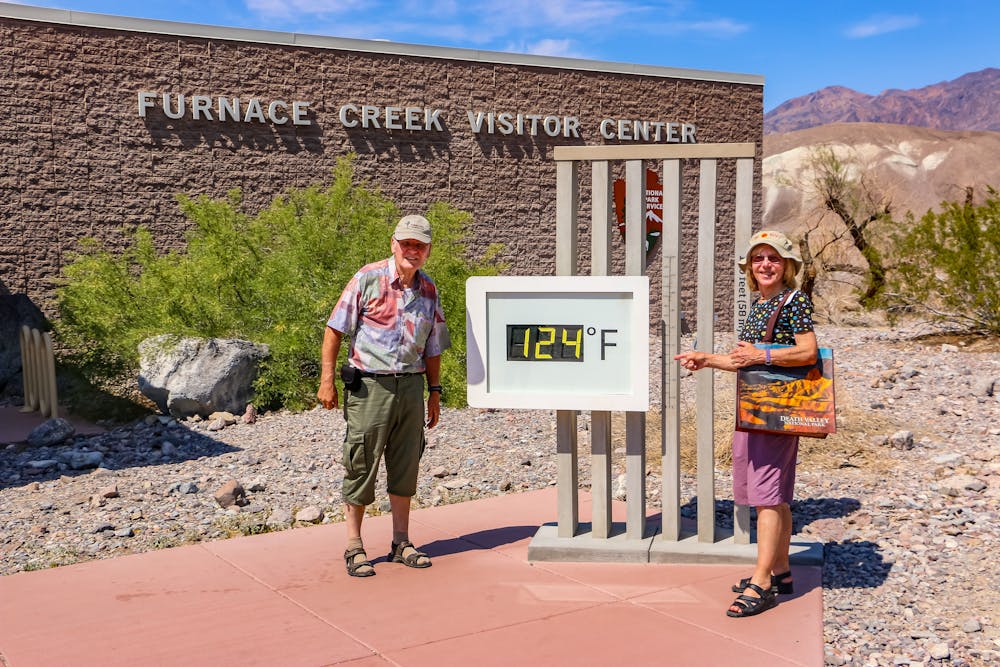 Tourists at the famous thermometer at Furnace Creek, Death Valley.
Shutterstock
Tourists at the famous thermometer at Furnace Creek, Death Valley.
Shutterstock
What does this mean for countries reliant on tourism?
The crisis in Rhodes shows us the perils of the just-in-time model of tourism, where you bring in tourists and everything they need –food, water, wine – as they need it.
The system is geared to efficiency. But that means there’s little space for contingencies. Rhodes wasn’t able to easily evacuate 19,000 tourists. This approach will have to change to a just-in-case approach, as in other supply chains.
For emergency services, tourists pose a particular challenge. Locals have a better understanding than tourists of risks and escape routes. Plus tourists don’t speak the language. That makes them much harder to help compared to locals.
Climate change poses immense challenges in other ways, too. Pacific atoll nations like Kiribati or Tuvalu would love more tourists to visit. The problem there is water. Sourcing enough water for locals is getting harder. And tourists use a lot of water – drinking it, showering in it, swimming in it. Careful planning will be required to ensure local carrying capacities are not exceeded by tourism.
So does this spell the end of mass tourism? Not entirely. But it will certainly accelerate the trend in countries like Spain away from mass tourism, or “overtourism”. In super-popular tourist destinations like Spain’s Balearic Islands, there’s been an increasing pushback from locals against overtourism in favour of specialised tourism with smaller numbers spread out over the year.
Is this year a wake-up call? Yes. The intensifying climate crisis means many of us are now more focused on what we can do to stave off the worst of it by, say, avoiding flights. The pressure for change is growing too. Delta Airlines is being sued over its announcement to go carbon neutral by using offsets, for instance.
Mountains not beaches: future tourism may look a lot different
You can already see efforts to adapt to the changes in many countries. In Italy, for instance, domestic mountain tourism is growing, enticing people from hot and humid Milan and Rome up where the air is cooler – even if the snow is disappearing.
China, which doesn’t do things by halves, is investing in mountain resorts. The goal here is to offer cooler alternatives like northern China’s Jilin province to beach holidays for sweltering residents of megacities such as Beijing and Shanghai.
Some mountainous countries are unlikely to seize the opportunity because they don’t want to draw more tourists. Norway is considering a tourist tax.
Forward-thinking countries will be better prepared. But there are limits to preparation and adaptation. Mediterranean summer holidays will be less and less appealing, as the region is a heating hotspot, warming 20% faster than the world average. Italy and Spain are still in the grip of a record-breaking drought, threatening food and water supplies. The future of tourism is going to be very different.
Read more: We're in the era of overtourism but there is a more sustainable way forward
Authors: Susanne Becken, Professor of Sustainable Tourism, Griffith Institute for Tourism, Griffith University

















