

New Zealand's maritime territory is 15 times its landmass – here's why we need a ministry for the ocean
- Written by Elizabeth Macpherson, Associate Professor of Law, University of Canterbury
The recent failure of the proposed Kermadec ocean sanctuary is a striking reminder of the need for leadership around New Zealand’s ocean policies.
The “no take” ocean sanctuary was meant to be one of the world’s largest marine protected areas. But last month Te Ohu Kaimoana (which represents Māori fisheries interests) voted against the latest proposal.
Their opposition was on the basis that the government hadn’t consulted iwi, and the proposal would extinguish iwi rights guaranteed in the 1992 Fisheries Deed of Settlement and the Māori Fisheries Act.
The government response was an admission that our marine policy is not working as it should, and that we need new marine protection tools consistent with te ao Māori and Te Tiriti o Waitangi.
Our new research suggests a different approach to how New Zealand manages competing uses of the marine environment.
It highlights opportunities to align marine policy and its implementation more closely by considering the ocean as an ecosystem with which people have reciprocal relationships.
New Zealand’s vast ocean territory
Aotearoa is surrounded by a sea territory 15 times the size of its landmass. This extends from the shorelines of the main islands to the Kermadecs (Rangitāhua) in the northwest, the Chathams (Rēkohu) in the east and the subantarctic Campbell Island in the south Pacific ocean.
Two in three New Zealanders live within 5km of the shore and many use the ocean and coasts for recreational and cultural activities. The blue economy provides significant income to New Zealand, including through commercial fisheries, offshore minerals, ports and marinas, maritime transport and coastal tourism.
The Hauraki Gulf alone was recently valued as a NZ$100 billion natural capital asset.
Marine and coastal ecosystems are threatened by climate change, as oceans are acidifying, sea levels rising and sea-surface temperatures increasing. But they are also our best line of defence in buffering extreme events, filtering land runoff and storing “blue carbon”.
Read more: Blue carbon: could a solution to the climate challenge be buried in the depths of fiords?
Māori have cared for their seascapes for generations and have a complex set of reciprocal marine relationships, including protected fishing rights and interests.
But our marine environment is under immense strain. Recent reports highlight a significant decline in marine ecological health, with flow-on impacts for communities.
The range of complex relationships New Zealanders have with the ocean can be difficult to reconcile, especially against an historical context of repeated Crown failures to respect and uphold the rangatiratanga held by iwi and hapū over oceans and fisheries.
Read more: Why Indigenous knowledge should be an essential part of how we govern the world's oceans
An ecosystem approach to marine policy
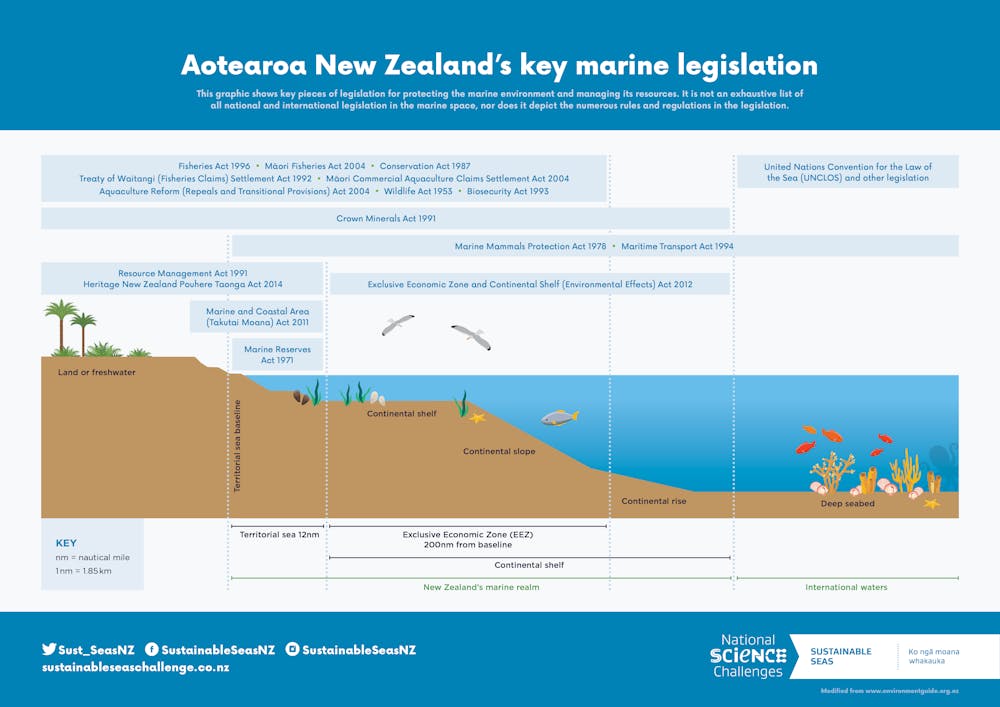
New Zealand’s marine policies are currently dispersed across multiple pieces of legislation and regulatory institutions. They may be working towards different, and sometimes competing, objectives and at various time and geographical scales.
Research conducted within the Sustainable Seas national science challenge looks at ecosystem-based management. This involves managing the marine environment in a way that reconciles competing values without degrading the ocean ecosystem. It also recognises that humans are part of the ecosystem.
A more holistic and relational ecosystem-based approach to managing human activities in the ocean would acknowledge the inter-dependencies between living and non-living marine ecosystem components, including people.
It would move away from siloed or single-sector approaches to instead managing relationships and the cumulative impacts of multiple activities in a way that is flexible and adapts to climate change.
Read more: Our oceans are in deep trouble – a 'mountains to sea' approach could make a real difference
Fundamental principles driving oceans policy
Our research found we already have legal and policy “hooks” (or promising reform initiatives underway) that can support ecosystem-based management across the four key marine policy areas of fisheries, conservation, coastal planning and Māori rights and interests. But these are not always well integrated or aligned.
For example, regional councils are responsible for the coastal marine area under the Resource Management Act (which is currently under reform), but the Ministry of Primary Industries is responsible for the regulation and allocation of fishing rights under the Fisheries Act.
Oceans protection is largely the responsibility of the Department of Conservation, while Māori rights and interests are held by iwi and hapū, subject to a wide range of legal regimes and regulation. Each of these policy areas operates on different time and geographic scales and is working towards (sometimes vastly) different policy objectives, with varying budgets and resources.
To overcome this, our research confirmed we need to agree on fundamental marine principles to “anchor” ecosystem-based management and ensure our policy objectives are complementary and consistent with Te Tiriti o Waitangi. We also need to resource this transition – which requires whole-of-government leadership and coordination.
A ministry for the ocean
The current government created a new ministerial portfolio of oceans and fisheries. This doesn’t go far enough.
Marine policy is still spread across multiple laws and institutions working for different purposes. Recent environmental reforms have focused on land-based issues of resource management, conservation and climate adaptation, taking a sector-by-sector approach and overlooking the interconnected threats facing our ocean.
Many have argued we need an oceans agency to support cross-sectoral collaboration and hold the government to account for implementing the rule of law.
We go further and argue Aotearoa needs a ministry for the ocean to match the ministerial portfolio, reflecting the complexity of marine management and departing from the terrestrial bias of our existing laws and institutions. A dedicated ministry could ensure oversight, coordination and alignment of marine policy.
Designing policy and creating institutional arrangements to support ecosystem-based management at central government level is only the beginning. This must also be the catalyst to drive, resource and enable connectivity in governance and management across all levels, to every bay and estuary.
It’s clear the journey for the Kermadec sanctuary is far from over. Te Ohu Kaimoana have proposed an iwi-led Indigenous approach to environmental management – or, as they put it, a relationship with people and nature together, not separated.
It will be interesting to see how this process evolves and whether it might lead to new marine protection tools that reflect our relationships with the ocean for generations to come.
We would like to acknowledge the contribution by Eric Jorgensen, a co-leader of the Sustainable Seas project.
Authors: Elizabeth Macpherson, Associate Professor of Law, University of Canterbury

















