

In a Stone Age cemetery, DNA reveals a treasured 'founding father' and a legacy of prosperity for his sons
- Written by Adam "Ben" Rohrlach, Mathematics Lecturer and Ancient DNA Researcher, University of Adelaide
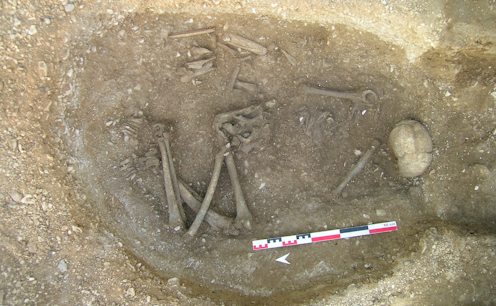
From the remains of nearly 100 ancient individuals, we have reconstructed two extensive prehistoric family trees from a 6,700-year-old cemetery in France, revealing fresh insights into a Stone Age community.
Our new results, published today in Nature, show a group of prehistoric farmers who lived within a network of other communities. This group even brought with them the bones of a “founding father”, establishing a lasting, male-dominated lineage.
Difficulties looking into the past
Around 9,000 years ago, during the late Stone Age period, the “Neolithic way of life” spread from Anatolia (the large peninsula made up mostly of today’s Türkiye) into Western Europe.
Instead of hunting and gathering, people began farming. With the ability to produce and store extra food, Neolithic people developed new social customs built on wealth, land ownership and access to resources, therefore forming social hierarchies.
Ancient burials can tell us a lot about how prehistoric people treated their dead. But figuring out how these societies behaved on a day-to-day basis has always been challenging for researchers. These challenges are due to a lack of written records, and physical data that can be hard to interpret.
These problems are even more complicated during the Neolithic in the Paris Basin in Northern France, where the French cemetery site of Gurgy “les Noisats” was discovered.
Why? The Paris Basin is well known for its massive Stone Age funerary monuments (large objects celebrating important people after their death). These grand monuments functioned like the ancient Egyptian pyramids or the Taj Mahal of their day, in that they were built for the “elite” people in society.
But only a few, much smaller burials have been found that would likely represent the everyday people of the region. Studying these “normal” burials might be the only way to understand the “non-elite”, regular people of the time.
Using new methods for obtaining and comparing ancient DNA, and by sampling nearly every individual from this non-monumental cemetery, our new results reveal two large family trees which open a window into the lives of the people of this prehistoric community.
Read more: Who owned this Stone Age jewellery? New forensic tools offer an unprecedented answer
A network of communities
At the cemetery of Gurgy, graves didn’t overlap, meaning there may have been some markings on top of the ground (perhaps like gravestones are used today). This also suggests closely related individuals knew where people were buried.
Using specialised ancient DNA techniques and several sources of evidence from the burials, we reconstructed two of the largest ever family trees from a prehistoric cemetery. One family tree connected 63 individuals over seven generations, while another connected ten individuals over four generations.
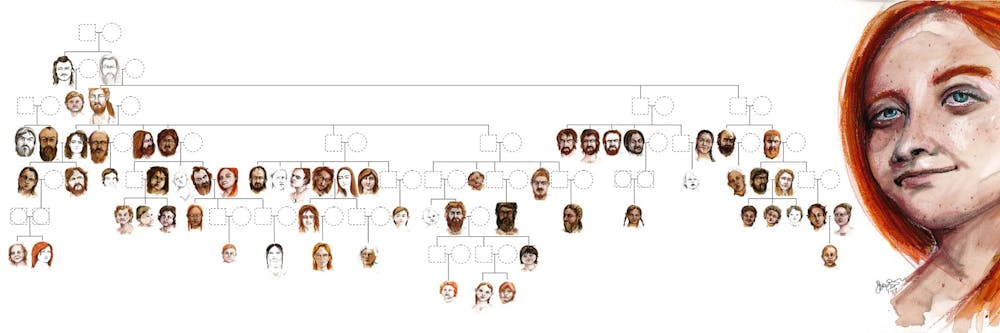
Exploring these family trees revealed a strong pattern of descent through the male line (called patrilineality). This is a practice where each generation is almost exclusively linked to the previous generation through their biological father.
Our results also suggested the practice of virilocality at Gurgy. This means the sons stayed where they were born, and produced children with women from outside of Gurgy.
Using strontium isotope analyses we confirmed these results by analysing the chemicals in the teeth of these individuals. Interestingly, some of the “new incoming” female individuals were distantly related to each other, meaning they may have come from a network of nearby communities, and even from the same communities.
Lastly, we also observed the adult daughters from Gurgy were not buried at the site, meaning they had likely left Gurgy to join other nearby communities themselves (once they had reached a certain age).
A founding father
We also discovered the grave of the “founding father” at the cemetery: a male individual from whom everyone in the largest family tree was descended.
We noticed this individual was actually brought from wherever he had originally died and was reburied at Gurgy (alongside a female individual we could not get DNA from). Only his long bones – thigh, leg, arm and forearm bones – were brought, and he must have represented an important ancestor to the founders of the new burial place of the community.
We observed an entire group, made up of several generations (children, parents and grandparents), arrived at Gurgy together from the beginning. This group must have left a previous site, leaving behind any previously deceased children (but yet still brought and reburied the founding father).
Similarly, in the final generations of Gurgy we observed many children without parents buried there. Hence, like the founding group, these last generations abruptly departed Gurgy together, leaving behind their own buried children. Hence, Gurgy was probably only used for three or four generations, or approximately 84–112 years.
This research represents a starting point for multidisciplinary studies of the social organisation of prehistoric societies, as these large family trees allow for new interpretations of the lives and practices of ordinary people from prehistoric communities.
As we discover and analyse more and more of these cemeteries, we may be able to compare and contrast social practices across regions and time periods, truly opening the window into our ancient past.
Read more: DNA study sheds light on Scotland's Picts, and resolves some myths about them
Authors: Adam "Ben" Rohrlach, Mathematics Lecturer and Ancient DNA Researcher, University of Adelaide

















