

unveiling their whereabouts supports their protection
- Written by Shona Murray, PhD candidate, The University of Western Australia

Open ocean sharks are elusive and mysterious. They undertake vast journeys that span hundreds to thousands of kilometres across immense ocean basins. We know very little about the secret lives of ocean sharks, where they live and why they are there.
What we do know is sharks are immensely important to the natural systems in which they live. Over 450 million years of evolution have perfected their role as apex predators and they play vital roles in fish community regulation and nutrient cycling. Healthy ecosystems rely on healthy shark populations.
Sharks, numbering more than 500 species, are also among the most threatened groups of vertebrates (animals with backbones). After surviving five mass extinctions through geological time, sharks are now facing the greatest threat to their survival from industrial fishing.
Their elusive nature and the immensity of our oceans means sharks are difficult to study. Our limited knowledge is particularly problematic given their threatened status. A solid understanding of the distribution of oceanic sharks is fundamental to their protection and our new research provides valuable insights into the secret lives of these wide-ranging predators.
Read more: Oceanic sharks and rays have declined by 71% since 1970 – a global solution is needed
Silky by name, silky by nature
Silky sharks (Carcharhinus falciformis), named for the silky-smooth feel of their skin, are emblematic of open ocean sharks. They are highly mobile, have long life-spans, and are slow to reproduce. They are found throughout tropical and sub-tropical waters.
Silky shark numbers have declined globally due to industrial-scale fishing. Targeted for their fins and meat, they are also frequently incidentally caught in tuna fisheries. In 2017 the International Union for the Conservation of Nature classified this species as vulnerable to extinction. Their trade is controlled under the Convention on International Trade in Endangered Species.
What we did
Baited remote underwater video systems, or BRUVS for short, are used to document the wildlife of the open oceans. Armed with a pair of small action cameras and baited to attract predators, BRUVS are suspended at 10m depth and drift with ocean currents. Video analysts review the footage to identify, count and measure all observed animals.
BRUVS have previously revealed the impact of human activity on marine predator populations, the ecological value of offshore oil and gas platforms as novel ecosystems, and even that tunas use sharks to scratch their itches.
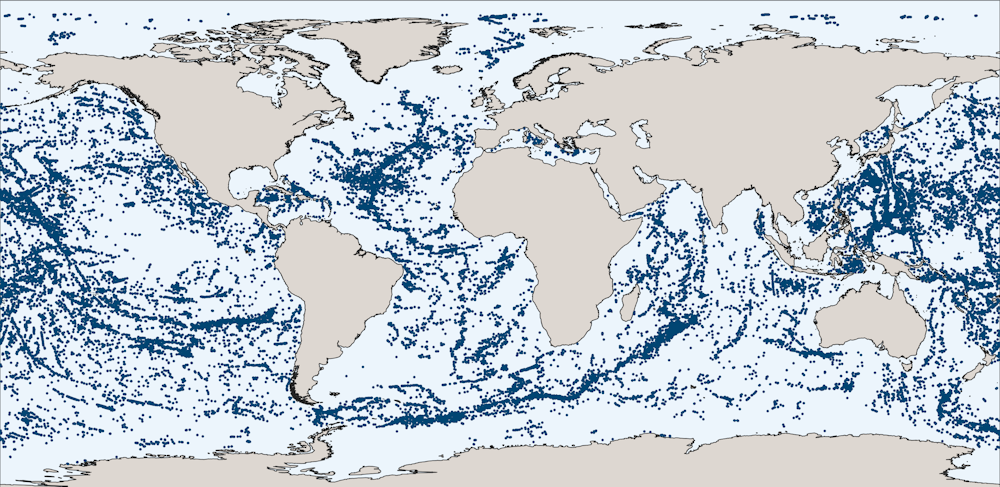
We deployed more than 1,000 BRUVS across the Atlantic, Pacific and Indian oceans between 2012-20 to record where silky sharks hang out and predict how many there are and how big they are.
Read more: How do fishes scratch their itches? It turns out sharks are involved
A love affair between silky sharks and seamounts
Silky sharks love seamounts. The closer we sampled to seamounts, the more frequently we observed silky sharks, and in higher numbers.
Seamounts are huge underwater mountains that rise from depths of thousands of metres to pinnacles that summit from hundreds to just tens of metres below the surface. The best estimate predicts the occurrence of more than 37,000 seamounts worldwide.
Seamounts are often hotspots of marine biodiversity. They act as landmarks in the otherwise relatively featureless open ocean seascape. Seamounts provide feeding, breeding, and resting spots for ocean roamers such as sharks, tuna, and whales. Migratory wildlife also use seamounts as navigational beacons and as stepping stones along their trans-ocean journeys.
Our results also reveal the smallest silky sharks hang out closest to seamounts. Seamounts may provide a rich smorgasbord for these rapidly growing youngsters.
A human footprint on silky sharks
Humans are leaving their heavy footprints on much of the ocean and silky sharks are no exception. Silky shark numbers declined the closer we sampled to coastal ports. Only the most remote areas had high numbers of silky sharks.
Silky sharks close to ports and human populations were also smaller than those observed further away. Such patterns are consistent with fishing impacts as exploitation typically first removes the largest individuals from the population. Our results reflect those for other open ocean sharks: hammerhead, sandbar, tiger and whale sharks have all declined globally in numbers and size .
The distribution of silky sharks exemplifies the pervasive and negative impacts of human activity on oceanic sharks more generally. It highlights the critical need for refuges in which these animals are protected from exploitation.
A path to protection
The need for improved protection for oceanic wildlife is well-recognised and marine protected areas are a key tool to deliver this protection. In 2022, under the Convention on Biological Diversity, nearly every country in the world committed to protect 30% of their oceans by 2030.
In 2023, the High Seas Treaty was ratified by the 193 member states of the United Nations, paving the path towards strong and effective protection of the vast swaths of ocean beyond national jurisdiction. Given that less than 2.9% of our oceans are currently highly protected, such opportunities are essential.
Our research provides clues on how best to harness these agreements to protect silky sharks and their open-ocean companions. If marine protected areas are going to work, they need to include areas that threatened wildlife inhabit. As seamounts are hotspots for silky sharks, they are a fitting focus for marine protected areas.
It has never been more important to protect sharks. We have never had as much knowledge to do so. We hope recent commitments to ocean protection will spur research to further unveil the secret lives of oceanic sharks and ensure their survival in the face of their greatest threat yet.
Authors: Shona Murray, PhD candidate, The University of Western Australia

















