

how our study of 100 decomposing piglet bodies will help solve criminal cases
- Written by Paola A. Magni, Senior Lecturer in Forensic Science, Murdoch University
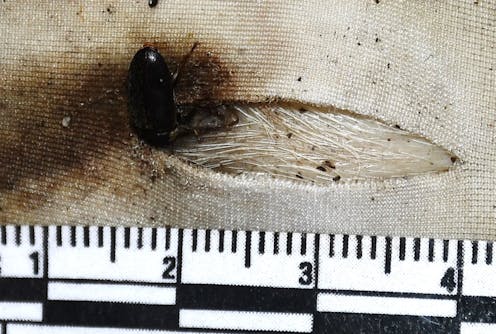
Until the late 19th century, the success of criminal investigations largely hung on witness reports and (often extorted) confessions. A lack of scientific tools meant investigators needed advanced deductive reasoning abilities – and even then they’d often hit a dead end.
Today, investigations demand an interdisciplinary and high-tech approach, involving experts from diverse scientific disciplines. Stabbing investigations are particularly important, as fatal stabbings are the leading cause of homicide in countries with restricted access to firearms, including Australia.
Carefully interpreting CCTV footage can be useful, but sometimes the crime scene won’t have surveillance cameras. The victim’s body may be discovered days, weeks, or months after the event. By then it may be partially consumed by insects – or rain may have washed away the blood stains, or potentially even the murder weapon.
In such a case, analysing damage to a victim’s clothing can provide crucial insight. But how does clothing on a decomposing body react to environmental and biological factors?
This was our question as we conducted research using the decomposing bodies of more than 100 stillborn piglets. Our findings from this first-of-its-kind experiment could help investigators solve future (and past) crimes in which stabs, tears or other damages to clothing are in question.
Pigs wrapped in fabric
Textile analysis has a significant role in forensic investigation. Clothes can preserve crucial information about the events leading up to someone’s death. Evidence might come in the form of fibres under a victim’s fingernails, tears in the clothing resulting from movement or traction, or cuts and holes caused by weapons.
However, the decomposition process itself will also alter the fabric and existing damages. It may even introduce new damages that complicate the analysis.
To understand how clothing might change throughout this process, we conducted an experiment in the summer heat of Western Australia. We used more than 100 stillborn piglets (simulating human remains) wrapped in common fabrics including cotton, stretchy synthetic material, and a fabric blend. Some piglets were left unclothed as control samples.
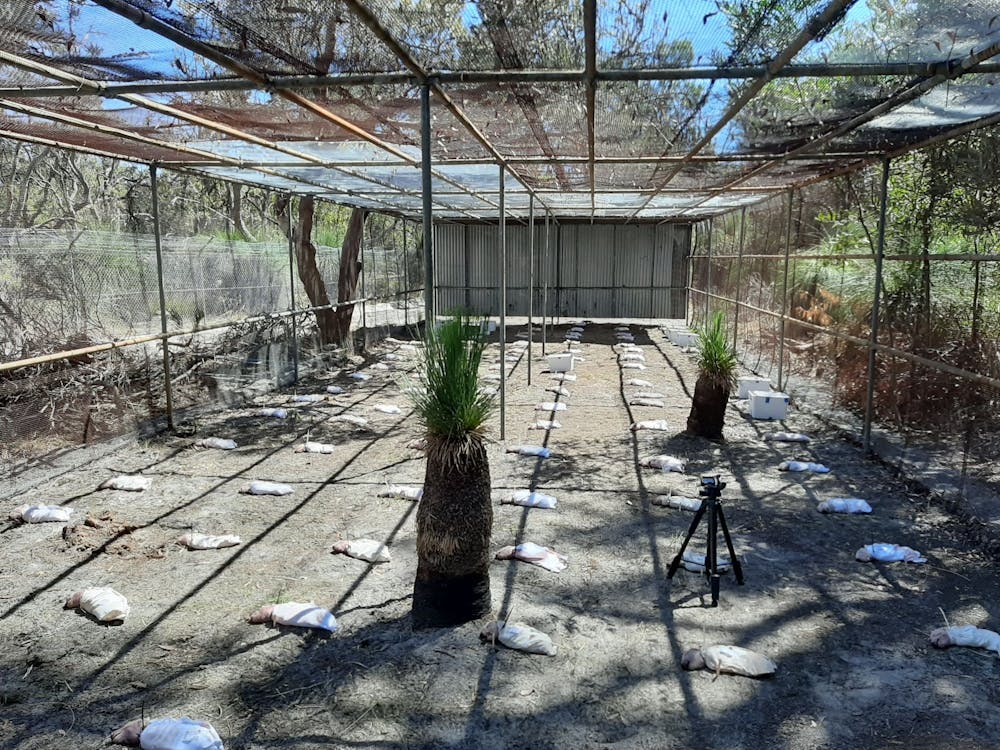
We intentionally inflicted cuts and tears on most of the fabrics, before leaving the carcasses to decompose naturally in a bushland environment until only bones remained. The bodies were shielded from large scavengers, but not from carrion insects.
While previous research has explored the impact of clothing on decomposition, we were focused on the other side of the coin: how do insects impact the fabric on a decomposing carcass? And in what ways could this jeopardise an investigation?
Read more: Flies, maggots and methamphetamine: how insects can reveal drugs and poisons at crime scenes
Exposed to natural elements
It wasn’t long before the fabrics started to transform due to exposure to bacteria, fungi, insects and other environmental factors.
They changed in shape and texture, and became stretched as a result of the natural bloating of the carcasses. Less than a week after the carcasses were placed, new holes appeared in the fabric – especially in cotton – as the fibres broke down.
There were also chemical changes due to potential exposure to body fluids and the chemical products of bacteria and fungi.
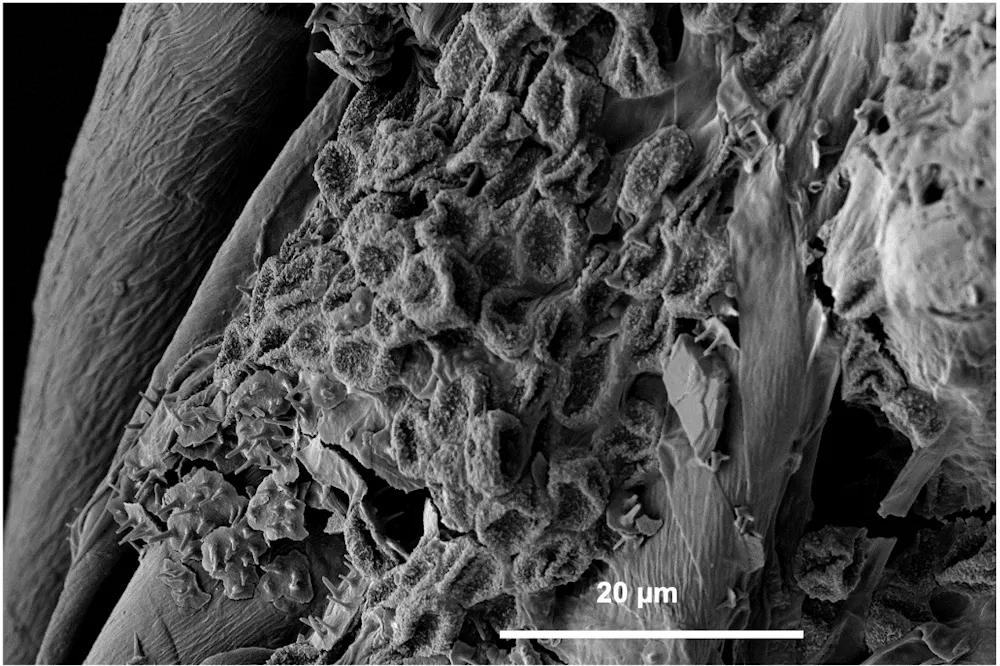 Experimental fabrics observed with a ‘scanning electron microscope’ (SEM) showed fungal colonisation.
Photo by Stevie Ziogos, Author provided
Experimental fabrics observed with a ‘scanning electron microscope’ (SEM) showed fungal colonisation.
Photo by Stevie Ziogos, Author provided
Insects were particularly active in areas where body fluids were present. Of twenty insect groups collected and identified, blowflies and carrion beetles were the most common antagonists.
Throughout the 47 days of the experiment, we managed to collect a range of data on fabric degradation throughout the decomposition process. It’s the first time this has been documented in such detail in a controlled experiment.
New tools to solve new (and old) mysteries
Although textile damage analysis is vital for forensics, there has been limited research on how it overlaps with forensic entomology and taphonomy (the study of how organisms decompose). Our research shows fabrics can hold significant evidence, and this evidence changes as bodies decompose while being exposed to the environment.
There are myriad examples of crimes where evidence related to clothing has been crucial to solving the case.
In the 1980 Chamberlain case, a jury wrongly found Lindy Chamberlain and her husband Michael guilty of murdering their nine-week-old daughter Azaria, who had disappeared.
It was only when Azaria’s clothing was recovered a week after her disappearance that investigators had evidence of a dingo having snatched her (as the clothes showed signs of having been dragged through sand). The Chamberlains were exonerated as a result.
More recently, a person of interest was arrested in New York as the “Craigslist ripper”, a serial killer responsible for the murder of more than ten people. Investigators obtained DNA evidence from strands of hair found in burlap sacks used to hide and transport the bodies.
Although many details of this particular case remain undisclosed, such investigations will most likely use insect-related evidence and other trace evidence on textiles to help make important inferences, including about time of death.
More generally, our work will help investigators avoid misinterpreting evidence from clothing. For instance, if investigators aren’t aware holes in fabric can form through exposure to insects and natural elements, they might incorrectly attribute them to an animal or human attacker.
Similarly, by gauging which portion of clothing has the most insect damage, they might be able to understand where the most fluid was present on the body (if it’s found as skeletal remains). This could help them figure out where and how damage was inflicted.
This year we published guidelines to help other forensic professionals in the process of observing and collecting insects at a crime scene, and in considering how insect activity may be connected with a victim’s clothing. We hope our work can help future investigations, and maybe even reopen some cold cases.
Authors: Paola A. Magni, Senior Lecturer in Forensic Science, Murdoch University

















