

A 140-year-old Tassie tiger brain sample survived two world wars and made it to our lab. Here's what we found
- Written by Rodrigo Suarez, Senior Lecturer- School of Biomedical Sciences and Queensland Brain Institute, The University of Queensland
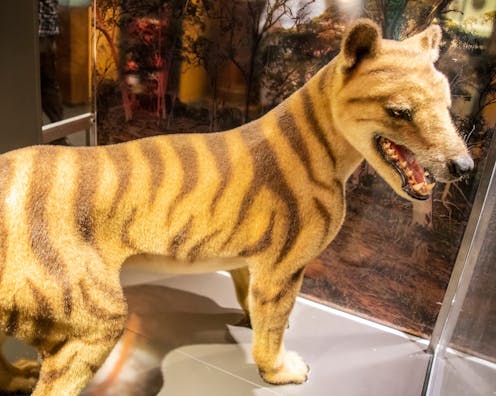
Researchers often think how and when their results will be published. However, many research projects don’t see the light until decades (or even centuries) later, if at all.
This is the case of a high-resolution atlas of the Tasmanian tiger or thylacine brain. Carefully processed over 140 years ago, it is finally published today in the journal PNAS.
Similar, but not wolves
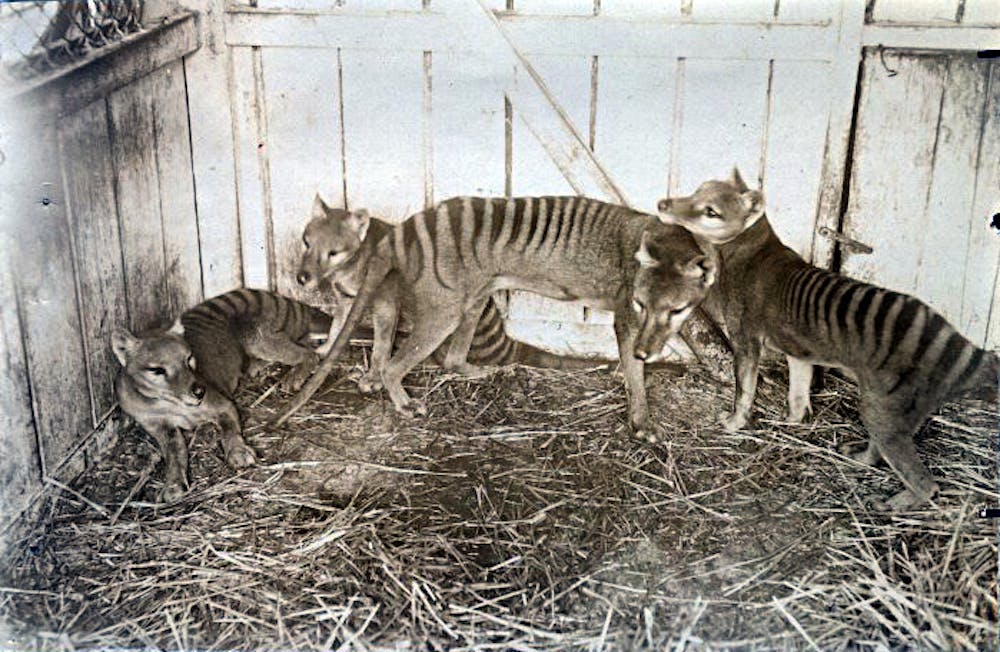
Thylacines were dingo-sized carnivorous marsupials that roamed through Australia and New Guinea prior to human occupation. They became confined to Tasmania around 3,000 years ago.
The arrival of European colonists and the introduction of farming, diseases and hunting bounties quickly led to their extinction. The last known individual died on September 7 1936 at Hobart’s Beaumaris Zoo. As a commemoration, September 7 became the National Threatened Species Day to raise conservation awareness in Australia.
Read more: Should we bring back the thylacine? We asked 5 experts
Thylacines looked remarkably similar to wolves and dogs (that is, canids). This is a textbook example of a process known as evolutionary convergence: when the body shapes of animals are really similar, despite them coming from different lineages.
However, whether thylacine brains are also similar to wolves has been very hard to find out, due to a lack of material available for microscopic studies. In the newly published study, my colleagues and I uploaded high-resolution images to a public repository, and studied brain sections prepared for microscopy from a thylacine that died in the Berlin Zoo in 1880.
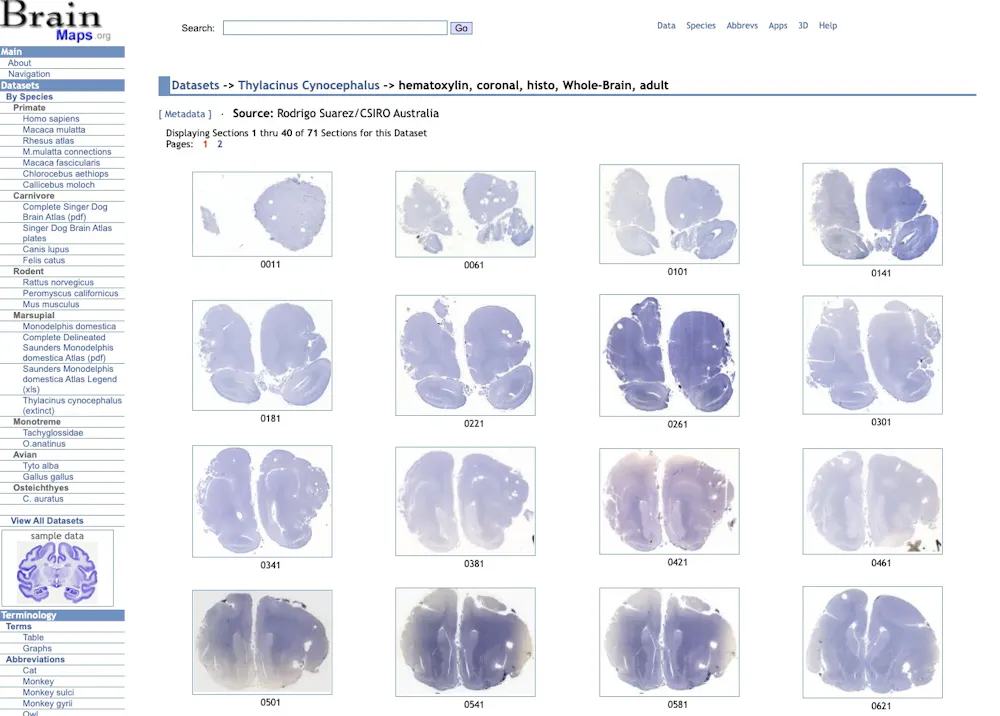 A screen capture showing a selection of the thylacine brain scans the team uploaded to a public image repository.
BrainMaps.org
A screen capture showing a selection of the thylacine brain scans the team uploaded to a public image repository.
BrainMaps.org
Kept safe by researchers
Unfortunately, very little information about this specimen was available (for example, its sex and body weight was missing). Details were likely lost during both world wars. But the samples were kept safe by researchers who understood their biological relevance.
Initial custodians likely included German scientists Oskar and Cecile Vogt, whose large privately owned brain sample collection was incorporated into the Kaiser Wilhelm Institute for Brain Research in 1914. Vogt – who also studied Lenin’s brain – was the founding director of the institute, prior to the couple escaping the Nazis in 1937.
The institute later became the Max Planck Institute for Brain Research and moved to Frankfurt in 1962. There, late neurobiologist Heinz Stephan handed the thylacine material to John Nelson from Monash University (co-author of this study) in 1973, to be returned to Australia.
The original samples are currently held by CSIRO’s Australian National Wildlife Collection in Canberra.
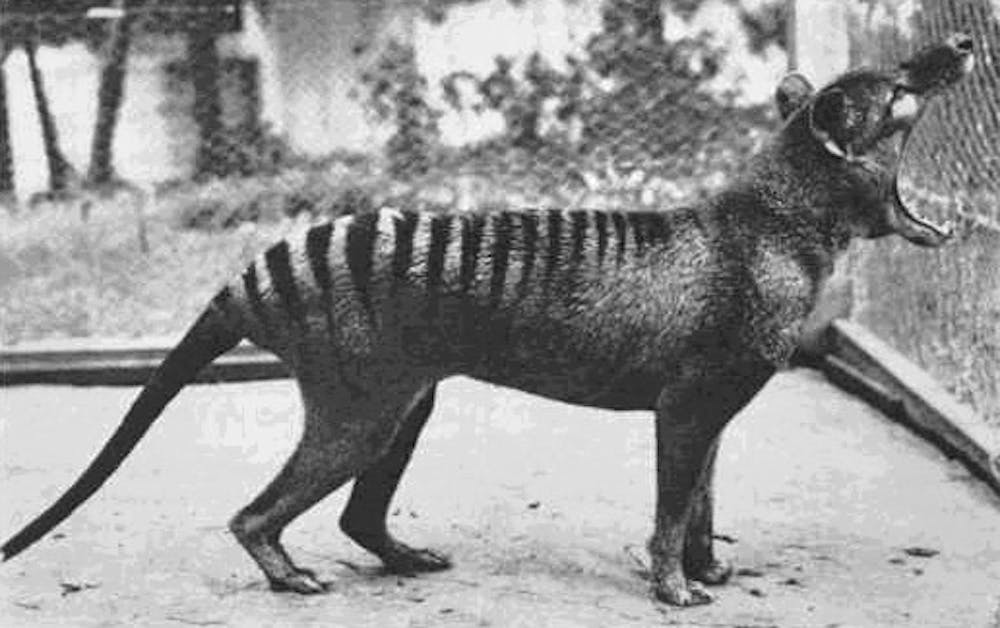 The last known thylacine was captured in Tasmania, and kept at the Beaumaris Zoo in Hobart.
Wikimedia
The last known thylacine was captured in Tasmania, and kept at the Beaumaris Zoo in Hobart.
Wikimedia
Read more: Extinct but not gone – the thylacine continues to fascinate us
Brain features reveal a family
So, what did we discover after analysing the samples? Overall, the thylacine brain resembles that of its carnivorous marsupial relatives (dasyurids, like dunnarts, quolls and Tasmanian devils) more than that of wolves or other canids.
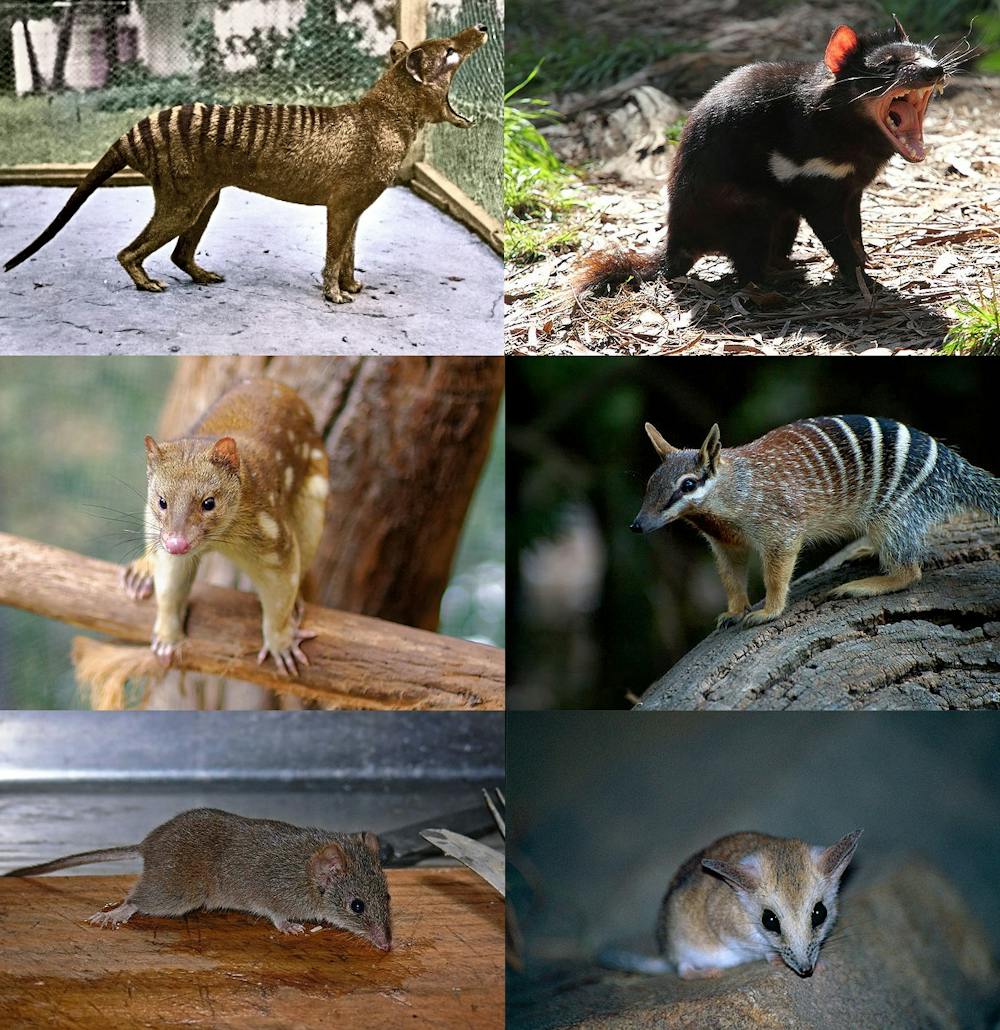 Thylacines are related to other Australian carnivorous marsupials, pictured here: Tasmanian tiger, Tasmanian devil, tiger quoll, numbat, yellow-footed antiechinus, fat-tailed dunnart.
Wikimedia, CC BY-SA
Thylacines are related to other Australian carnivorous marsupials, pictured here: Tasmanian tiger, Tasmanian devil, tiger quoll, numbat, yellow-footed antiechinus, fat-tailed dunnart.
Wikimedia, CC BY-SA
The brain region known as the cerebral cortex, which is responsible for planning actions and sensing the environment, is larger than in other dasyurids. Brain regions involved in processing smells also suggest that scavenging and hunting behaviours were important in this species.
These findings show that despite body resemblance, brain features better show the evolutionary relatedness between species.
Making this material openly available allows for anyone to study the thylacine brain and gain a clearer picture of this long-gone species. Our ongoing research using dunnarts is also providing new insights about the development and evolution of the mammalian brain.
Authors: Rodrigo Suarez, Senior Lecturer- School of Biomedical Sciences and Queensland Brain Institute, The University of Queensland




















