

How algae conquered the world – and other epic stories hidden in the rocks of the Flinders Ranges
- Written by Alan Collins, Professor of Geology, University of Adelaide
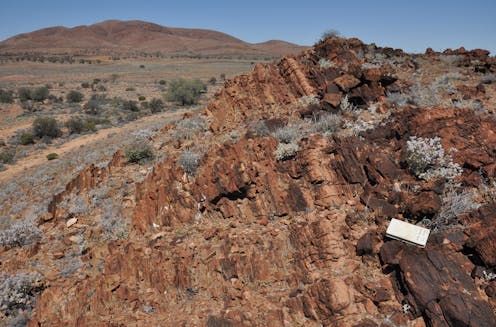
Earth was not always so hospitable. Evidence of how it came to be so beautiful and nurturing is locked in the rocks of South Australia’s Flinders Ranges – a site now vying for World Heritage listing.
Our new research seeks to better understand this near billion-year-old story. We discovered immense planetary upheaval recorded in the ranges.
In two related research projects, we’ve mapped how the continent that later became Australia responded to the most extreme climate change known in Earth’s history. We then dated this event.
The changes gave rise to algae. Their legacy is the oxygen we breathe and the evolution of the first animals more than 500 million years ago. The soft bodies of these animals have been exceptionally preserved at the new Nilpena-Ediacara National Park, which opened in April 2023.
Read more: Friday essay: histories written in the land - a journey through Adnyamathanha Yarta
A superbasin on the shores of the Pacific
The rocks of the Flinders Ranges formed at the same time as the Pacific Ocean basin. The plate tectonic “dance of the continents” tore North America away from Australia 800 million years ago. This created a valley that became an ocean where sand and mud was deposited.
Geologists call this the Adelaide Superbasin. “Super” because it is huge, and “basin” because it formed a depression where sediment could accumulate.
The superbasin stretches from Kangaroo Island in the south, to north of the Flinders Ranges and from Coober Pedy in the west to the Barrier Ranges of New South Wales in the east.
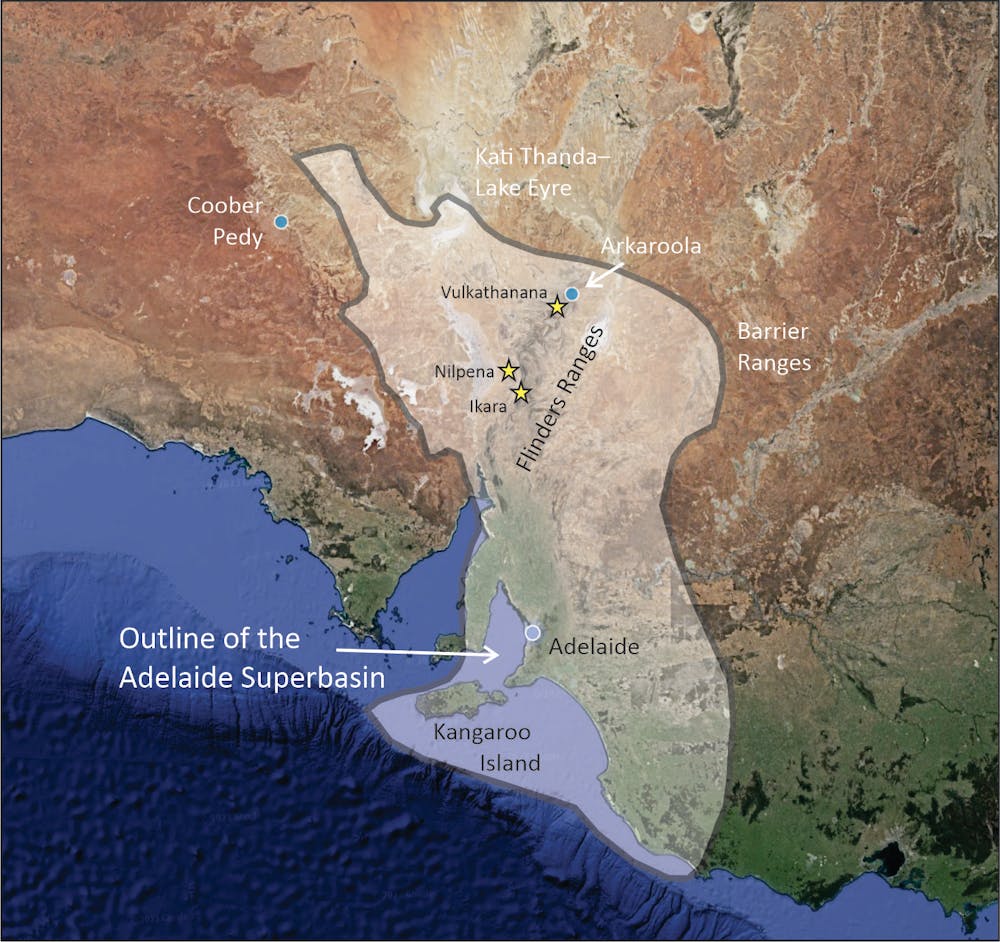
At special places such as Arkaroola and the national parks of Vulkathunha-Gammon Ranges and Ikara-Flinders, rocks of the Adelaide Superbasin tell us how our planet came to be the way it is today.
Read more: A map that fills a 500-million year gap in Earth's history
Land of fire and ice
Until about 800 million years ago, Earth was an oxygen-poor but stable planet. So stable, in fact, this time has been nicknamed the “Boring Billion”.
That all changed 716 million years ago. The planet plunged into an 80-million-year Ice Age, the likes of which has never been seen again. It’s known as the Cryogenian Period.
The Cryogenian contains a least two global glaciations when the planet became covered in ice - an occurrence earth scientists refer to as “Snowball Earth”. What caused this incredible cooling is still a mystery. But many researchers think it relates to huge volcanic eruptions that directly preceded the icy conditions. The heavily worn remains of these volcanoes have recently been discovered in Arctic Canada and Alaska.
We know lava from volcanoes reacts with CO₂, dragging it out of the atmosphere. Scientists believe this reversed the pre-historic greenhouse effect and the planet cooled.
Read more: Ancient volcanic eruptions disrupted Earth's thermostat, creating a 'Snowball' planet
Part One: Picturing the world before the first animals
The first part of our new research reconstructs the shores of the balmy Pacific as this climate shock hit, causing vast ice sheets to lumber north and smother the region for millions of years.
The glaciers ploughed through hills and valleys, planing off the country and leaving behind vast swathes of boulder clay that now forms rocks over much of the Flinders Ranges.
 Correlation of rock sections across the northern Flinders Ranges. Blue represents rocks deposited during and after the Sturt glaciation. These sequences overlie rocks deposited in warm, tropical conditions (pink).
Georgina Virgo, from Virgo et al. (2023) Sedimentologika, CC BY-ND
Correlation of rock sections across the northern Flinders Ranges. Blue represents rocks deposited during and after the Sturt glaciation. These sequences overlie rocks deposited in warm, tropical conditions (pink).
Georgina Virgo, from Virgo et al. (2023) Sedimentologika, CC BY-ND
Our research analysed unusual magnesium-rich sedimentary rocks in part formed by microscopic bacteria. Hundreds of millions of years later, small variations in the concentration of critical elements are still preserved. We used these variations to build a picture of highly saline shallow seas rich in bacterial life, but devoid of much else.
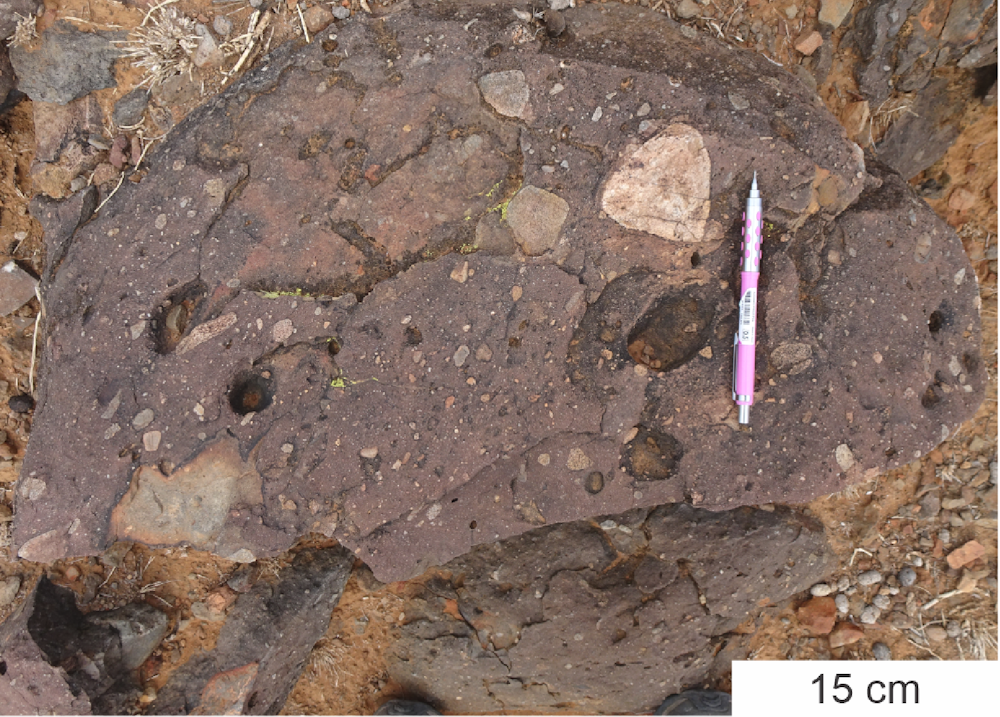 This ancient rock called diamictites was deposited by the Sturtian glaciers in the northern Flinders Ranges.
Georgina Virgo, CC BY-ND
This ancient rock called diamictites was deposited by the Sturtian glaciers in the northern Flinders Ranges.
Georgina Virgo, CC BY-ND
Part Two: Dating Snowball Earth
Dating sedimentary rocks is challenging. The grains of sand and pebbles that make up the rock formed elsewhere. They were carried by wind or water to the beach, or river, where they were deposited. Then, gradually, new rock formed.
Using established methods we can date one of the minerals in the sand (zircon). This uranium–lead method gives us the oldest possible age for sedimentary rock. That’s a reliable maximum age, but the true age of the rock could be much younger.
In the second part of our research we combined this established method with a new technique called “in-situ rubidium–strontium dating”. This enabled us to more accurately date the Snowball Earth rocks in the Flinders Ranges called the Sturt Formation.
The new technique attempts to directly date the “glue” that holds the grains of sedimentary rocks together. So we’re using a laser to date minerals that form as the sediment turns to rock. Some of these “authigenic” minerals (minerals that form “in place”) contain tiny amounts of radioactive rubidium. Over time, rubidium changes to strontium by radioactive decay.
Our study dates mudrock deposited within the glaciation. It is the first study to directly date sedimentary rocks that formed during the Snowball Earth event. This mudrock (a part of the Sturt Formation) formed around 684 million years ago.
Our “detrital zircon” method also gave us maximum ages of about 698 million years for a boulder clay below the mudrock, and about 663 million years from a boulder clay above the mudrock. These dates fit with estimates from elsewhere on the globe, suggesting the icy time likely lasted 50 million years.
Put together, the results of these two projects suggest the “Sturtian” glaciation took place between 716 and 663 million years ago and may have been more dynamic than previously thought. It’s likely there were at least two ice-advance and ice-retreat events, or two separate glacial times. So the planet experienced more of a cold period rather than a completely frigid snowball.
The rise of the algae
These two research projects using rocks within the proposed World Heritage area, along with work from many other researchers, develops a picture of the world that led to the evolution of the first animals. The geological processes and their timing helps us understand how the Earth system came to be.
The frozen world of the Cryogenian stressed the microbial life that dominated the oceans way back then. Glaciers ground rock to powder and this powder turned the oceans of the day to a nutrient soup.
So when warmer times came, a previously minor player in the biosphere bloomed. This newcomer was algae, life with cells containing a nucleus. Essentially, seaweed.
They were larger than the life that existed before and better at photosynthesising. They pumped their oxygen waste into the oceans and atmosphere, inadvertently providing the fuel for microbes to combine to form more complex multicellular life forms (metazoans) and ultimately, the first animals.
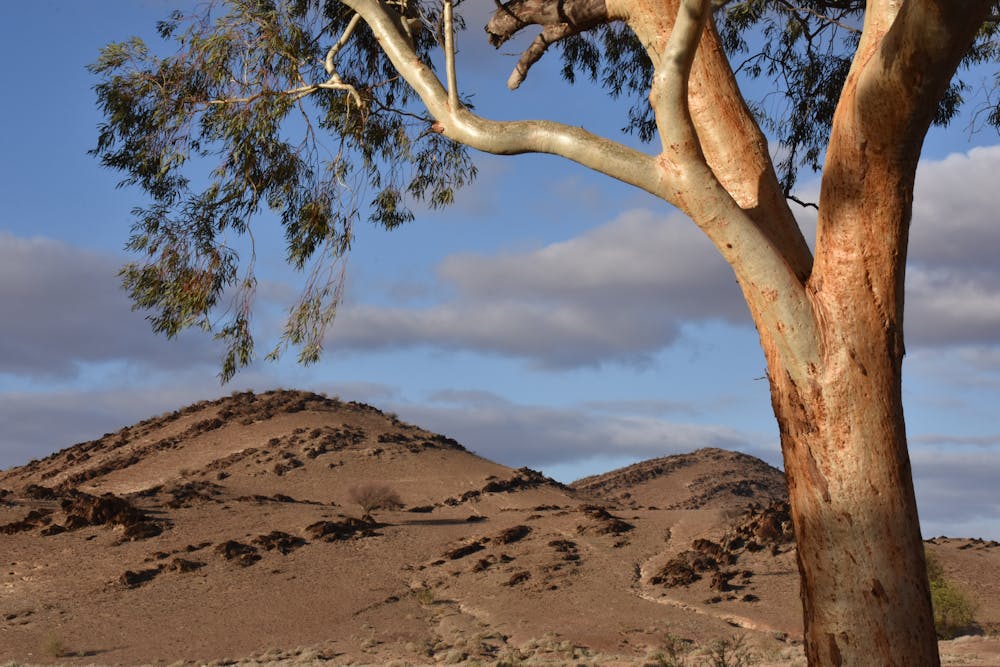 The hills in the background contain layers of 800 million year old rocks from the northern part of the ‘Adelaide Superbasin’ in the Flinders Ranges.
Alan Collins, CC BY-ND
The hills in the background contain layers of 800 million year old rocks from the northern part of the ‘Adelaide Superbasin’ in the Flinders Ranges.
Alan Collins, CC BY-ND
A place of true world heritage
The rocks of the Flinders Ranges preserve so many stories, from the Dreamtime-formed shapes of the ranges, to the scars of the early mining history.
Our research into these rocks links the interdependence of Earth systems. Here we find stories about how plate tectonics and volcanoes control the climate, how the climate helps feed life with nutrients and how the resulting life changes the chemistry of the ocean and atmosphere, feeding back into powering new forms of life.
The stories locked in the hills of the Flinders Ranges undoubtedly give the region a heritage value to the world. We eagerly await news of world heritage listing, which is not expected until 2025 at the earliest.
Authors: Alan Collins, Professor of Geology, University of Adelaide

















