

their actions would reverberate as far as Melbourne
- Written by Amanda Harris, ARC Future Fellow, Sydney Conservatorium of Music, University of Sydney
Aboriginal and Torres Strait Islander readers are advised this article contains names and images of deceased people.
“No Fred – No Lawrence – No Corroboree” ran the February 16 1951 headline in the Darwin newspaper The Northern Standard.
Performers from Northern Territory’s Daly region and Tiwi Islands unanimously agreed to withhold their planned public dance show in solidarity with Aboriginal workers’ rolling strikes in Darwin for equal pay and civil rights.
In the weeks before, the strike leaders, Wadjiginy man Lawrence Wurrpen (Urban) and Larrakia man Fred Nadpur Waters, had been detained under the Aboriginals Ordinance Act of 1918 – laws that did not apply to non-Aboriginal people.
From thousands of kilometres away there was further support for the Darwin strike leaders. In Sydney, New Theatre members supported the Darwin strikers by leafleting performances of the ballet Corroboree. In Victoria, members of the Australian Aborigines’ League condemned the “intimidation of the Northern Territory Aborigines” in a protest letter sent to Prime Minister Robert Menzies.
Our new article in The Australian Journal of Politics and History shows how Aboriginal people in 1951 framed cultural practice as labour and as a tool for advocacy for Aboriginal rights stretching across the continent.
Aboriginal workers in 1951
The corroboree strike of 1951 followed months of action led initially by Lawrence Wurrpen (Urban), a Wadjiginy man from Delissaville Native Settlement (now known as Belyuen).
Wurrpen led three strikes of Aboriginal workers in Darwin over 1950–51. The strikers demanded fair pay and access to civil rights, particularly the freedom to move about Darwin and the Northern Territory.
At the third strike, on January 24 1951, Wurrpen was arrested and sentenced to four months in jail. On his release under appeal, he was directed to stay within Bagot Compound Reserve in Darwin.
He defied these orders and was arrested for leaving the compound, for disorderly behaviour, and for drinking alcohol.

As the press reports highlighted at the time, no non-Aboriginal person could have been charged with defying orders restricting their movement, nor for drinking alcohol.
Senior Larrakia man Fred Nadpur Waters led a fourth strike in February. A leader of the Larrakia community on whose Country the settlement of Darwin had been built, Waters was keenly aware of the potential of the union movement to support Aboriginal workers’ demands for better pay and working conditions.
But after the strike, the Director of Native Affairs ordered Waters be removed from Darwin. He was sent to the remote Central Australian community of Haasts Bluff (Ikuntji), 1,700 km away.
The corroboree strike emerged in response to the banishment of Waters, drawing further attention to discriminatory treatment of the Aboriginal strike leaders.
 Aboriginal dancers on the road to the Botanical Gardens for a corroboree for a tourist ship.
Libraries & Archives NT
Aboriginal dancers on the road to the Botanical Gardens for a corroboree for a tourist ship.
Libraries & Archives NT
Read more: Enforcing assimilation, dismantling Aboriginal families: a history of police violence in Australia
Ripples in the southeast
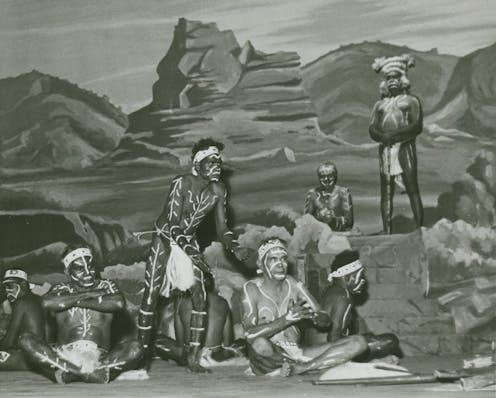
In the southeast, leaders of the Australian Aborigines’ League collaborated on performances and protest actions. In solidarity in Sydney, New Theatre members distributed leaflets to audiences of the non-Indigenous ballet Corroboree, being performed at the Tivoli theatre.
The leaflets highlighted the Darwin performers’ refusal to “put on a corroboree,” stating:
the idea of human rights […] demands that we do something more than admire aborigines from the safe distance of the Tivoli auditorium.
This local action linked condemnation of the treatment of Darwin strikers with local struggles for justice.
Other protests linking Aboriginal rights and the arts were also taking place across 1951.
In January, the league protested the exclusion of Melbourne Aboriginal people from programming of the Jubilee Festival and Centenary of Melbourne. Led by Doug Nicholls, the league threatened to parade a float through the streets with:
a chained aborigine guarded by a white man with a whip [to] represent the introduction of Western ‘civilisation’.
Within days, Nicholls was invited to join the Melbourne Centenary Celebrations Committee. He went on to produce the Aboriginal Moomba with Bill and Eric Onus, featuring singing stars Harold Blair and Georgia Lee (Dulcie Pitt), alongside a cast of performers from up and down the east coast.
In March, an article reported on a meeting aiming to create a Council For The Advancement of Aborigines. This Australia-wide organisation would support civil rights for Aboriginal people, advocate for “Jubilee justice” and object to the intimidation of Northern Territory Aboriginal protesters.
Strike action continued in June 1951 when Wiradjuri man Ray Peckham attempted to travel with Melbourne’s Unity Dance Group to East Berlin and was denied a passport.
The Australian Aborigines’ League’s Bill and Eric Onus mobilised Melbourne dockside workers, threatening to “tie up every ship that’s in port and round the shores of Australia”. Peckham’s passport was quickly delivered to the ship.
 Ray Peckham (fifth from left) returning from the World Youth Festival in East Berlin, 1952.
National Archives of Australia
Ray Peckham (fifth from left) returning from the World Youth Festival in East Berlin, 1952.
National Archives of Australia
Read more: Ablaze review: a powerful, personal portrait of Aboriginal activist and filmmaker Bill Onus
Performing culture for equal rights
Aboriginal performances in the far north and southeast were acts of interconnected resistance to state-based discriminatory policies. We have now mapped these connections in a new website showing how bonds of history and kinship enabled public displays of culture, music and dance.
Through performance and protest, Aboriginal people publicly asserted their continued presence and maintenance of culture even as they fought for equal pay, freedom of movement and citizenship.
The 1951 incidents in the Northern Territory, NSW and Victoria contained the seeds of united national campaigns for citizenship rights that would change the Australian political landscape in years to come.
Performance – when it was staged, and when it was withheld – played a key role in asserting these rights.
Authors: Amanda Harris, ARC Future Fellow, Sydney Conservatorium of Music, University of Sydney

















