

Do I have the right bicycle helmet and how can I tell if it's any good? A bike helmet researcher explains
- Written by Kwong Ming Tse, Senior lecturer in Department of Mechanical Engineering and Product Design Engineering, Swinburne University of Technology
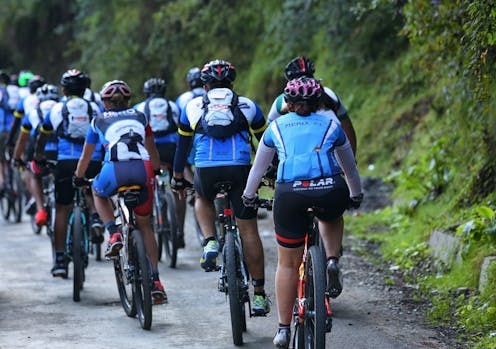
If you ride a bike and want to cut your risk of traumatic head injury, you should wear a helmet. A major Australian review of 40 different studies and 64,000 injured cyclists worldwide showed wearing a bicycle helmet reduces the risk of serious head injury by nearly 70%.
But there’s a bewildering array of designs out there. How do you know if yours is up to scratch or when it’s time to replace it?
I’m a head injury biomechanics researcher who has researched on bicycle helmet designs. Here’s what you need to know about choosing a bike helmet.

Read more: Over-the-top policing of bike helmet laws targets vulnerable riders
The parts of the helmet
A typical bicycle helmet consists of a plastic shell, foam-like liner and the straps that keep it on your head.
The shell prevents any sharp penetration. The liner – usually made of expanded polystyrene foam or expanded polypropylene – absorbs the impact energy that would otherwise be colliding dangerously with your head.
In Australia, bicycle helmets must be certified to the mandatory Australian and New Zealand standard (the technical name for this standard is “AS/NZS 2063 — Bicycle helmets”).
This is a very robust safety regulation, and means the helmet has to be tested for:
impact attenuation (how well it absorbs impact),
load distribution (how well force is spread out over a larger area, so as to reduce the risk),
strength, and
effectiveness of the strap retention system (how well the helmet stays on your head).
So check your helmet to see if it says “AS/NZS 2063” on it somewhere (usually on a sticker inside it).
However, it’s worth noting these tests mostly look at the helmet’s ability to reduce the translational force (a force which causes an object to move in a single direction) of a direct impact.
They don’t properly consider the damage done by what’s called “rotational forces” – when the head is hit at an angle, causing it to shift abruptly.
This can cause the brain to rotate inside the skull, leading to severe and irreversible brain damage.
Bike helmet technology is always changing
A recent review by colleagues and I at Swinburne University of Technology looked at bicycle helmet design technologies that may reduce the risk caused by rotational forces.
The best known one is called a “multi-directional impact protection system” (sometimes abbreviated as MIPS). This design allows the helmet shell to rotate around the inner liner, so the helmet absorbs some of the angular forces that would otherwise be transmitted to your head.
You can tell whether a helmet is MIPS-equipped by looking for a small yellow MIPS logo from the outside or a thin yellow liner beneath the pads on the inside.
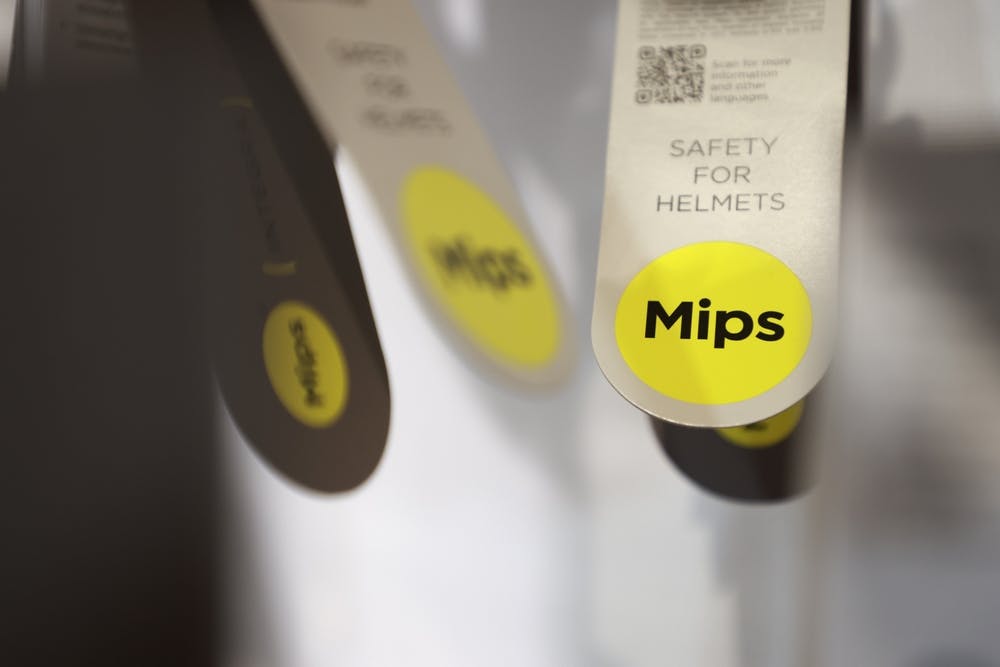 A MIPs-equipped helmet will usually be labelled as such.
Shutterstock
A MIPs-equipped helmet will usually be labelled as such.
Shutterstock
Another fancy helmet technology is called an “omni-directional suspension system” (ODS), which has double liner layers connected by special rubbery materials. If you want this feature, look for a white, red and black ODS logo on the helmet shell.
Then there are “shearing pads inside” helmets (also known as SPIN helmets), which features silicone-injected pads in a structure that moves inside the shell.
These help redirect rotational forces when the rider’s head is hit in an accident. Helmets with this feature usually have a SPIN logo on the helmet shell or blue strips on the inside.
A few bicycle helmets use special collapsible liners to reduce the stiffness of shearing in the helmet. Helmets that feature this technology may have words like AIM (which stands for angular impact mitigation), WaveCel and HEXR on them.
My team at Swinburne is developing a bio-inspired flexible structure which can potentially be used as a bicycle helmet liner, and we are currently conducting tests in our Impact Engineering Laboratory. We’re also working on a helmet design featuring an inflatable airbag in a traditional bike helmet.
How to pick a helmet
When choosing a helmet in the shop, pick one that fits comfortably yet firmly on your head and can’t be tilted for more than an inch in any direction.
It should be snug but not annoyingly tight; you’re less likely to wear it if it’s uncomfortable.
Ensure the helmet complies with the national or international bicycle helmet standards, which should be stated on the label inside the helmet.
You may consider buying a helmet featuring one of the advanced protection technologies mentioned earlier (things like AIM, MIPS, SPIN or ODS), as these can help mitigate rotation-induced traumatic brain injury if your head gets hit at an angle.
Pick a helmet with a thicker liner, as long as it’s still comfortable enough to wear properly when riding. Thicker liners tend to absorb more impact energy because they have a longer crushing zone (a bit like how a car with a longer hood in the front has a longer crush zone before the impact hits the driver).
Ideally, choose one just firm enough to minimise impact forces without “bottoming out” (where the impact crushes and flattens the liner).
Denser foams resist very hard impacts better before crushing to their ultimate limit. Once a foam reaches its crush limit, the remaining impact energy is transmitted to your head. Softer foams compress or crush more easily in lighter impacts, giving better protection against milder injuries.
You never know what kind of accident you will have, so it’s better to choose a helmet with both dense and soft foam layers in the liner.
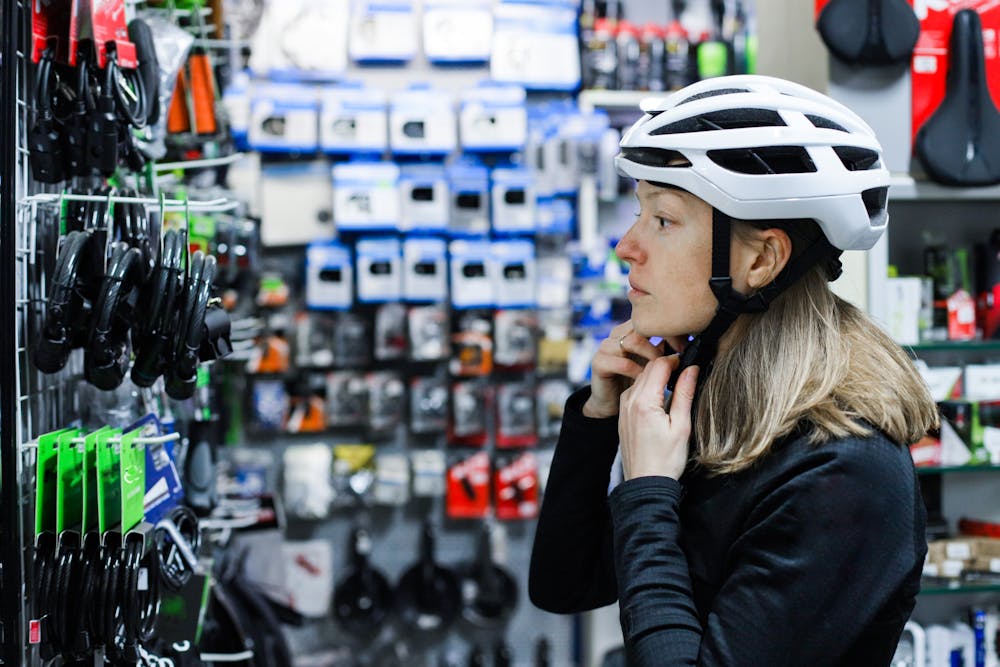 Your helmet should be snug but not annoyingly tight.
Shutterstock
Your helmet should be snug but not annoyingly tight.
Shutterstock
Should you replace your helmet every few years anyway?
The US Consumer Product Safety Commission says it might be prudent replace your bike helmet between five and ten years after you bought it.
But an Australian Competition and Consumer Commission (ACCC) spokesperson told The Conversation the lifespan of a bicycle helmet is not set by time alone; it depends on its use pattern.
The ACCC suggests a bicycle helmet should be replaced if:
it’s showing obvious signs of wear and tear (a helmet that is used more often is likely to show more wear and tear sooner)
it’s showing sign of damage (cracks, pieces missing, compression of the foam, frayed straps)
it has been involved in an accident and has received a severe blow (even if it appears undamaged, you should destroy and replace it).
Read more: Here's what bike-sharing programs need to succeed
Authors: Kwong Ming Tse, Senior lecturer in Department of Mechanical Engineering and Product Design Engineering, Swinburne University of Technology

















