

Darwin's 'sustainable' Middle Arm project reveals Australia's huge climate policy gamble
- Written by Timothy Neale, Senior Research Fellow, Deakin University
Protesters rallied at Parliament House in Canberra on Tuesday, railing against Darwin’s controversial Middle Arm venture which critics say would benefit the gas industry.
The project has been thrust into the headlines of late. Northern Territory Chief Minister Natasha Fyles drew the ire of critics last week in a speech to the National Press Club where she insisted her government was “not for turning” on the project.
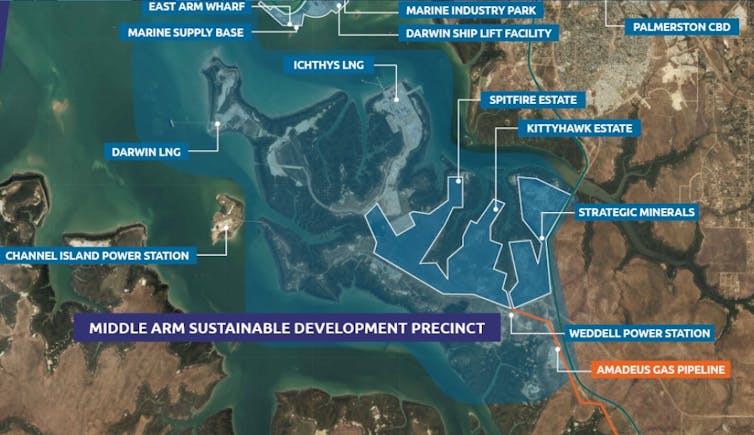
Fyles describes Middle Arm as a “sustainable development precinct”. But that claim is highly questionable. The site is already home to two gas facilities, and more are planned. Meanwhile, the NT is pursuing a goal of net zero emissions by 2050 and has committed to “no net increase” in emissions from fracking. So what’s going on?
It comes down to a new buzz-term in policymaking: “circular economy”. We’ve heard it applied to realms such as plastics and food waste. It’s increasingly being applied to carbon emissions, to describe an imagined scenario where carbon released from one source is used or stored by others to create a “closed loop” system.
But as our new research finds, this path is a massive gamble. Such offsetting relies on projects and technologies that do not yet exist, or are not yet feasible at scale. In effect, the Middle Arm project, and others like it, are grand experiments with our climate.
The ‘circular’ economy
Over the past two decades, international climate policy has increasingly shifted towards a circular model of managing carbon emissions. We’ve seen this happening not just in Australia, but places such as Canada, the United Kingdom, the European Union and Saudi Arabia.
The strategy doesn’t seek to reach net-zero simply by pumping less carbon into the atmosphere – for example, by deploying renewable energy. It also involves activities that remove, capture, store or use carbon, therefore “offsetting” or cancelling out emissions from other sources.
Proponents of the strategy characterise it as a simple matter of inputs (emissions) and outputs (offsets) cancelling each other out. But implementing the model is actually very messy, as our new paper shows.
We analysed how the federal and NT governments have sought to implement circular carbon policies, including through the Middle Arm development.
Due to its existing gas infrastructure and proximity to Darwin, this peninsula has long been the target of grand development plans. In July 2020, the NT government announced it would create an industrial petrochemical precinct there to use gas from the Beetaloo and offshore fields.
The following year, the hub was rebranded as a “sustainable development precinct”. References to “petrochemicals” were abandoned. The NT government now frequently talks up the site’s potential for hydrogen and carbon-capture facilities, and says the precinct will be:
largely powered by renewables, master-planned to achieve a circular economy approach of sustainable and responsible production and will use technology to achieve low-to-zero emissions.
The federal government has committed more than A$1.5 billion to the development.
‘Sustainable’ claims called into question
There are serious doubts over Middle Arm’s environmental credentials.
For example, internal government documents make clear the precinct is “seen as a key enabler” of the gas industry.
One confirmed future tenant will be Tamboran Resources, which plans to frack and drill for gas in the Beetaloo Basin. Tamboran intends to build a gas plant in the precinct. Federal crossbenchers, including Warringah MP Zali Steggall, have questioned why public money is being spent on infrastructure “for a private gas company to make record profits from exports”.
What’s more, low-emissions projects planned for the precinct rely on highly speculative technologies.
A carbon-capture and storage facility has been mooted at the site. Announcing the project in 2021, the NT government called it a “a game-changer”. But it neglected to mention that the project relies on unproven technology and has no timeline or guarantee of delivery.
For examples of this, we need only look to Chevron’s Gorgon gas project in Western Australia. The project was supposed to capture at least 80% of CO₂ from the gas it produces. After a three-year delay, carbon capture and storage began in 2019 but has consistently failed to reach its targets.
Claims that Middle Arm would substantially be powered by renewable energy are also in doubt. The Sun Cable solar project – once billed as the largest solar energy development in the southern hemisphere – was planning a battery at the site. But in 2023 the company went into administration and its future is unclear.
Questions also surround Middle Arm’s two proposed green hydrogen projects. Neither company involved has ever built a green hydrogen facility. One of the companies, Total Eren, intends to use solar energy from a facility that has not yet been assessed let alone approved for construction.
Offsets won’t save us, either
As part of its “decarbonisation” plan, the NT is set to grow its carbon offset industries.
And in 2021, the then Coalition government released a climate plan in which more than half the carbon savings would be achieved via carbon offsets, as well as unspecified “technology breakthroughs”.
Carbon offsets are used by polluters to compensate for their emissions. It involves buying “carbon credits” from organisations that have undertaken activities to reduce emissions.
Carbon offsets are contentious because they allow companies to keep pumping out carbon. And ensuring carbon credits represent genuine emissions reduction can be difficult.
We’ve seen this in Australia, where the integrity of certain carbon methods has been questioned. An independent review of the overall scheme concluded it was essentially sound, but critics say key questions remain. Further, there are signs we do not have enough credits to meet market demand.
Looking ahead
The goal of Australian governments to reach net-zero emissions by 2050 increasingly relies on gambits such as the Middle Arm precinct and speculative methods for offsetting and burying emissions.
Meanwhile, the world has just experienced its hottest month on record. And in temperate Australia, a hot, dry El Nino summer is approaching.
At a time like this, we must focus on achieving genuine emissions reductions, rather than playing risky games with our climate.
Authors: Timothy Neale, Senior Research Fellow, Deakin University

















