

Is the Great Barrier Reef reviving – or dying? Here's what's happening beyond the headlines
- Written by Mike Emslie, Senior Research Scientist, Australian Institute of Marine Science
The Great Barrier Reef is not dead. Nor is it in good health. The truth is complex. To understand what’s going on takes more than a headline.
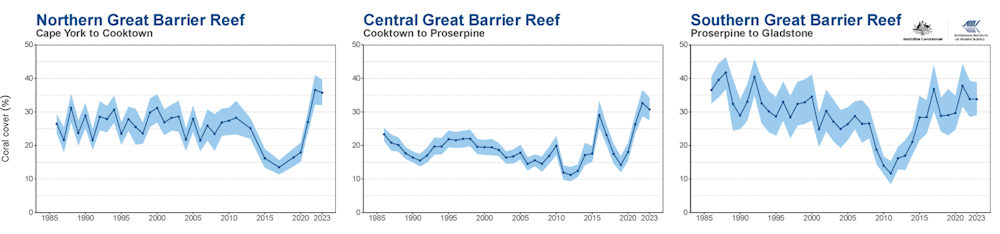
For the last 37 years, our organisation has monitored the health of the world’s largest reef. Each year, we add our findings to our dataset, the Reef’s longest running and largest coverage. This lets us produce annual updates for the northern, central and southern regions of the Reef. That makes us perhaps the team best qualified to answer the question many people have – how is the Reef going?
Released today, this year’s update paints a complex picture. It wasn’t long ago the Great Barrier Reef was reeling from successive disturbances, ranging from marine heatwaves and coral bleaching to crown-of-thorns starfish outbreaks and cyclone damage, with widespread death of many corals especially during the heatwaves of 2016 and 2017.
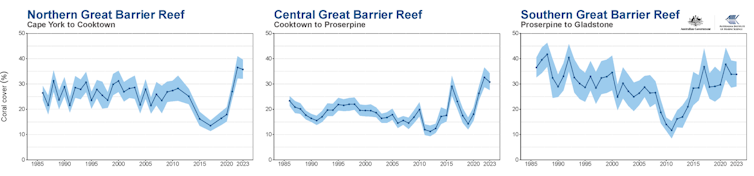
Since then, the Reef has rebounded. Generally cooler La Niña conditions mean hard corals have recovered significant ground, regrowing from very low levels after a decade of cumulative disturbances to record high levels in 2022 across two-thirds of the reef.
The Reef has shown an impressive ability to recover from widespread disturbances, when it gets a chance – it’s not all just bleaching and death. But it’s also true we’re heading towards a future where hotter water temperatures will likely cause bleaching every year, along with ongoing threats of cyclones and coral-eating starfish. Recovery requires reprieve – and those opportunities will diminish as climate change progresses.
Last year, for instance, parts of the Reef experienced bleaching in the middle of La Niña – the first time that’s happened on record.
What’s happening on the Reef?
To take the pulse of the Great Barrier Reef, one indicator we use is hard coral cover. It’s a widely used, robust indicator of reef health, but it doesn’t tell the whole story. We also collect detailed data on coral and fish populations, diversity, structural complexity, and abundance of juvenile corals. And we take digital photographs and convert them into 3D photogrammetry models so we can analyse what’s happening in more depth than ever before.
Here’s what our analysis shows.
Over the last few years, the Reef was mostly in La Niña conditions. That gave the hard-hit northern and central parts of the reef a chance to begin recovery. Many reefs had a high proportion of Acropora corals, of which the best known are the staghorn and plate corals. These species have been a vital part of the reef over 37 years of monitoring – and probably for millennia.
These corals are the most common on many reefs, and grow fast. Because of that, they tend to dominate trends in hard coral cover.
Does this mean the Great Barrier Reef’s recovery in 2022 relied on “weedy” corals which are taking over? Yes and no. The natural ecological niche of Acropora corals has always been to rapidly fill empty space, which means it tends to dominate trends in coral recovery.
Again, the story is more complicated than the headlines. Some reefs have recovered strongly, some very little. Some reefs are recovering with less Acropora than before, some with more. Each reef is charting its own course on the journey from impact to recovery and back again.
Overall, the record high hard coral cover seen last year was welcome news, representing recovery across much of the Reef in the absence of common coral killers.
But what about recent heating?
This year, the rapid coral rebound paused. Some reefs continued to recover, but these were offset by others which lost coral. Coral loss came from effects of the 2022 bleaching event in northern and central regions, crown-of-thorns starfish predation in the northern and southern regions, damage from Tropical Cyclone Tiffany in the north and coral disease in some areas of the south.
The picture is complex. Recovery here, fresh losses there.
While the recovery we reported last year was welcome news, there are challenges ahead. The spectre of global annual coral bleaching will soon become a reality.
Right now, marine heatwaves are sweeping through ocean basins in the northern hemisphere. Sea surface temperatures are far above long term averages.
At least eight countries are reporting coral bleaching, including the United States and Belize. This summer, it looks likely we’ll see our first El Niño on the Great Barrier Reef since 2016, bringing higher sea surface temperatures. That last El Niño – coupled with global heating – was the direct cause of the 2016–17 mass bleaching and mass death of corals.
The prognosis is, in short, extremely concerning. Yes, the Reef has rebounded beyond our expectations. But now the heat is back on. If we get mass bleaching like 2016 – or even worse – it could undo all the recent recovery.
Read more: Out of danger because the UN said so? Hardly – the Barrier Reef is still in hot water
Authors: Mike Emslie, Senior Research Scientist, Australian Institute of Marine Science

















