

Modern Australian
The Times

Efforts to find safe housing for homeless youth have gone backwards. Here's what the new national plan must do differently

  • Written by David MacKenzie, Associate Professor, University of South Australia
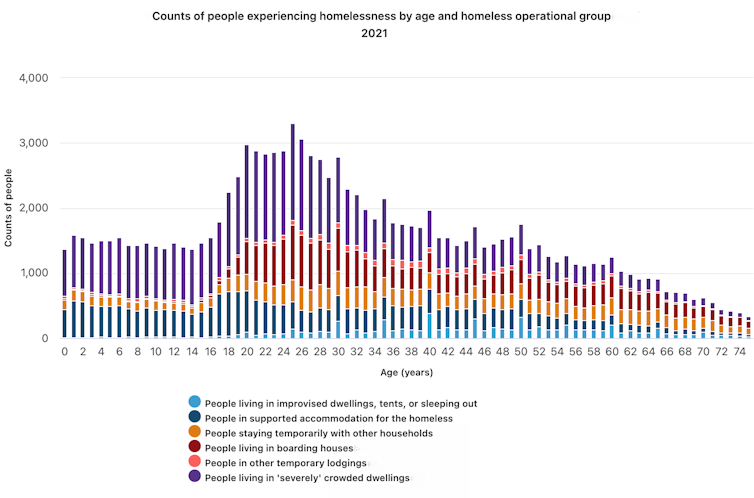
Vertical bar chart showing breakdown of homelessness in Australia by age and category

What needs to change to greatly reduce youth homelessness in Australia? Now is the time to find answers to this question, and not just because it’s National Homelessness Week.

The federal government is developing a National Housing and Homelessness Plan and says public consultations will begin soon. In recent years, there have been two parliamentary inquiries into homelessness in Victoria and across Australia. Then came a Productivity Commission review of the National Housing and Homelessness Agreement, which expired on June 30 this year.

More than a decade ago, the Rudd government made homelessness a national priority. A 2008 white paper, The Road Home, advanced three key strategies:

  1. “turning off the tap” – early intervention and prevention
  2. “improving and expanding services” – the existing service system
  3. “breaking the cycle” – supported housing to prevent homelessness reoccurring.

Yet today more people need help because of homelessness than 15 years ago. The ambitious agenda of 2008 has not been fulfilled.

The forthcoming plan might just be a second chance for Australia to get it right.

Read more: Yes, we see you. Why a national plan for homelessness must make thousands of children on their own a priority

Homelessness is more than ‘sleeping rough’

Homelessness conjures images of someone sleeping in a doorway, alley or city park. “Rough sleeping” is, after all, the visible homelessness that people see. But there are other forms of homelessness that are more hidden.

Some vocal advocates seek to model the Australian homelessness response on that of the United States. In the US, nearly 600,000 people are sleeping rough or in shelters. The rate of homelessness is at least ten times the rate in Australia.

A problem in the US is that homelessness is very narrowly defined. Fortunately, in Australia, homelessness has been understood and defined more broadly as not having a secure and safe home. So the good news is the new homelessness plan is unlikely to make the mistake of adopting the narrow US focus on rough sleeping.
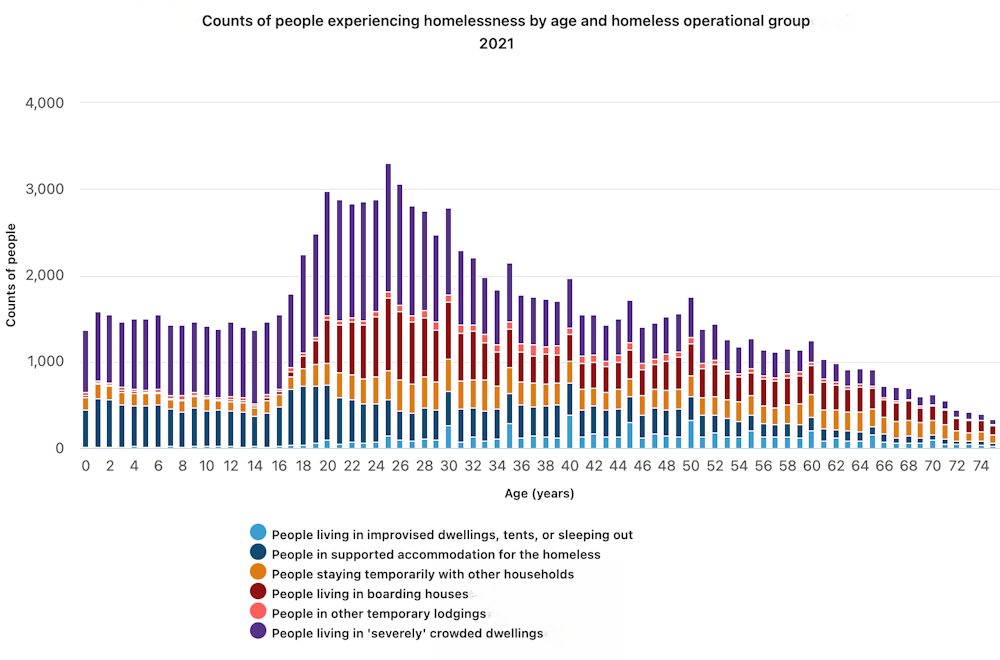

Vertical bar chart showing breakdown of homelessness in Australia by age and category
Source: ABS Census of Population and Housing 2021, CC BY Homelessness funding has largely gone into crisis management – that is, after people become homeless. An expanded role for “prevention” work coupled with supported housing options in each community would be a valuable strategic reform. The Productivity Commission review recommended “prevention and early intervention programs should be a higher priority under the next agreement”, backed by “a separate pool of funding”. The commission even suggested: The nearly $3 billion [annually] given to first home buyers works against improving affordability. This money would be better spent preventing homelessness. Too many young Australians who become homeless and disengage from education then experience long-term disadvantage. The cost to Australia of their lost opportunities amounts to hundreds of millions of dollars a year. Read more: 6 steps towards remaking the homelessness system so it works for young people We have examples of intervention that works There are promising early intervention models for at-risk young people that are ready to be scaled up. Examples include the COSS Model, Kids Under Cover, Ruby’s Reunification and Home Stretch programs. If implemented adequately, programs like these would greatly reduce the flow of young people into homelessness. Housing affordability in Australia has worsened over a long time. For people whose homelessness cannot be averted, the immediate need is access to a crisis service, rapid rehousing and then supported housing options. The Albanese government’s A$10 billion Housing Australia Future Fund could begin to turn the housing crisis around, but it would be only a beginning. All sides of politics need to get behind greater investment in high-quality social housing, shared equity home purchase programs (the government or another investor covers some of the purchase price in return for a share of equity in the home) and increased Commonwealth Rental Assistance. Government subsidies for the private housing sector, such as negative gearing, also need to be reviewed. Read more: To deliver enough affordable housing and end homelessness, what must a national strategy do? Homeless young people have little chance of getting into mainstream social housing when they most need supported housing to get their lives back on track. The social housing business model is not set up to provide supported housing for adolescents and young adults. One notable innovation is the world’s first model of social housing for youth developed by My Foundations Youth Housing. It provides up to five years’ supported residency with rents scaling up annually. Most residents move on to other accommodation when ready to do so. Read more: Homeless numbers set to rise again, but inquiry can be a turning point if we get smarter about housing people Get the plan right and it can be a game-changer Expanding the social housing options for young people would have a significant impact. Should the Senate finally pass the Housing Australia Future Fund legislation, young people (15-24 years) could be guaranteed a specific share of that funding, as has been done for women escaping domestic violence and older women at risk of homelessness. This funding would go into expanding social housing for young people. A key structural reform would be to reorganise support services for at-risk and homeless young Australians on a community-by-community basis. What’s needed is a rigorous approach to needs-based funding for both early intervention and post-homelessness support and supported housing. Will the National Housing and Homelessness Plan be a game-changer for vulnerable young Australians? Well, that remains to be seen. We hope Australia can avoid a rerun of what happened after the 2008 white paper. Authors: David MacKenzie, Associate Professor, University of South Australia

Read more https://theconversation.com/efforts-to-find-safe-housing-for-homeless-youth-have-gone-backwards-heres-what-the-new-national-plan-must-do-differently-210704

Why Retail Cleaning Plays a Key Role in Customer Experience and Business Success

Professional retail cleaning services are an essential part of maintaining a welcoming, safe, and professional environment for customers and staff...

Simple Ways to Make a Commercial Property More Appealing to Buyers

Selling or leasing a commercial property isn’t just about listing the square metres, taking a few photos and waiting for the right person to appea...

What Café Owners Should Know Before Upgrading Their Display Setup

A café display fridge does a lot more than keep cakes cold and sandwiches fresh. It quietly shapes the way customers browse, the way staff move beh...

Creating a Backyard That Feels Comfortable All Year Round

A great backyard doesn’t need to be huge, expensive or perfectly styled. Most of the time, the spaces people actually use are the ones that feel e...

How Homeowners Can Make Smarter Energy Decisions Before Upgrading

Energy upgrades used to feel like something you only looked into after a power bill gave you a nasty surprise. These days, though, more homeowners a...

Why Retail CX Breaks During Peak Sales Events and How to Prevent It

Retail customer experience has become one of the most important drivers of revenue growth, especially during high-intensity sales periods. However, ev...

15 South Indian Dishes Everyone Should Try

If your only experience of "Indian food" is butter chicken and garlic naan, South Indian cuisine is going to feel like discovering an entirely new c...

What Every Homeowner Should Know About Roof and Drainage Maintenance

A home's roof and drainage system work together every day to protect the property from water damage. While many homeowners focus on visible areas such...

From Plans to Priced Quote: The Estimating Workflow Most Builders Skip

For a small one-off job, an experienced builder can size up the materials in their head. The problem is that most jobs are not small one-off jobs, and...

Organisational Experts Share Their Tips for Achieving a Clutter-Free Kitchen

They say the kitchen is the heart of a house which means a clutter-free kitchen not only makes your home in general look nicer, it also makes cookin...

10 Creative Ways AI Image Extenders Are Transforming Digital Content Creation in 2026

Introduction Artificial intelligence continues to reshape the digital landscape, and one of the most exciting innovations in 2026 is the rise of AI i...

What to Do When You're Arrested in Victoria

Most people have thought about this in the abstract. A knock at the door, a hand on the shoulder, a car pulled over on the Hume. In the abstract, th...

Common Financial Disputes During Separation

Separation hits on many levels, not just emotionally. When a partnership ends, untangling the financial side — assets, debts, and everything built t...

Why Posting More Content is Killing Your Brand

More content. More often. More platforms.Most brands have been running this playbook for three years. Most brands have nothing to show for it.Not be...

Garden Clean-Up vs. Regular Maintenance: Which Do You Really Need?

Most people ring a gardener and ask for a "tidy up." What they mean by that, and what the garden actually needs, are often two completely different ...

Solar Panel Maintenance Tips for Melbourne Homes

Three years in and the panels are still on the roof. The inverter is still blinking. The electricity bills are still lower than they used to be, rou...

Cost Effective Kitchen Renovations – From the Ground Up

Even in times of uncertainty, it seems renovations continue to be on the to-do list for many Australian property owners. As a result, demand on materi...

Why Bathroom Product Selection Matters More Than Most Homeowners Realise

Most homeowners think wrong when it comes to a bathroom renovation. They think hard about the layout. Spend hours choosing tiles. Agonise over pain...















