

New evidence suggests the world's largest known asteroid impact structure is buried deep in southeast Australia
- Written by Andrew Glikson, Adjunct professor, UNSW Sydney
Acknowledgment: I’d like to thank my colleague Tony Yeates, who originated the view of the Deniliquin multi-ring structure as an impact structure – and who was instrumental to this work.
In recent research published by myself and my colleague Tony Yeates in the journal Tectonophysics, we investigate what we believe – based on many years of experience in asteroid impact research – is the world’s largest known impact structure, buried deep in the earth in southern New South Wales.
The Deniliquin structure, yet to be further tested by drilling, spans up to 520 kilometres in diameter. This exceeds the size of the near-300km-wide Vredefort impact structure in South Africa, which to date has been considered the world’s largest.
Hidden traces of Earth’s early history
The history of Earth’s bombardment by asteroids is largely concealed. There are a few reasons for this. The first is erosion: the process by which gravity, wind and water slowly wear away land materials through time.
When an asteroid strikes, it creates a crater with an uplifted core. This is similar to how a drop of water splashes upward from a transient crater when you drop a pebble in a pool.
This central uplifted dome is a key characteristic of large impact structures. However, it can erode over thousands to millions of years, making the structure difficult to identify.
Structures can also be buried by sediment through time. Or they might disappear as a result of subduction, wherein tectonic plates can collide and slide below one another into Earth’s mantle layer.
Nonetheless, new geophysical discoveries are unearthing signatures of impact structures formed by asteroids that may have reached tens of kilometres across – heralding a paradigm shift in our understanding of how Earth evolved over eons. These include pioneering discoveries of impact “ejecta”, which are the materials thrown out of a crater during an impact.
Researchers think the oldest layers of these ejecta, found in sediments in early terrains around the world, might signify the tail end of the Late Heavy Bombardment of Earth. The latest evidence suggests Earth and the other planets in the Solar System were subject to intense asteroid bombardments until about 3.2 billion years ago, and sporadically since.
Some large impacts are correlated with mass extinction events. For example, the Alvarez hypothesis, named after father and son scientists Luis and Walter Alvarez, explains how non-avian dinosaurs were wiped out as a result of a large asteroid strike some 66 million years ago.
Uncovering the Deniliquin structure
The Australian continent and its predecessor continent, Gondwana, have been the target of numerous asteroid impacts. These have resulted in at least 38 confirmed and 43 potential impact structures, ranging from relatively small craters to large and completely buried structures.
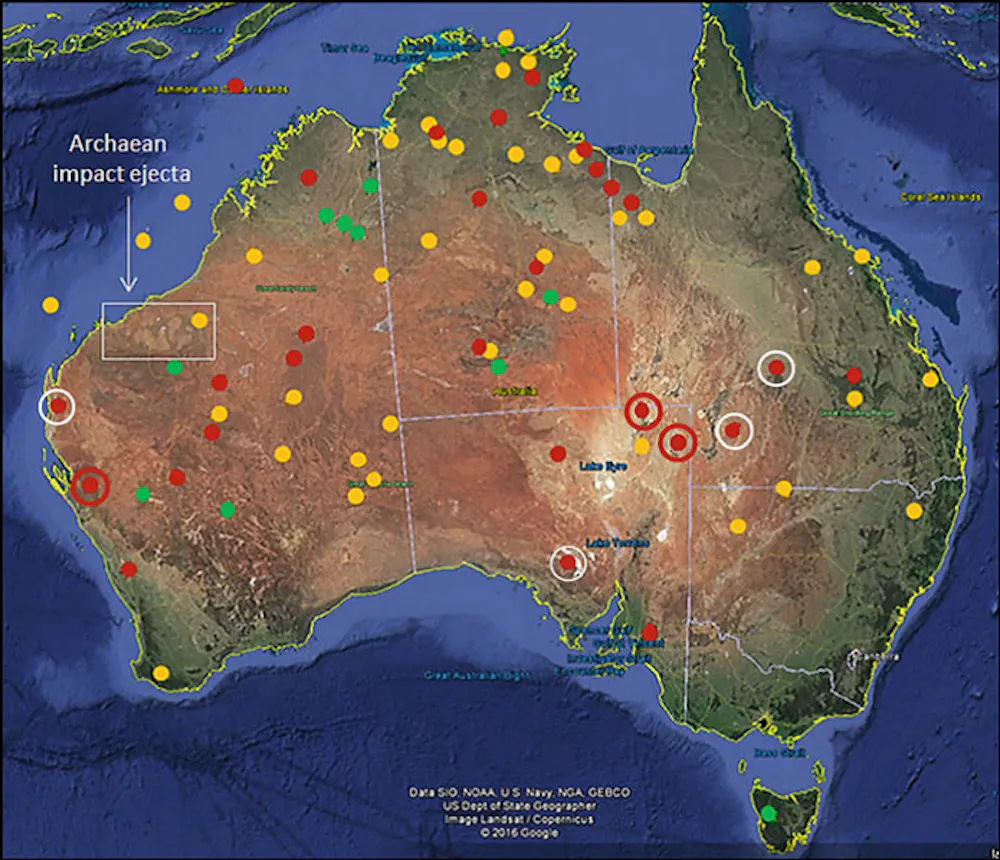
As you’ll recall with the pool and pebble analogy, when a large asteroid hits Earth, the underlying crust responds with a transient elastic rebound that produces a central dome.
Such domes, which can slowly erode and/or become buried through time, may be all that’s preserved from the original impact structure. They represent the deep-seated “root zone” of an impact. Famous examples are found in the Vredefort impact structure and the 170km-wide Chicxulub crater in Mexico. The latter represents the impact that caused the extinction of the dinosaurs.
Between 1995 and 2000, Tony Yeates suggested magnetic patterns beneath the Murray Basin in New South Wales likely represented a massive, buried impact structure. An analysis of the region’s updated geophysical data between 2015 and 2020 confirmed the existence of a 520km diameter structure with a seismically defined dome at its centre.
The Deniliquin structure has all the features that would be expected from a large-scale impact structure. For instance, magnetic readings of the area reveal a symmetrical rippling pattern in the crust around the structure’s core. This was likely produced during the impact as extremely high temperatures created intense magnetic forces.
A central low magnetic zone corresponds to 30km-deep deformation above a seismically defined mantle dome. The top of this dome is about 10km shallower than the top of the regional mantle.
Magnetic measurements also show evidence of “radial faults”: fractures that radiate from the centre of a large impact structure. This is further accompanied by small magnetic anomalies which may represent igneous “dikes”, which are sheets of magma injected into fractures in a pre-existing body of rock.
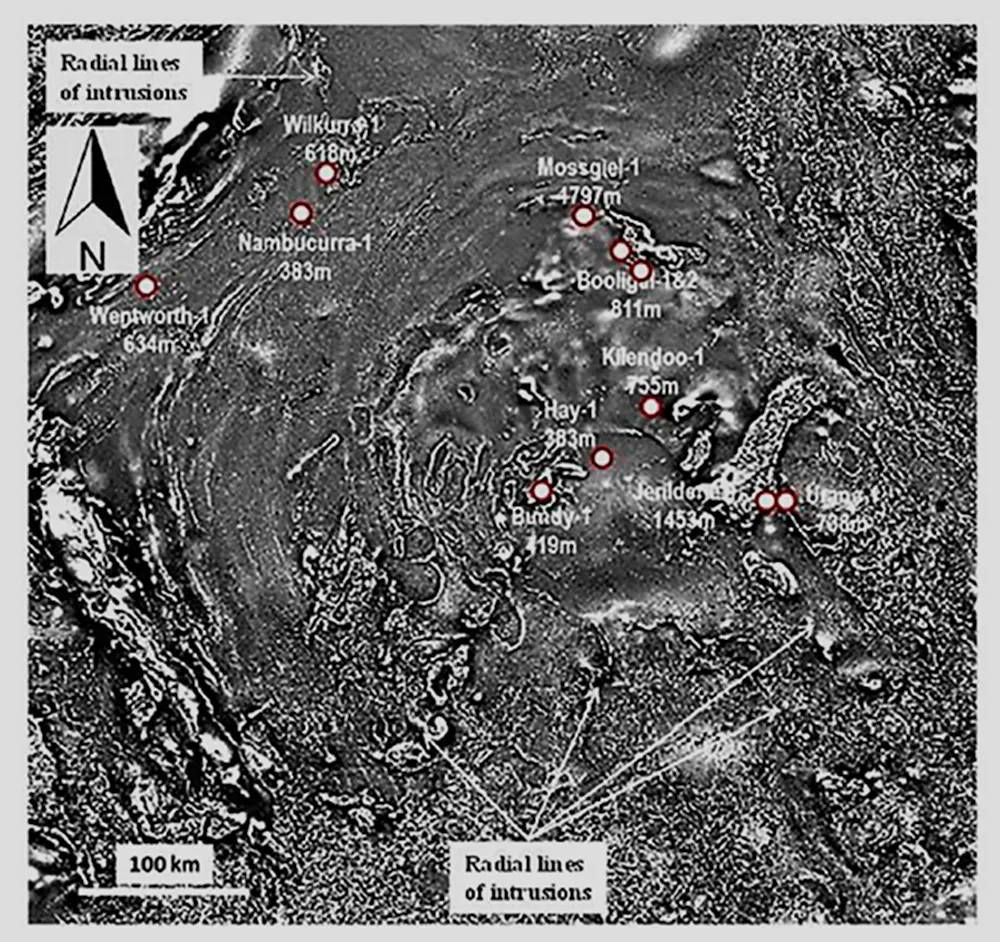 This ‘total magnetic intensity’ image of the Deniliquin impact structure portrays its 520km-diameter multi-ring pattern, the central core, radial faults and the location of shallow drill holes.
Data from Geoscience Australia, published in Glikson and Yeates, 2022
This ‘total magnetic intensity’ image of the Deniliquin impact structure portrays its 520km-diameter multi-ring pattern, the central core, radial faults and the location of shallow drill holes.
Data from Geoscience Australia, published in Glikson and Yeates, 2022
Radial faults, and igneous sheets of rocks that form within them, are typical of large impact structures and can be found in the Vredefort structure and the Sudbury impact structure in Canada.
Currently, the bulk of the evidence for the Deniliquin impact is based on geophysical data obtained from the surface. For proof of impact, we’ll need to collect physical evidence of shock, which can only come from drilling deep into the structure.
Read more: These 5 spectacular impact craters on Earth highlight our planet's wild history
When did the Deniliquin impact happen?
The Deniliquin structure was likely located on the eastern part of the Gondwana continent, prior to it splitting off into several continents (including the Australian continent) much later.
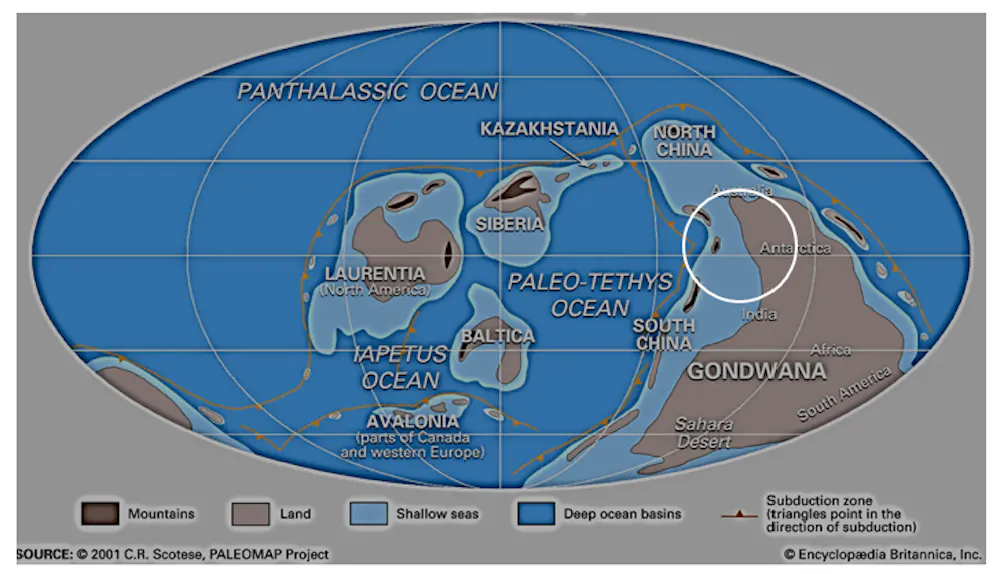 The Deniliquin structure was likely created in eastern Gondwana during the Late Ordovician.
Zhen Qiu et al, 2022, CC BY
The Deniliquin structure was likely created in eastern Gondwana during the Late Ordovician.
Zhen Qiu et al, 2022, CC BY
The impact that caused it may have occurred during what’s known as the Late Ordovician mass extinction event. Specifically, I think it may have triggered what’s called the Hirnantian glaciation stage, which lasted between 445.2 and 443.8 million years ago, and is also defined as the Ordovician-Silurian extinction event.
This huge glaciation and mass extinction event eliminated about 85% of the planet’s species. It was more than double the scale of the Chicxulub impact that killed off the dinosaurs.
It is also possible the Deniliquin structure is older than the Hirnantian event, and may be of an early Cambrian origin (about 514 million years ago). The next step will be to gather samples to determine the structure’s exact age. This will require drilling a deep hole into its magnetic centre and dating the extracted material.
It’s hoped further studies of the Deniliquin impact structure will shed new light on the nature of early Paleozoic Earth.
Authors: Andrew Glikson, Adjunct professor, UNSW Sydney

















