

Research reveals who's been hit hardest by global warming in their lifetime
- Written by: Andrew King, Senior Lecturer in Climate Science, The University of Melbourne
Earth is warming and the signs of climate change are everywhere. We’ve seen it in the past few weeks as temperatures hit record highs around the world – both in the Northern Hemisphere and the warm Australian winter.
Global warming is caused by humanity’s greenhouse gas emissions, which continue at near-record pace. These emissions are predominantly generated by people in the world’s wealthiest regions.
Our world-first analysis, published today, examines the experience of global warming over the lifetimes of people around the world: young and old, rich and poor. We sought to identify who has perceived warmer temperatures most keenly.
We found middle-aged people in equatorial regions have lived through the most perceptible warming in their lifetimes. But many young people in lower-income countries could experience unrecognisable changes in their local climate later in life, unless the world rapidly tackles climate change.
Measuring the climate change experience
We examined temperature data and population demographics information from around the world.
Key to our analysis was the fact that not all warming is due to human activity. Some of it is caused by natural, year-to-year variations in Earth’s climate.
These natural ups and downs are due to a number of factors. They include variations in the energy Earth receives from the sun, the effects of volcanic eruptions, and transfers of heat between the atmosphere and the ocean.
This variability is stronger in mid-to-high-latitude parts of the world (those further from the equator) than in low-latitude areas (in equatorial regions). That’s because the weather systems further away from the equator draw in hot or cold air from neighbouring areas, but equatorial areas don’t receive cold air at all.
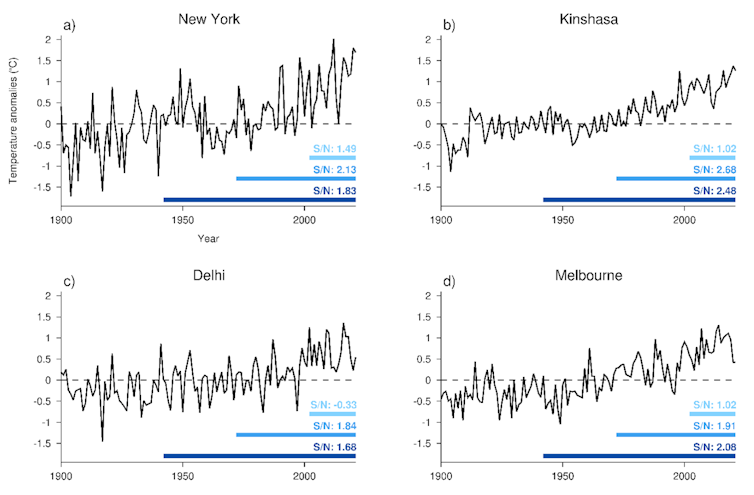
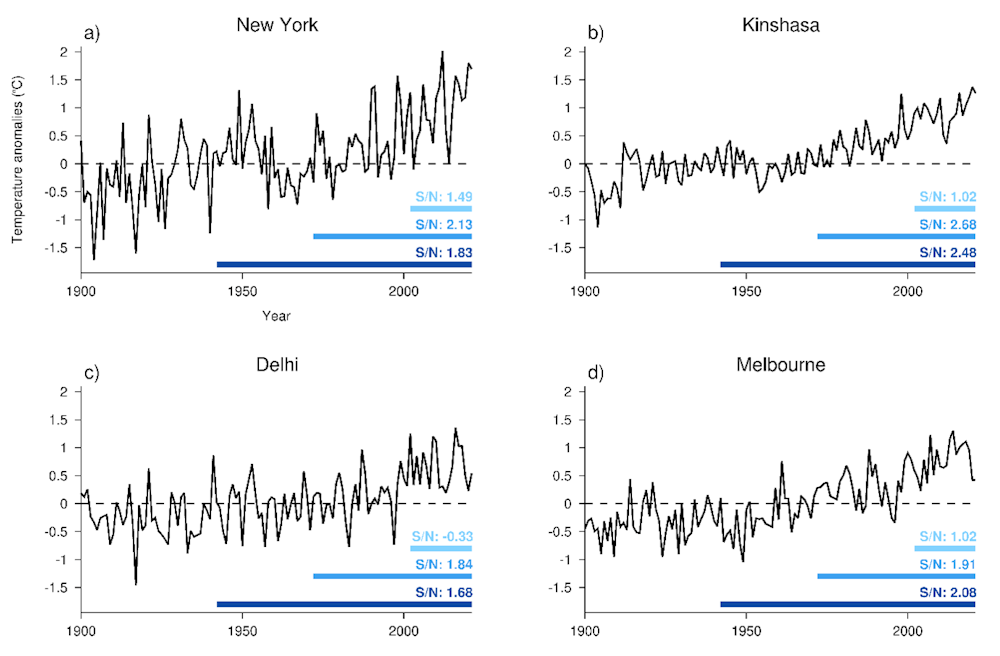
That’s why, for example, the annual average temperature in New York is naturally more variable than in the city of Kinshasa (in the Democratic Republic of Congo).
To account for this, we applied what’s known as the “signal-to-noise ratio” at each location we studied. That allowed us to separate the strength of the climate change “signal” from the “noise” of natural variability.
Making this distinction is important. The less naturally variable the temperature, the clearer the effects of warming. So warming in Kinshasa over the past 50 years has been much more perceptible than in New York.
Our study examined two central questions. First, we wanted to know, for every location in the world, how clearly global warming could be perceived, relative to natural temperature variability.
Second, we wanted to know where this perceived change was most clear over human lifetimes.
Our results
So what did we find? As expected, the most perceptible warming is found in tropical regions – those near the equator. This includes developing parts of the world that constitute the Global South – such as Africa, Latin America and the Caribbean, and Asia.
Household incomes in the Global South are typically lower than in industrialised nations (known as the Global North). We might, then, conclude people in the poorest parts of the world have experienced the most perceptible global warming over their lifetimes. But that’s not always the case.
Why? Because most parts of the Global South have younger populations than wealthier regions. And some people under the age of 20, including in northern India and parts of Sub-Saharan Africa, haven’t experienced warming over their lifetimes.
In these places, the lack of recent warming is likely down to a few factors: natural climate variability, and the local cooling effect of particles released into the atmosphere from pollution and changes in land use.
There’s another complication. Some populated regions of the world also experienced slight cooling in the mid-20th century, primarily driven by human-caused aerosol emissions.
So, many people born earlier than the 1950s have experienced less perceptible warming in their local area than those born in the 1960s and 1970s. This may seem counter-intuitive. But a cooling trend in the first few decades of one’s life means the warming experienced over an entire lifespan (from birth until today) is smaller and less detectable.
So what does all this mean? People in equatorial areas born in the 1960s and 1970s – now aged between about 45 and 65 – have experienced more perceptible warming than anyone else on Earth.
Rich countries must act
Our findings are important, for several reasons.
Identifying who has experienced significant global warming in their lives may help explain attitudes to tackling climate change.
Our findings also raise significant issues of fairness and equity.
Humanity will continue to warm the planet until we reach global net-zero emissions. This means many young people in lower-income countries may, later in life, experience a local climate that is unrecognisable to that of their youth.
Of course, warming temperatures are not the only way people experience climate change. Others include sea-level rise, more intense drought and rainfall extremes. We know many of these impacts are felt most acutely by the most vulnerable populations.
Cumulative greenhouse gas emissions are much higher in the Global North, due to economic development. To address this inequality, rich industrialised nations must take a leading role in reducing emissions to net-zero, and helping vulnerable countries adapt to climate change.
Read more: Why is Australia having such a warm winter? A climate expert explains
Authors: Andrew King, Senior Lecturer in Climate Science, The University of Melbourne


















