

Yes, climate change is bringing bushfires more often. But some ecosystems in Australia are suffering the most
- Written by: David Lindenmayer, Professor, The Fenner School of Environment and Society, Australian National University
Black Summer, Black Saturday, Ash Wednesday: these and so many other bushfire disasters are regular reminders of the fact Australia is among the most flammable continents on Earth.
Alarmingly, climate change is making bushfires more frequent. This is a huge concern, given the devastating effects of fire on both human communities, and the diversity of plants and animals.
As our new research shows, however, the trend is not uniform. We examined the frequency of wildfires in parts of Victoria over the past 40 years. We found fire frequency is increasing in all ecosystems we studied, but to varying extents. In some places, fires are occurring so often, entire ecosystems are at risk of collapse.
These nuances are important. They point to the urgent need to tackle climate change. They also have major implications for biodiversity conservation, and bushfire management and prevention, and cast further questions over the controversial practice of native forest logging.
Fires are becoming shockingly more frequent
To understand the effects of wildfires, it’s not enough to focus on a single fire. We must examine successive fires in an area and how frequently they occur.
Our analysis focused on southeastern Australia – one of the most populated, heavily forested, and fire-prone parts of the continent.
Specifically, we homed in on six geographic areas in Victoria known as “bioregions”. Bioregions vary in their climatic conditions, geological features, biodiversity and other characteristics. The six areas together cover 4.64 million hectares – much of it forest.
We excluded deliberate burns such as hazard reduction (or prescribed) burns lit by fire authorities. We also excluded places that had been logged, because they’re known to be at a high risk of severe fire – and so including them would have skewed the results.
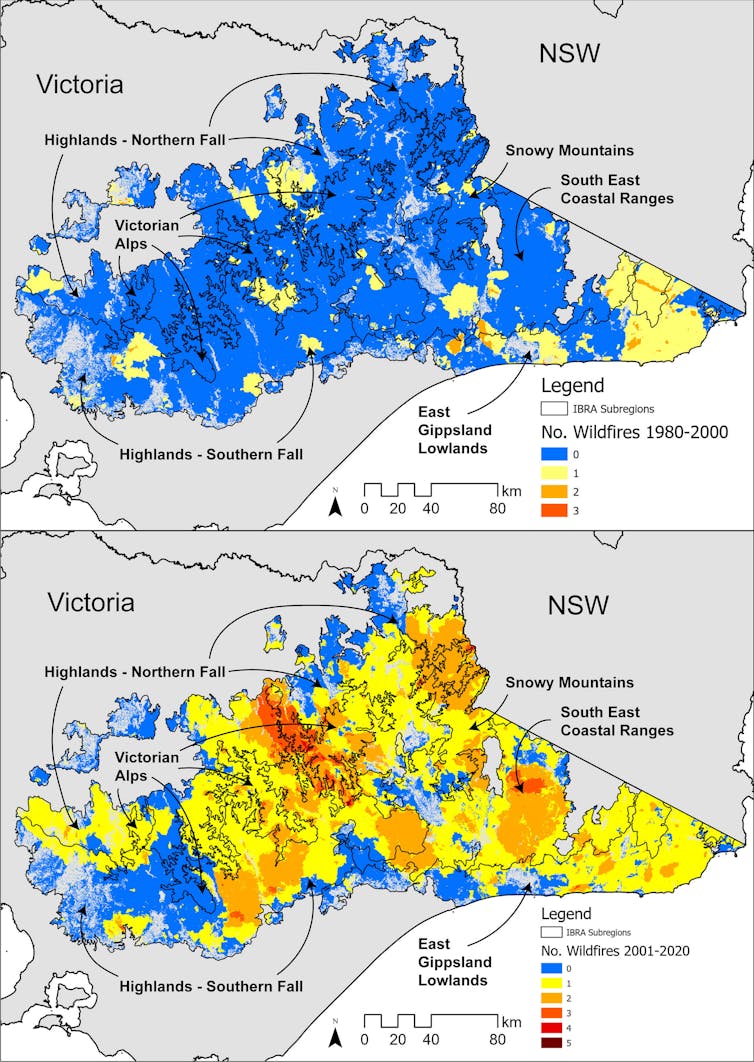
We found a major change in the frequency of wildfire over the past four decades. Between 2001 and 2020, there were substantially more fires in almost all bioregions than between 1981 and 2000.
In the earlier two decades, almost 667,000 hectares of forest burned. More than 36,000 hectares of this burned more than once.
In the latter two decades, 3.1 million hectares burned. About 1 million hectares burned more than once.
The change was most pronounced in the three bioregions at higher elevations - the Snowy Mountains, Victorian Alps, and South East Coastal Ranges (which lie southeast of the Snowy Mountains).
The least amount of change was found in Victoria’s East Gippsland Lowlands. This area had more fires in 1981-2000 than the other areas we studied, but only a modest increase in number of fires between 2000 and 2020.
Fascinatingly, however, the story doesn’t end there.
A complex picture
We found the changes in fire frequency were nuanced and complex. Across the study areas, the frequency of wildfires was very strongly affected by topographical features such as slope, as well as climate measures such as rainfall and temperature. However, the influence of these factors differed markedly between areas.
For example, in four bioregions we studied, wildfires became more frequent as rainfall declined. But the opposite was true in the other two bioregions.
The reasons for these complex findings remain unclear. Increased average rainfall may, in some cases, arrive in storm events with associated lightning (which can start fires). It can also lead to faster water runoff, meaning rainfall may not be as well retained in the soil as otherwise might be, and forests could become drier.
Similarly, fire frequency was also affected by the extent to which temperatures deviated from the long-term average. Generally, this deviation was toward hotter temperatures.
In some areas, this temperature variation was associated with less frequent fires. In others, it coincided with more frequent fires. Again, the reasons for these differences are not yet clear.
The increase in fire frequency is alarming. Some places where fire has been particularly frequent include wetter forests, such as those dominated by ash-type eucalypts. Consistent with earlier analyses, we found evidence of locations that have experienced up to four fires in the past 25 years.
Fires in ash-type ecosystems have historically occurred only once every 75 to 150 years. Fires occurring too often in these environments may lead to the entire ecosystem collapsing.
Our results have major implications for the native forest logging forestry industry. More frequent fires means many trees burn well before they’ve reached an age suitable for sawlogs. This suggests yields from native forest logging in south-eastern Australia will decline, making the practice even more financially precarious.
What must happen next?
Our results confirm wildfires are becoming more frequent in parts of fire-prone south-eastern Australia. And while climate change influences the frequency of fire, the effects vary across geographical areas.
Clearly, we must seek to limit the number of wildfires. An obvious response is to take more strident steps to tackle climate change. But even if humanity meets this huge global challenge, it will be a long time before we see demonstrable changes in climate conditions.
More immediate options include managing vegetation to reduce flammability. For example, activities such as logging and thinning can make forests more flammable, so such practices should be halted in these vulnerable ecosystems.
Greater efforts are needed to conserve biodiversity that is sensitive to fire, and to conserve ecosystems at risk of collapse. We must also embrace new technologies to detect wildfires as soon as they ignite, and suppress them as quickly as possible.
Authors: David Lindenmayer, Professor, The Fenner School of Environment and Society, Australian National University


















