

Thousands of migratory birds will make NZ landfall in spring – will they bring a deadly bird flu with them?
- Written by Jemma Geoghegan, Professor and Webster Family Chair in Viral Pathogenesis, University of Otago
A highly pathogenic bird flu is currently sweeping the world – and New Zealand could be better prepared for its potential arrival.
Over the past few years, more and more birds have come to harbour new strains of this deadly virus as it continues to evolve to infect new species. It is now causing a panzootic (a pandemic of animals) among wild aquatic birds.
The virus, known as highly pathogenic avian influenza virus, has likely already killed thousands of birds worldwide (the exact number is difficult to estimate). What’s more, spillovers to non-avian hosts such as mammals are becoming increasingly common.
While only a few human cases have been reported, cats, foxes and sea lions are being infected at an alarming rate.
Despite intercontinental transmission of highly pathogenic bird flu variants during the past 20 years, no cases have been reported in New Zealand – yet. Australia is also considered free of the virus, although a few years ago a strain in chickens was thought to have evolved locally.
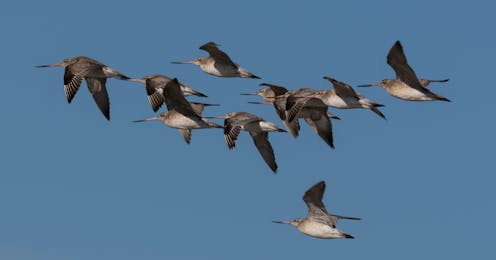
One reason we emphasise “yet” is because each spring, thousands of migratory birds arrive in Aotearoa New Zealand. Will they bring these deadly strains of avian influenza with them? An unwanted viral hitchhiker of this type could have devastating consequences for our biota and industries.
How bird flu could get to New Zealand
New Zealand is conventionally assumed to be at low risk from highly pathogenic avian influenza. We are thought to be too far away from other landmasses and not on routes that migratory waterfowl usually take.
Any migratory shore and seabirds that do usually make landfall in New Zealand are thought likely to die of the disease before reaching our shores.
But some wild birds might experience asymptomatic infections, even of strains that are typically highly pathogenic.
Read more: Avian flu has jumped into wild seabirds and is spreading fast
Also, the recent expansion of susceptible host species, including to marine mammals, increases the risk that some species might carry the virus here.
As for geography, research suggests wild bird migrations are responsible for transmitting the virus from Europe to the Americas across the Atlantic, as well as throughout Eurasia. So why not to New Zealand? Are we really just too far away?
How to prepare for an outbreak
If this highly pathogenic avian influenza virus were to arrive, New Zealand is not as prepared as it could be. The major reason is that we have very little active virus surveillance of wildlife.
New Zealand monitors livestock, including cows, sheep and poultry, for a range of diseases. But the impact of this virus on people and non-poultry livestock is likely to be minimal.
The first signs might be the death of seabirds or marine mammals. While perhaps not as iconic as a kiwi or kākāpō, New Zealand is home to a great many seabirds found nowhere else on the planet.
Some species, such as tara iti (or fairy tern) are critically endangered, with only about 50 individuals left. A virus such as this could directly drive the extinction of species with such low numbers.
Given this risk, the US took action to vaccinate the Californian condor against avian influenza – but only after finding 21 dead condors (4% of the remaining population) which had tested positive for the H5N1 strain.
What should New Zealand watch for and how can we be better prepared to detect any incursions early?
Raising awareness: unexpected deaths in animals are a red flag. Usually, such events are investigated by the Ministry for Primary Industries. But we must better inform the public about what to do if they spot a dead bird or sea lion.
Testing: ramp up active and targeted surveillance of known pathogens. Wild birds have been surveyed annually since 2004 for avian influenza. However, since 2010 the focus has shifted away from migratory birds to sampling resident wildfowl in the summer months, concentrating on a small number of coastal locations visited by migratory shorebirds. This is based on the lack of positive samples from migratory bird prior to 2010, but the global situation and consequences of an incursion warrant revisiting active migratory bird surveillance across more locations.
Genomics: use the viral genomics capabilities we have already established during the COVID-19 pandemic. In Europe, for instance, there are some circulating variants of avian influenza that seem to better infect mammals. If the virus arrives here, viral genomics can be used effectively to let us know what form we are dealing with, and inform our response.
It is clear that to first spot and then stop a virus such as this, we need to look at the entire ecosystem – that is, where humans, animals and the environment are interconnected. This is known as the “One Health” approach.
While this makes intuitive sense, the reality is that disease surveillance affecting humans, domestic animals and wildlife is largely siloed and under-resourced. There is limited integration of activities across these domains. The result is that we are currently ill-equipped to track and respond rapidly to this deadly virus were it to arrive in New Zealand.
We are advocating defragmentation of our surveillance for emerging pathogens. It is time to provide a more enhanced and integrated One Health surveillance system, involving expertise across universities, research institutes and government departments to re-evaluate our pandemic (and panzootic) preparedness.
Authors: Jemma Geoghegan, Professor and Webster Family Chair in Viral Pathogenesis, University of Otago

















