
double standards a double fault
- Written by: Marilyn Giroux, Senior Lecturer in Marketing, Auckland University of Technology
Naomi Osaka has made history as the first Japanese woman to claim a Grand Slam singles title after defeating Serena Williams in the final of the US Open.
However, her defining performance was overshadowed by controversy around sexism and double standards in sports. As our current research suggests, female and male athletes are held to different standards - and this also filters through to endorsement deals. “Bad boy” sports stars with an anti-hero or rule-breaker image are generally welcomed by sponsors, but female athletes aren’t treated the same.
The Grand Slam
Osaka’s opponent, Serena Williams, was looking to win her 24th Grand Slam singles title, one year after giving birth. The feat would have equalled the record of controversial Australian Margaret Court.
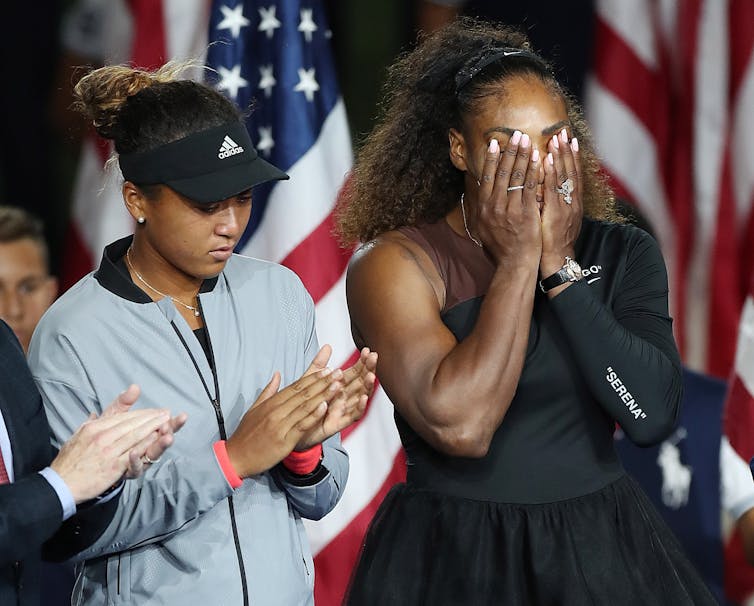 Osaka undoubtedly dominated her opponent, but what people will remember is Williams’ outburst of frustration.
AAP, CC BY-ND
Osaka undoubtedly dominated her opponent, but what people will remember is Williams’ outburst of frustration.
AAP, CC BY-ND
Opinions about this incident have been divided across the globe. Billie Jean King, a strong advocate of women’s rights in sports, tweeted:
Global outrage followed a sketch by Mark Knight, the editorial cartoonist of the Herald Sun, which depicted Williams as a baby and Osaka as white, misrepresenting both athletes.
Read more: The Herald Sun's Serena Williams cartoon draws on a long and damaging history of racist caricature
Double standard in sports
Differences between permissible on-court decorum of female and male athletes have been called into question, prompted by the severe umpire calls towards Williams’ behaviour as well as penalties against French player Alizé Cornet earlier in the tournament for briefly taking off her shirt on court after realising it was on backwards.
This incident came days after the French Tennis Federation announced a new dress code that will ban Serena Williams’ catsuit. Designed to help prevent blood clots that threatened her health after giving birth, the suit was deemed to be disrespectful of the game.
Several celebrities and athletes have argued for a redefinition of women’s tennis oriented towards strength, power and athleticism. Former top-five tennis player and Miami Open tournament director, James Blake, alluded to contradictory gendered reactions to athletes expressing their anger and frustration.
The sport definitely has a double standard when it comes to perception.
Several comments noted “boys will be boys” reactions to male tennis players such as Novak Djokovic and Dominic Thiem when these players misbehaved by destroying a racquet on court.
Marketability of male and female athletes
Over the past decades, female athletes in tennis have been fighting for equal pay. Some gains have been made, but equity is far from achieved. Prize money in tennis is only equal in Grand Slam tournaments. More than 70% of male professional tennis players in the world’s top 200 have earned more than their female counterparts.
Tennis is not an isolated case. According to the Women’s Sports and Fitness Federation, women’s sport only gets 7% of media coverage and barely 0.4% of commercial investment goes to women-only sport. Substantial pay disparity has also been evident in the football world cup, with men receiving US$28.6m in prize money, while the women’s tournament only receives US$820,000.
Notable discrepancies have also also been observed in terms of sponsorship opportunities, with women underrepresented in endorsement deals. In order to secure a sponsorship deal, athletes are expected to behave in an exemplary manner on and off the court and have to shoulder the immense pressure of being positive role models. In Williams’ case, this is particularly true as attacks on her have been personal and her suitability as a role model was called into question.
Nike’s reaction to Maria Sharapova’s drug suspension, in contrast to its response to Tiger Woods’ infidelity scandal or Kobe Bryant’ rape accusation, highlights equity issues among consumers and sponsors.
Villain or rogue
Research has demonstrated that celebrity endorsements are based on credibility and attractiveness. The main premise of endorsement decisions is based on the transfer of positive associations between the endorser and the brand. However, several sources have noted differences between how male and female athletes are evaluated in terms of marketable qualities.
Female athletes are more often judged on attractiveness and physical appearance, while male athletes are judged primarily on performance and skill.
For example, at the 2015 Australian Open, after becoming the first Canadian woman to qualify for the semi-final at a major tennis tournament, Eugenie Bouchard was asked by the on-court announcer to “give us a twirl”.
Similarly, the Women’s National Basketball Association holds makeup seminars for rookie players to ensure women secure the sponsorship deals they need to play. The evidence suggests marketability of female and male athletes does indeed revolve around different meaning transfers.
Read more: Why sports fans need villains
In an era where brands are searching for athletes that are different and unique, there’s been an increased interest in athletes with intriguing personalities. Research has in the past demonstrated the appeal of a hero defeating the villain, but recently controversial athletes with a rogue image have gained appeal to specific target markets.
Our current work examines the role of anti-heroes in sports and how breaking the rules can have positive effects for sponsoring companies, even making an athlete more attractive. Positive sentiments such as fearlessness and intrigue are often associated with bad boys, while the perceptions of a bad girl is not so favourable. The “lovable bad boy” has no female equivalent.
No matter which side of the fence you may sit on with regards to the events between Serena Williams and Naomi Osaka, the conversation about women in sports is long overdue, albeit, unfortunately, at the expense of the current US Open women’s singles champion.
Authors: Marilyn Giroux, Senior Lecturer in Marketing, Auckland University of Technology
Read more http://theconversation.com/women-in-sports-double-standards-a-double-fault-103082


















