

Modern Australian
Times Advertising

only a genuine shift to rail will put NZ on track to reduce emissions

  • Written by Philip Laird, Honorary Principal Fellow, University of Wollongong
only a genuine shift to rail will put NZ on track to reduce emissions

Both the Labour government and the opposition National Party have now released major transport polices that put the emphasis on maintaining and expanding roads.

The cost and priority of various projects will clearly be an election issue. But at the heart of the debate lies an inconvenient truth about climate change: encouraging road transport while needing to reduce carbon emissions simply does not add up.

We can see this tension in transport agency Waka Kotahi’s own policy statements: road safety and better travel options on the one hand, addressing sustainability on the other. But transport is responsible for 17% of New Zealand’s total greenhouse gas emissions.

Furthermore, road vehicle use has been increasing, as has the popularity of larger cars and SUVs that create more emissions per kilometre. Road congestion has become worse, with the popular response being to expand road capacity.

Hence the present government’s recently announced plans for a second harbour crossing in Auckland involving two road tunnels. And the main thrust of National’s Transport for the Future policy is on more urban and intercity roads. Both Labour and National favour a second Mount Victoria tunnel in Wellington.

In the background sits the government’s Rail Plan, which sets out the “vision and priorities for rail over the next decade and beyond”. But given the clear need for New Zealand’s transport policies to change, the planned improvements need to be on a fast track.

Light rail right next door

Cars and planes are convenient, but both have low energy efficiency compared to rail.
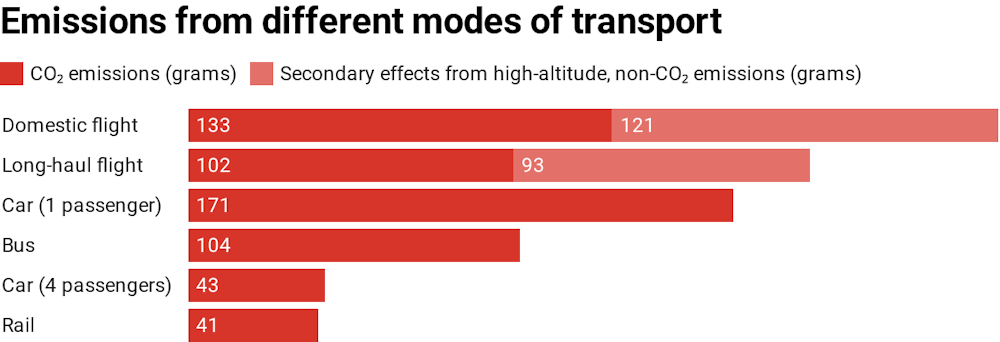
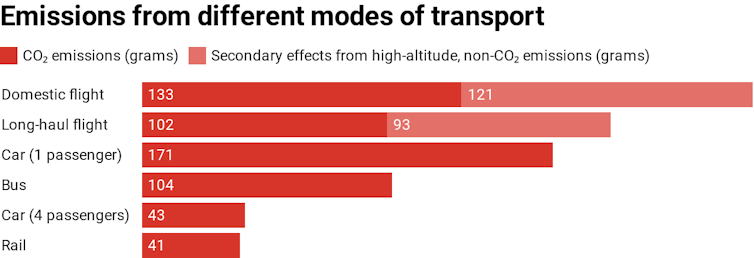
Data source: Greenhouse gas reporting: conversion factors 2019 A car’s carbon emissions per passenger kilometre can be around four times that of domestic rail (as shown by the graph above, based on UK data). The government’s transport plans for Auckland do include light rail, but National has promised to scrap the scheme if elected. Looking across the Tasman, however, there is good evidence that light rail should not be this contentious. Few might have predicted that Queensland’s Gold Coast light rail network – G:link, which opened in July 2014 – would see six million riders in its first 12 months of operation. Work started on a second stage within 24 months, with construction of a third stage now under way. Read more: 70 years of road-based policies created today's problems – does National’s transport plan add up? The system has now seen more than 73 million paid passenger trips since it opened, with upwards of ten million trips likely in the 2022-23 year. In 2019, three other new light rail systems opened in Australia: a short section in Newcastle, another in Canberra (where post-COVID patronage is recovering), and Sydney’s CBD and south-east line (where patronage is also bouncing back). Adelaide’s single line was also extended during the 2010s. However, the combined patronage of all of these new light rail systems is far exceeded by Melbourne’s trams, now building back to pre-COVID levels of 205 million rides in 2018-19. This is all part of a remarkable renaissance of light rail around the world. New Zealand could be part of this – if the will was there. Light rail success: Melbourne’s trams have seen more than 200 million rides per year. Getty Images The freight factor New Zealand’s historical shift from rail to road as the primary mode of freight transport has seen an ever-increasing dependence on trucks. While road freight grew steadily in the first two decades of this century, rail freight in 2021-2022 was the same as it was in 1999-2000. Road freight does have some advantages, including point-to-point delivery and flexibility. But for many freight movements, using trucks rather than rail increases emissions by a factor of three. If reducing freight emissions is the goal, shifting some from road to rail is a logical solution. Read more: New Zealand must get over its obsession with big cars and go smaller or electric to cut emissions Rail will therefore have to increase its own energy efficiency, including through more electrification of rail routes such as the Auckland-Hamilton-Tauranga and Palmerston North-Waikanae links. While this was hinted at in the government’s 2023 budget, it doesn’t appear in the recently released draft government statement on land transport. Increasing the allowable axle loading for freight wagons across the rail network would also allow trains to carry heavier loads, improve efficiency and reduce emissions. Finally, the North Island main trunk needs upgrading to make the track straighter and allow trains to go faster. In turn this will make rail more attractive and help reduce emissions. Read more: To get New Zealanders out of their cars we'll need to start charging the true cost of driving When’s the next train? Clearly, roads need to be maintained, and New Zealand’s road network has to be made more resilient to adverse weather impacts. But expanding road capacity at the expense of a more efficient rail system and improved public transport is a recipe for increasing emissions. While road congestion in major cities is a problem, overseas experience tells us that more road capacity only increases vehicle use. The net result is more, not fewer, transport emissions. Read more: Why restoring long-distance passenger rail makes sense in New Zealand – for people and the climate It would make more sense to upgrade the rail network to move more freight and transport more urban and intercity passengers. In fact, the Transport and Infrastructure Select Committee has recently recommended that the Ministry of Transport investigate how the Rail Plan could better incorporate inter-regional passenger rail. But New Zealand needs to move beyond recommendations. As the International Energy Agency has noted: “Rail transport is the most energy-efficient and least carbon-intensive way to move people and second only to shipping for carrying goods.” Whichever parties form the next government have an opportunity to put New Zealand transport on the right track. On the evidence so far, however, it could be a slow train coming. Authors: Philip Laird, Honorary Principal Fellow, University of Wollongong

Read more https://theconversation.com/slow-train-coming-only-a-genuine-shift-to-rail-will-put-nz-on-track-to-reduce-emissions-211662

Why Does My Power Keep Tripping? Common Causes Explained by Electricians Sydney

The electrical system is the lifeblood of your home, powering everything from your phones to cooking utensils and more. But from time to time, your po...

Interstate Car Transporter Urges Buyers to Book Early

As the conflict in the Middle East continues to put increasing pressure on local fuel supply, Australian transport companies are experiencing increasi...

Digital Minimalism for Business Owners: Fewer Tools, Better Systems

Be honest. How many apps are open right now? One for scheduling, another for invoices, a third for customer notes, plus a spreadsheet someone email...

The Importance Of Proactive NDIS Renewal Preparation For Sustaining Your Provider Business

Your NDIS renewal notice is not a signal to start preparing. By the time it arrives, preparation should already be well underway. For new providers, s...

Why Fire Extinguisher Testing in Sydney Is Becoming a Records Game, Not Only a Maintenance Job

A fire extinguisher used to feel like one of the simpler parts of building safety. It hung on the wall, wore a service tag, and sat there quietly unle...

The Switchboard Upgrade Question Every Melbourne Renovator Should Ask Before the Walls Close Up

Renovations have a funny way of making people think on surfaces first. Splashback, stone, joinery, tapware, paint. Fair enough too. That is the exciti...

Winter Sanitation Gaps in Parramatta Kitchens: A Hidden Pest Risk

Winter brings a host of changes to our homes, from the chill in the air to the cozy warmth indoors. However, this season also introduces sanitation ch...

When to Seek Advice from Employment Lawyers in Melbourne

Australian employment law is detailed and, at times, complex, with rights and obligations that aren't always obvious to employees or employers witho...

7 Benefits of Professional Gutter Cleaning for Australian Homeowners

Gutters aren't exactly glamorous. They sit up there on the edge of your roof, doing their job quietly - until they stop working. Clogged, overflowing ...

Pipe Floats Strengthening Pipeline Performance In Demanding Environments

Pipelines often travel through environments that are anything but predictable, water currents shift, terrain changes, and materials keep moving unde...

Why Ceiling Fans Are Essential For Comfort, Efficiency, And Modern Living

Creating a comfortable indoor environment is not just about temperature; it is about how air moves, how a room feels, and how efficiently energy is ...

Why Duct Cleaning In Melbourne Is A Smart Investment For Healthier Living Spaces

Behind your walls, ceilings, and vents lies a network quietly working every day to keep your home comfortable. Yet over time, this system can become...

Disability Service Providers Supporting Inclusive And Independent Living

Finding the right support system can feel like assembling a puzzle where every piece must fit just right. For individuals and families navigating di...

A Beginner's Guide to Owning a Caravan in Australia

Owning a caravan opens up a style of travel that's hard to match for freedom and flexibility. However, for those just starting out, the process of c...

Preparing Your Air Conditioner for Summer: What Most Homeowners Overlook

As temperatures rise, many homeowners switch on their air conditioning for the first time in months — only to find it’s not performing the way i...

What Actually Adds Value to Properties in Newcastle

Newcastle has seen steady growth over the past few years, with more buyers looking beyond Sydney for lifestyle, space, and long-term value. As dema...

What is Design and Build in Construction?

Imagine you’re about to start a new construction project, maybe it’s a custom home or a commercial building. You’ve got the idea, the land, an...

Commercial roof leak detection: why early action protects your building

Water ingress is one of the most disruptive and costly issues facing commercial properties. For property managers and facilities teams, even a minor...

















