

Google AI


Modern Australian

only a genuine shift to rail will put NZ on track to reduce emissions

  • Written by: Philip Laird, Honorary Principal Fellow, University of Wollongong
only a genuine shift to rail will put NZ on track to reduce emissions

Both the Labour government and the opposition National Party have now released major transport polices that put the emphasis on maintaining and expanding roads.

The cost and priority of various projects will clearly be an election issue. But at the heart of the debate lies an inconvenient truth about climate change: encouraging road transport while needing to reduce carbon emissions simply does not add up.

We can see this tension in transport agency Waka Kotahi’s own policy statements: road safety and better travel options on the one hand, addressing sustainability on the other. But transport is responsible for 17% of New Zealand’s total greenhouse gas emissions.

Furthermore, road vehicle use has been increasing, as has the popularity of larger cars and SUVs that create more emissions per kilometre. Road congestion has become worse, with the popular response being to expand road capacity.

Hence the present government’s recently announced plans for a second harbour crossing in Auckland involving two road tunnels. And the main thrust of National’s Transport for the Future policy is on more urban and intercity roads. Both Labour and National favour a second Mount Victoria tunnel in Wellington.

In the background sits the government’s Rail Plan, which sets out the “vision and priorities for rail over the next decade and beyond”. But given the clear need for New Zealand’s transport policies to change, the planned improvements need to be on a fast track.

Light rail right next door

Cars and planes are convenient, but both have low energy efficiency compared to rail.
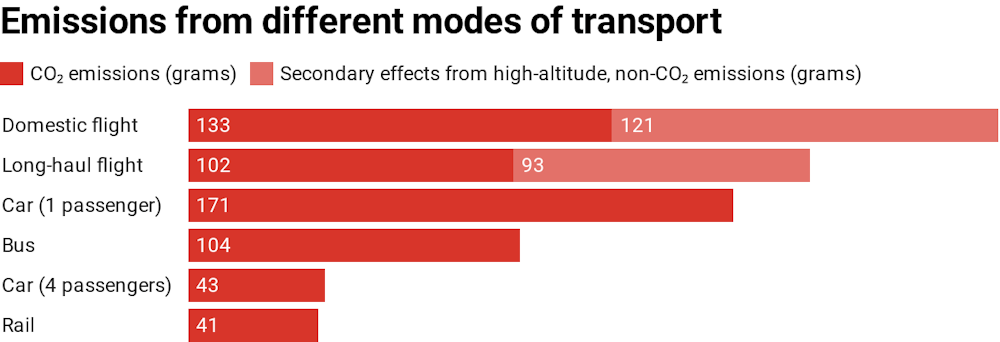
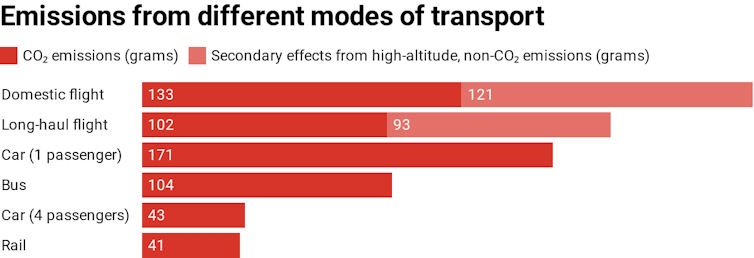
Data source: Greenhouse gas reporting: conversion factors 2019 A car’s carbon emissions per passenger kilometre can be around four times that of domestic rail (as shown by the graph above, based on UK data). The government’s transport plans for Auckland do include light rail, but National has promised to scrap the scheme if elected. Looking across the Tasman, however, there is good evidence that light rail should not be this contentious. Few might have predicted that Queensland’s Gold Coast light rail network – G:link, which opened in July 2014 – would see six million riders in its first 12 months of operation. Work started on a second stage within 24 months, with construction of a third stage now under way. Read more: 70 years of road-based policies created today's problems – does National’s transport plan add up? The system has now seen more than 73 million paid passenger trips since it opened, with upwards of ten million trips likely in the 2022-23 year. In 2019, three other new light rail systems opened in Australia: a short section in Newcastle, another in Canberra (where post-COVID patronage is recovering), and Sydney’s CBD and south-east line (where patronage is also bouncing back). Adelaide’s single line was also extended during the 2010s. However, the combined patronage of all of these new light rail systems is far exceeded by Melbourne’s trams, now building back to pre-COVID levels of 205 million rides in 2018-19. This is all part of a remarkable renaissance of light rail around the world. New Zealand could be part of this – if the will was there. Light rail success: Melbourne’s trams have seen more than 200 million rides per year. Getty Images The freight factor New Zealand’s historical shift from rail to road as the primary mode of freight transport has seen an ever-increasing dependence on trucks. While road freight grew steadily in the first two decades of this century, rail freight in 2021-2022 was the same as it was in 1999-2000. Road freight does have some advantages, including point-to-point delivery and flexibility. But for many freight movements, using trucks rather than rail increases emissions by a factor of three. If reducing freight emissions is the goal, shifting some from road to rail is a logical solution. Read more: New Zealand must get over its obsession with big cars and go smaller or electric to cut emissions Rail will therefore have to increase its own energy efficiency, including through more electrification of rail routes such as the Auckland-Hamilton-Tauranga and Palmerston North-Waikanae links. While this was hinted at in the government’s 2023 budget, it doesn’t appear in the recently released draft government statement on land transport. Increasing the allowable axle loading for freight wagons across the rail network would also allow trains to carry heavier loads, improve efficiency and reduce emissions. Finally, the North Island main trunk needs upgrading to make the track straighter and allow trains to go faster. In turn this will make rail more attractive and help reduce emissions. Read more: To get New Zealanders out of their cars we'll need to start charging the true cost of driving When’s the next train? Clearly, roads need to be maintained, and New Zealand’s road network has to be made more resilient to adverse weather impacts. But expanding road capacity at the expense of a more efficient rail system and improved public transport is a recipe for increasing emissions. While road congestion in major cities is a problem, overseas experience tells us that more road capacity only increases vehicle use. The net result is more, not fewer, transport emissions. Read more: Why restoring long-distance passenger rail makes sense in New Zealand – for people and the climate It would make more sense to upgrade the rail network to move more freight and transport more urban and intercity passengers. In fact, the Transport and Infrastructure Select Committee has recently recommended that the Ministry of Transport investigate how the Rail Plan could better incorporate inter-regional passenger rail. But New Zealand needs to move beyond recommendations. As the International Energy Agency has noted: “Rail transport is the most energy-efficient and least carbon-intensive way to move people and second only to shipping for carrying goods.” Whichever parties form the next government have an opportunity to put New Zealand transport on the right track. On the evidence so far, however, it could be a slow train coming. Authors: Philip Laird, Honorary Principal Fellow, University of Wollongong

Read more https://theconversation.com/slow-train-coming-only-a-genuine-shift-to-rail-will-put-nz-on-track-to-reduce-emissions-211662

Better Business Photos Without Misleading Customers: An Australian Guide

A timber dining set looks inviting against a sunny deck, with cushions, lanterns and enough chairs for the whole family. But imagine the retailer sell...

Understanding a dental implant Melbourne Treatment Plan

A dental implant Melbourne patients may consider is one option for replacing a missing tooth, but suitability depends on oral health, bone support a...

How 3PL Logistics Australia Supports Faster and More Efficient Supply Chains

Why Has 3PL Logistics Become Important for Growing Businesses?  Gone are the days when supply chains were simpler and in minimal quantity. Now, the...

Common Skin Concerns and Treatment Options Available in Melbourne

Skin concerns can develop gradually or become noticeable following changes in age, lifestyle, sun exposure or hormonal factors. Pigmentation, rednes...

Why a Code-Compliant Home Can Still Feel Uncomfortable

When people build or renovate a home, they usually expect that meeting current building requirements will also produce a comfortable place to live. ...

Breach of Contract in Business: What Are Your Options?

Contracts are essential to business relationships. They establish expectations, allocate responsibilities and provide a framework for delivering goods...

How Pest Control Companies Can Rank for the Problems Customers Search First

Introduction SEO for Pest Control needs to start with the customer’s problem. Most people do not search for pest services in a neat or technical wa...

What Are the Benefits of Renovating an Older Home in Sydney?

Sydney has plenty of character homes, from Federation cottages to mid-century brick homes. Renovating rather than rebuilding can preserve what makes t...

Pool and Deck Design: How to Plan the Perfect Outdoor Living Space for Your Sydney Home

For many Australians, the backyard is where life happens. Summer barbecues, weekend swims and long evenings outdoors are all part of the lifestyle, ...

Is Solar Pool Heating Worth It? What Sydney Homeowners Should Know

There's nothing quite like a backyard pool on a hot Sydney day. But once autumn rolls in, many pools sit unused for months because the water is simp...

Planning a Luxury House Move: A Week-by-Week Timeline for Prestige Sydney Homes

Selling or buying a prestige home is a major milestone. Whether it's a waterfront residence in Birchgrove, a grand Federation home in Haberfield or ...

Downsizing or Upgrading Your Caravan? Here's How to Sell It Without the Hassle

Selling a caravan can feel like a major task, especially when you are unsure about its value, paperwork, or how to find a buyer. Whether you are dow...

The Best Overseas Adventure Holidays for Australians Who Love the Outdoors

Australia offers no shortage of incredible outdoor experiences, but sometimes the best way to satisfy your sense of adventure is to head overseas. A...

Cape Town Wine Shuttle: Winelands Tasting & Tours

Embark on an unforgettable journey through the picturesque Cape Winelands, where world-class wines and breathtaking scenery await. Our Cape Town Win...

Metal Fabrication: Choosing Metal Fabrication Melbourne Services for Custom Projects

What Modern Metal Fabrication Involves From individual components to complete structures, metal fabrication brings together processes such as desig...

Why Giant Rats Tail Grass Keeps Coming Back After Spraying

Giant Rats Tail Grass (GRT) is one of the most frustrating pasture weeds for farmers and lifestyle property owners. You spray an infested area, see th...

When Custom Cardboard Boxes Make Sense for Your Business

Custom cardboard boxes can be useful when a standard carton does not fit a product, packing method or presentation requirement particularly well. A ...

Full-Height vs. Pop-Top Caravan: Which Is Better for Family Travel across WA?

A pop-top caravan is an excellent choice for travellers who want the comfort of a caravan without committing to a larger, bulkier setup. With a lowe...

















