

Russia has declared a new space race, hoping to join forces with China. Here's why that's unlikely
- Written by Richard de Grijs, Professor of Astrophysics / Executive Director, International Space Science Institute-Beijing, Macquarie University
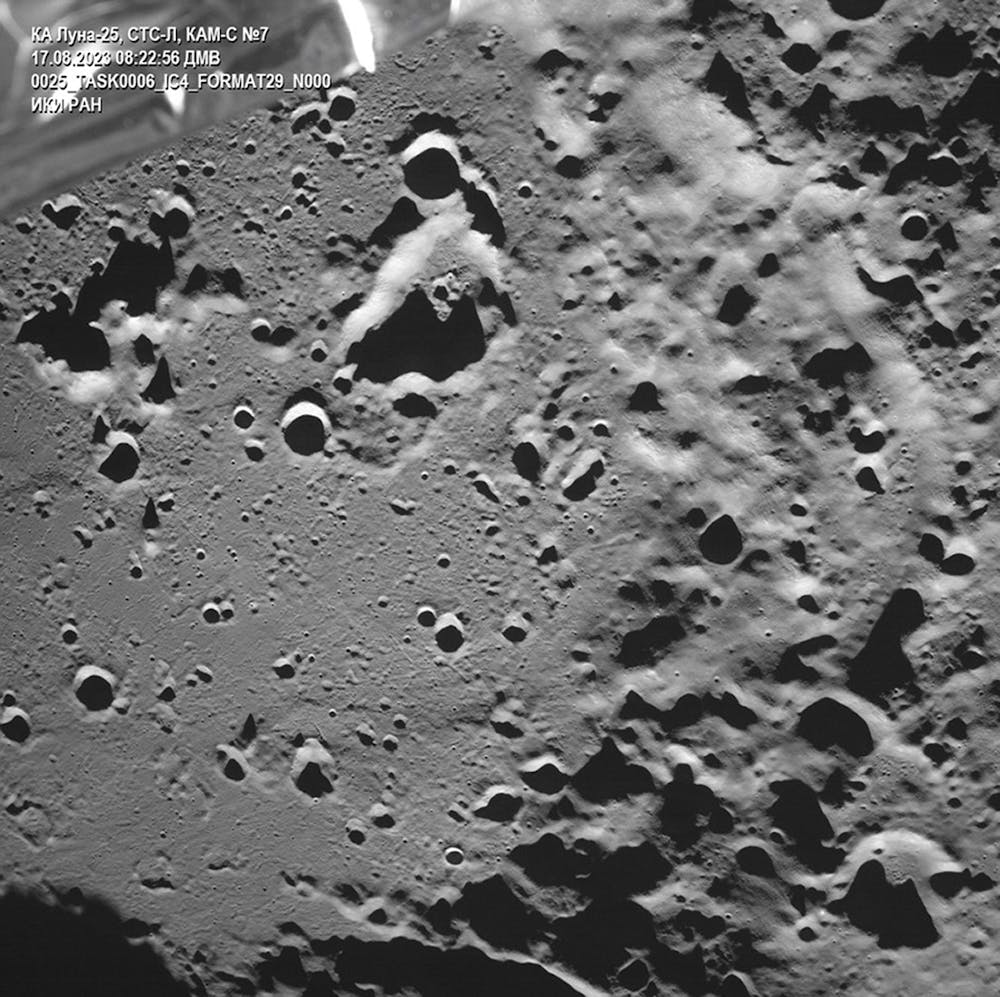
This week, the Russian space agency Roscosmos had hoped to return to the Moon after an absence of nearly 50 years. Instead, on Saturday it lost control of its Luna-25 lander. The agency explained the spacecraft “switched to an off-design orbit and ceased to exist as a result of a collision with the lunar surface”.
Yet, in an interview aired on state television, the agency’s chief, Yuri Borisov, pledged his nation’s unwavering commitment to lunar exploration:
This is not just about the prestige of the country and the achievement of some geopolitical goals. This is about ensuring defensive capabilities and achieving technological sovereignty.
Roscosmos had been keen to beat a rival Indian spacecraft, Chandrayaan-3, to achieve a soft landing near the lunar south pole. The Indian mission remains on schedule for a soft landing today (around 9pm AEST).
Despite the Luna-25 failure, the head of Russia’s space agency also declared a “new race to exploit the Moon’s resources has begun”, and there would be a potential crewed Russian-Chinese mission in the future, as reported by Reuters. His statement sounds like it is less about the scientific exploration of the lunar surface, and more about geopolitical posturing.
I recently spent the better part of a decade as a senior academic at Peking University, and in July 2023 was appointed as Executive Director of the International Space Science Institute–Beijing. These appointments have allowed me to gain unique insights into the processes driving China’s space science program.
Read more: Is the US in a space race against China?
A lunar outpost
The lunar south pole region is thought to contain significant water reservoirs locked in grains of ice. That makes the area interesting as a potential staging post for future missions to Mars and beyond, as lunar explorers can use the water for survival.
In early 2021, Roscosmos and the China National Space Administration signed a memorandum of understanding to jointly establish an International Lunar Research Station by the mid-2030s.
The lunar south pole may well be a prime site for such a robotic base, which might also involve the European Space Agency and other international partners.
Yet human involvement in Sino-Russian space missions is not anticipated any time soon. Therefore, Borisov’s assertion that Russia would explore a joint crewed mission came as an unlikely surprise. He may well have been speaking to a domestic audience, in an attempt to salvage his agency’s credentials.
Despite an impressive number of collaboration agreements, high-profile Sino-Russian space projects remain few and far between. If joint human exploration of the Moon is not currently on the cards, it is highly unlikely the Chinese space authorities will take the bait.
No need for a space race
China has always carefully planned its approach to Solar System exploration and human spaceflight, navigating a succession of clearly defined technological benchmarks. China will unlikely be coerced into rushing its planned milestones. As such, the notion of a “space race” involving China seems a moot point.
Chinese scientists and engineers have become highly adept at developing homegrown capabilities. They no longer require international assistance. If anything, in the Sino-Russian relationship, Russia is now well and truly the junior partner. Its ageing technology pales in comparison with the leaps of modernisation we have witnessed in relation to China’s progress in space.
Although the country only joined the league of space-faring nations in 1970 with the launch of its first satellite, Dong Fang Hong 1 (The East is Red 1), it has since made massive strides in technology readiness.
China’s lunar exploration program has gradually built on proven capabilities, from entering the Moon’s orbit on its first lunar missions (Chang'e 1 and Chang'e 2; named after the Chinese Moon goddess) to achieving soft landings (Chang'e 3 and Chang'e 4) and a successful sample return mission, Chang'e 5.
Venturing out to the planets
Solar System exploration is now firmly on China’s agenda, not least because of the recent Tianwen 1 (Heavenly Questions) mission to Mars. That mission successfully deployed the Zhurong rover (named after a Chinese mythological god of fire), a major technological feat in its own right.
Read more: On its first try, China's Zhurong rover hit a Mars milestone that took NASA decades
Similarly, China’s human spaceflight program is starting to yield impressive results. As the country’s scientists and engineers are banned from collaborating with their federally funded US counterparts by the 2011 Wolf Amendment, the China Manned Space program has been pursuing construction of a sovereign space station, Tiangong (Heavenly Palace).
Future plans include the development of a next-generation crewed spacecraft to replace the workhorse Shenzhou (Divine Vessel on the Heavenly River) series. We are told it will be capable of carrying taikonauts to the Moon, but that does not mean Russian cosmonauts will be invited to come along.
Although China can no longer boast the economic successes of the past and external cash injections might be seen as helpful, Russia’s financial losses due to its ongoing war in Ukraine may well make any such overtures merely wishful thinking.
Russia’s prowess in space appears to have become just a dim reflection of its Soviet precursor.
Read more: China's new space station opens for business in an increasingly competitive era of space activity
Authors: Richard de Grijs, Professor of Astrophysics / Executive Director, International Space Science Institute-Beijing, Macquarie University

















