

Do universal values exist? A philosopher says yes, and takes aim at identity politics – but not all of his arguments are convincing
- Written by Denise Gamble, Visiting Research Fellow, School of Humanities, University of Adelaide

In Moral Progress in Dark Times, German philosopher Markus Gabriel makes a case for a new enlightenment based on universal values, arguing that the democratic law-based state is a valuable vehicle for encouraging this “moral progress”.
The aims of his book are admirable, but Gabriel is only partially successful in explaining what the new enlightenment might entail and how it might be implemented in democratic societies.
Review: Moral Progress in Dark Times: Universal Values for the 21st Century – Marcus Gabriel (Wiley)
Moral realism
Gabriel is a moral realist. He asserts the objectivity of moral facts, their universality, and their essential knowability by human beings – although he concedes that in “dark times” they can be obscured by ideology, propaganda, psychology and manipulation.
According to Gabriel, moral facts are not justified by God, human reason or evolution, but “by themselves”. They are, however, “partially concealed” and require insight to be discovered in opaque circumstances.
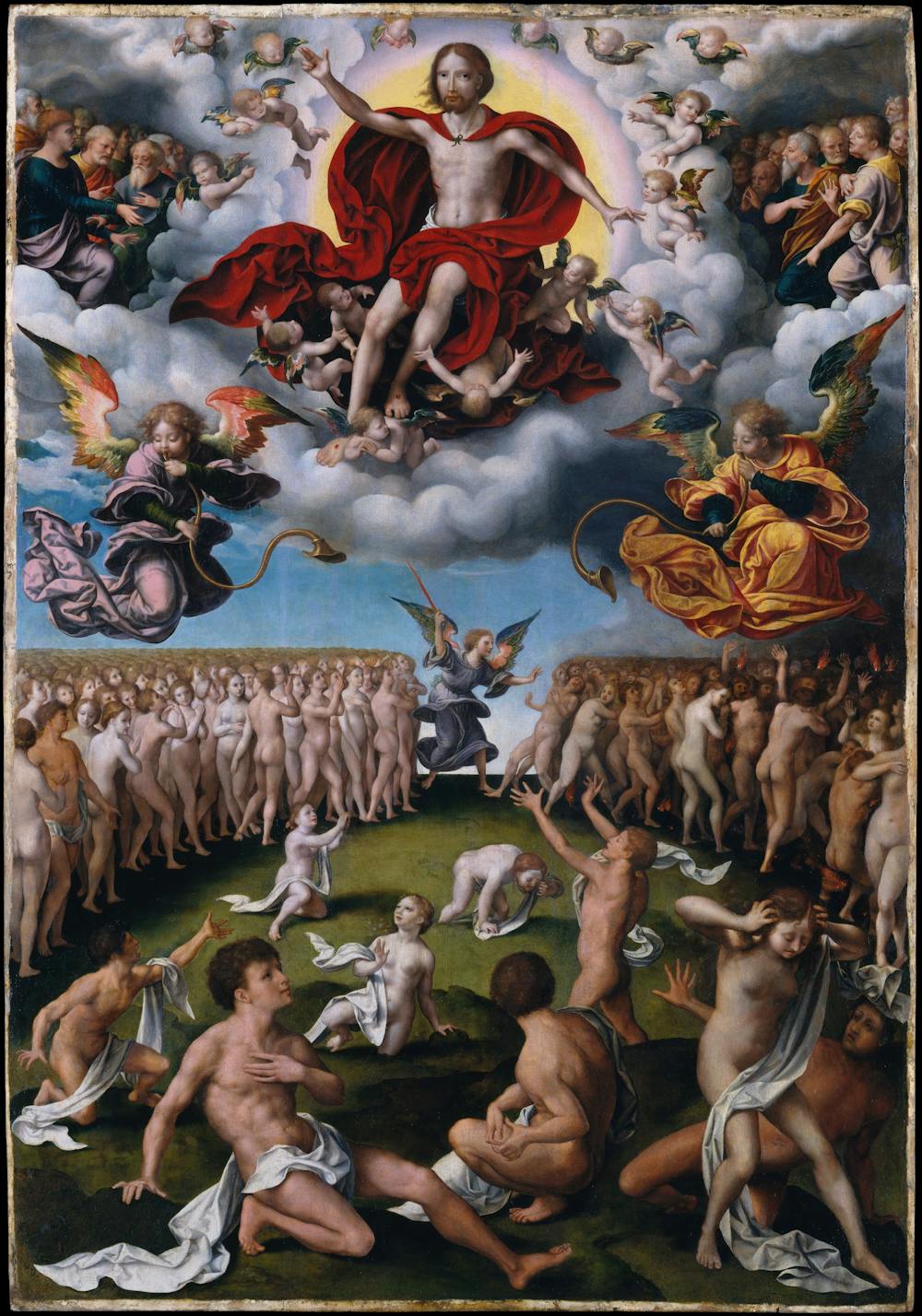 The Last Judgment – Joos van Cleve (c.1540)
Public domain
The only argument Gabriel offers – which he calls a “new argument” – rests on a thought experiment termed the “Day of Judgement”. He asks us to consider what our reaction would be if we were facing God’s judgement and God commended us for all the bad things we have done and condemned us for the good. We would find this judgement incomprehensible. A god whose judgements had no continuity with our own would not be God, but a “terrible demon”.
This thought experiment does not, of course, assume the actual existence of God, but Gabriel suggests the scenario demonstrates that “moral facts are largely obvious; we can basically recognise, albeit often with some difficulty, what we should do”.
Read more:
English philosophers thought they had sloughed off the dead weight of history, but history suggests otherwise
Populism and identity politics
Gabriel does make some worthwhile and insightful points. Of particular interest is his rejection of identity politics.
Modern social sciences, Gabriel believes, have taught us that notions of what is “normal” and “typical” are “impermissible simplifications of the social reality”. Yet because everyday life runs more smoothly on the basis of established expectations, we take familiar patterns of life as nature itself.
Gabriel maintains there is “no normality that applies to the whole of society”. And yet “society” is invoked by various parties, associations and activists groups to justify courses of action.
This is how Gabriel defines “populism”. Populism is when an assumed normality is associated with “the people”. The problem with populism is that it produces “an imaginary, distorted picture of normality”.
Gabriel does not associate “populism” only with the right. Left-wing attempts to give voice to minorities simply because they are minorities are deemed “equally incoherent”. Both left and right are condemned for engaging in “relativist manoeuvres in the culture war of identities”.
Identity politics, argues Gabriel, establishes patterns between “identities” and the distribution of material and symbolic resources. These patterns are then used to formulate political guidelines.
But this is the wrong way to go, because such “identities” do not really exist. Identity politics stands on the “propagation of stereotypes”. It attributes individual behaviours to identification with particular social groups.
As distortions of reality, stereotypes are unsuitable vehicles for negotiating conflicts. They are also dangerous, as they encourage prejudices against certain groups of people, who are deprived of resources as a result. The near-religious fervour of identity politics, Gabriel suggests, arises from stereotypical social identities becoming metaphysically “charged”.
Moral progress thus aims to dismantle the system of stereotypes. Identity politics must be overcome in the light of universal moral values. While it is good that people resist oppressive discrimination, those struggles should not aim at the preservation of identities. The goal is to overcome such identities, in so far as they dehumanise people.
“No one who fights against unjust oppression,” Gabriel argues, “should have the goal of unjustly oppressing the oppressors.”
The Last Judgment – Joos van Cleve (c.1540)
Public domain
The only argument Gabriel offers – which he calls a “new argument” – rests on a thought experiment termed the “Day of Judgement”. He asks us to consider what our reaction would be if we were facing God’s judgement and God commended us for all the bad things we have done and condemned us for the good. We would find this judgement incomprehensible. A god whose judgements had no continuity with our own would not be God, but a “terrible demon”.
This thought experiment does not, of course, assume the actual existence of God, but Gabriel suggests the scenario demonstrates that “moral facts are largely obvious; we can basically recognise, albeit often with some difficulty, what we should do”.
Read more:
English philosophers thought they had sloughed off the dead weight of history, but history suggests otherwise
Populism and identity politics
Gabriel does make some worthwhile and insightful points. Of particular interest is his rejection of identity politics.
Modern social sciences, Gabriel believes, have taught us that notions of what is “normal” and “typical” are “impermissible simplifications of the social reality”. Yet because everyday life runs more smoothly on the basis of established expectations, we take familiar patterns of life as nature itself.
Gabriel maintains there is “no normality that applies to the whole of society”. And yet “society” is invoked by various parties, associations and activists groups to justify courses of action.
This is how Gabriel defines “populism”. Populism is when an assumed normality is associated with “the people”. The problem with populism is that it produces “an imaginary, distorted picture of normality”.
Gabriel does not associate “populism” only with the right. Left-wing attempts to give voice to minorities simply because they are minorities are deemed “equally incoherent”. Both left and right are condemned for engaging in “relativist manoeuvres in the culture war of identities”.
Identity politics, argues Gabriel, establishes patterns between “identities” and the distribution of material and symbolic resources. These patterns are then used to formulate political guidelines.
But this is the wrong way to go, because such “identities” do not really exist. Identity politics stands on the “propagation of stereotypes”. It attributes individual behaviours to identification with particular social groups.
As distortions of reality, stereotypes are unsuitable vehicles for negotiating conflicts. They are also dangerous, as they encourage prejudices against certain groups of people, who are deprived of resources as a result. The near-religious fervour of identity politics, Gabriel suggests, arises from stereotypical social identities becoming metaphysically “charged”.
Moral progress thus aims to dismantle the system of stereotypes. Identity politics must be overcome in the light of universal moral values. While it is good that people resist oppressive discrimination, those struggles should not aim at the preservation of identities. The goal is to overcome such identities, in so far as they dehumanise people.
“No one who fights against unjust oppression,” Gabriel argues, “should have the goal of unjustly oppressing the oppressors.”
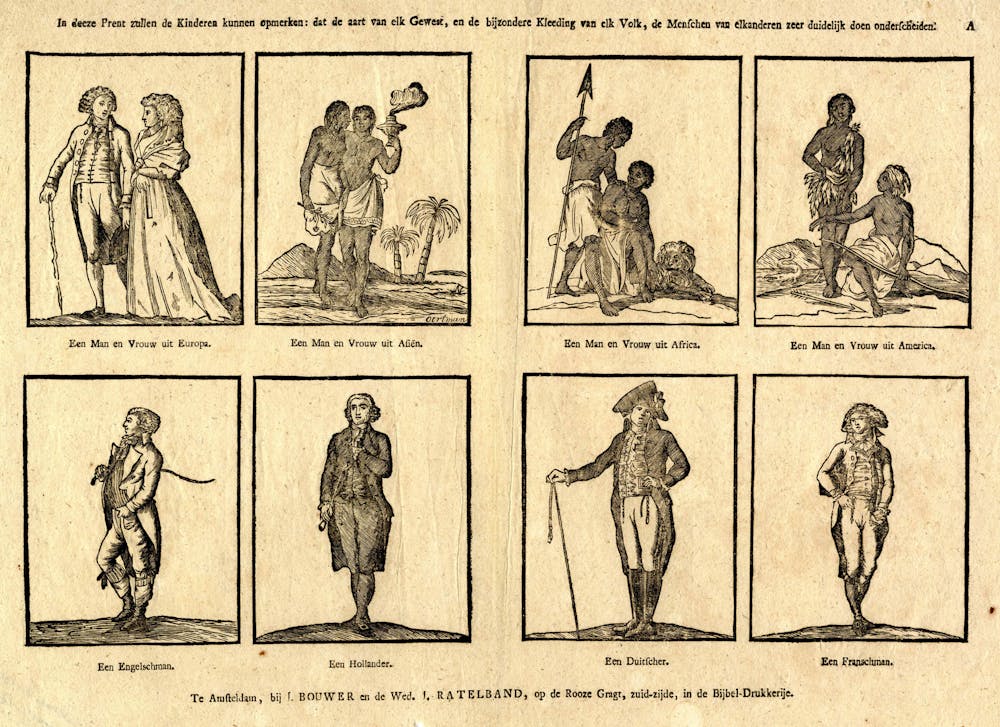 According to philosopher Marcus Gabriel, we must dismantle stereotypes. Image: an 18th-century Dutch engraving of the peoples of the world.
Wikimedia Commons.
Difference politics
Against identity politics, Gabriel advocates “difference politics”. This recognises “that every person is the other (of another)”. It proposes that being different is a symmetrical relationship. Difference politics is not simply a matter of tolerating diverse identities; it requires us to understand difference as a feature of our common humanity.
But recognising difference is only a necessary first step towards tolerance and leniency. It remains insufficient because it retains the idea of identities.
This is where Gabriel’s position runs into practical difficulties.
Gabriel argues that if race has no biological basis, which it doesn’t, then it cannot be grounds for assigning special rights. The goal of moral progress is to achieve “colour-blindness”. Thus groups discriminated against in the past on the basis of some non-existent “race” are not morally entitled to perpetuate racism to balance the past damage.
While there is a role in society for commemorative cultures, we should not “turn racist nonsense into cultural stereotypes and perpetuate these under the banner of de facto non-existent cultures”. According to Gabriel, we all need to train ourselves through moral reflection to become aware of our own stereotypes and try to prevent them affecting our actions.
But while race does not exist, racism does. There is a “lived experience” of discrimination undergone by some groups. It is not clear how Gabriel’s argument might help us negotiate the practical political issues and entrenched material disadvantages that are the result of this historical legacy.
Similarly, on the economic front, Gabriel does not reject capitalism per se, although he does deem a “social market economy” superior to “morally reprehensible” US-style neoliberalism, in which the extreme wealth of the few is not used by the state to free others “from poverty, hardship and despair”.
The goal, he argues, should be to develop a system of just and sustainable distribution.
Yet Gabriel does not agree that a disadvantaged majority is entitled to set up systems that disadvantage a wealthier minority. He asserts it is wrong to attack elites if you aim to be a universalist. It would be contradictory for a universalist to attack them, he asserts, because the attackers would in fact be advocating the “statistical pseudo-universalism” of their own group identity.
Read more:
Friday essay: could a reinterpreted Marxism have solutions to our unprecedented environmental crisis?
Spirit
What, then, is Gabriel’s universalism based on?
Biology and evolutionary psychology show humans are adaptable animals sharing a “survival form”. A baby of one ethnicity raised in a culture of another ethnicity will automatically learn the language and culture of their social context. This is taken to falsify racial stereotypes.
But humans are not only animals, according to Gabriel. What separates humans from other animals, including sentient ones, is “spirit”. For Gabriel, this amounts to an ability to exercise a kind of self-reflective free agency, wherever we happen to be situated geographically, historically, culturally and socially.
Our individual self-perceptions are connected to our “existential identity”. Certain things are “sacred” to us as individuals. We have an “existential, inalienable need for the meaning of life”.
These factors comprise what Gabriel calls an “anthropological constant”. What unites humans is that we are by nature self-definers. Different groups of people thus have far more in common than identity politics would suggest.
Read more:
What Socrates' 'know nothing' wisdom can teach a polarized America
According to philosopher Marcus Gabriel, we must dismantle stereotypes. Image: an 18th-century Dutch engraving of the peoples of the world.
Wikimedia Commons.
Difference politics
Against identity politics, Gabriel advocates “difference politics”. This recognises “that every person is the other (of another)”. It proposes that being different is a symmetrical relationship. Difference politics is not simply a matter of tolerating diverse identities; it requires us to understand difference as a feature of our common humanity.
But recognising difference is only a necessary first step towards tolerance and leniency. It remains insufficient because it retains the idea of identities.
This is where Gabriel’s position runs into practical difficulties.
Gabriel argues that if race has no biological basis, which it doesn’t, then it cannot be grounds for assigning special rights. The goal of moral progress is to achieve “colour-blindness”. Thus groups discriminated against in the past on the basis of some non-existent “race” are not morally entitled to perpetuate racism to balance the past damage.
While there is a role in society for commemorative cultures, we should not “turn racist nonsense into cultural stereotypes and perpetuate these under the banner of de facto non-existent cultures”. According to Gabriel, we all need to train ourselves through moral reflection to become aware of our own stereotypes and try to prevent them affecting our actions.
But while race does not exist, racism does. There is a “lived experience” of discrimination undergone by some groups. It is not clear how Gabriel’s argument might help us negotiate the practical political issues and entrenched material disadvantages that are the result of this historical legacy.
Similarly, on the economic front, Gabriel does not reject capitalism per se, although he does deem a “social market economy” superior to “morally reprehensible” US-style neoliberalism, in which the extreme wealth of the few is not used by the state to free others “from poverty, hardship and despair”.
The goal, he argues, should be to develop a system of just and sustainable distribution.
Yet Gabriel does not agree that a disadvantaged majority is entitled to set up systems that disadvantage a wealthier minority. He asserts it is wrong to attack elites if you aim to be a universalist. It would be contradictory for a universalist to attack them, he asserts, because the attackers would in fact be advocating the “statistical pseudo-universalism” of their own group identity.
Read more:
Friday essay: could a reinterpreted Marxism have solutions to our unprecedented environmental crisis?
Spirit
What, then, is Gabriel’s universalism based on?
Biology and evolutionary psychology show humans are adaptable animals sharing a “survival form”. A baby of one ethnicity raised in a culture of another ethnicity will automatically learn the language and culture of their social context. This is taken to falsify racial stereotypes.
But humans are not only animals, according to Gabriel. What separates humans from other animals, including sentient ones, is “spirit”. For Gabriel, this amounts to an ability to exercise a kind of self-reflective free agency, wherever we happen to be situated geographically, historically, culturally and socially.
Our individual self-perceptions are connected to our “existential identity”. Certain things are “sacred” to us as individuals. We have an “existential, inalienable need for the meaning of life”.
These factors comprise what Gabriel calls an “anthropological constant”. What unites humans is that we are by nature self-definers. Different groups of people thus have far more in common than identity politics would suggest.
Read more:
What Socrates' 'know nothing' wisdom can teach a polarized America
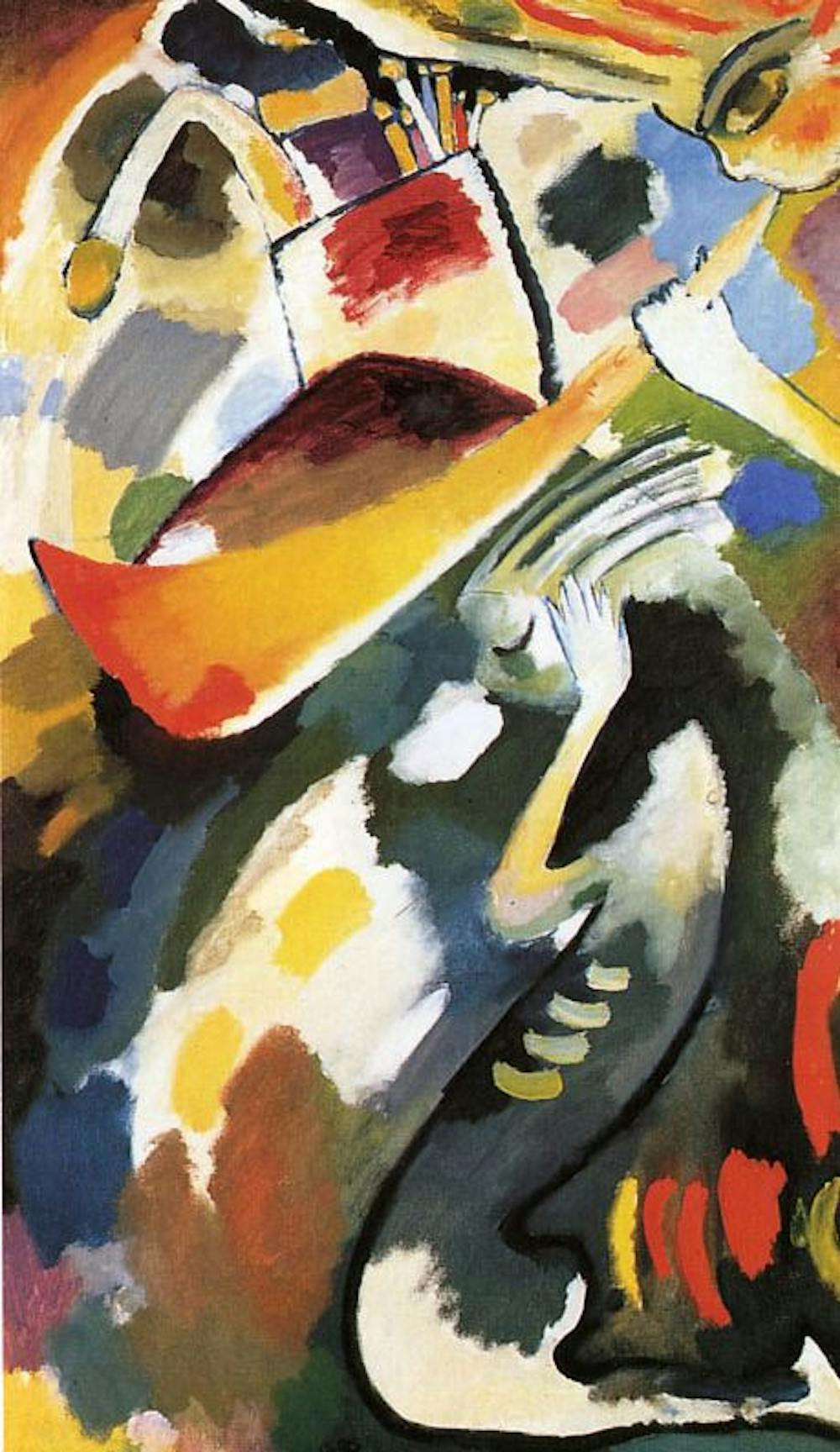 Last Judgment – Wassily Kandinsky (1910)
Public domain
Darkening of spirit
The internet, Gabriel believes, has massively contributed to “darkening our spirit”. Moral progress is threatened by “digital distortions”, which undermine our knowledge of truth, facts, knowledge and ethics. Internet dependence can lead us to treat self-evident moral truths, such as respect for others, as null and void.
The response to the coronavirus pandemic crisis, however, represents moral progress. The vast majority of people accepted lockdowns for moral reasons: they believed lockdowns would protect the vulnerable and support hospital systems.
The pandemic also made the structures of society more visible. It brought home the importance of interpersonal contact and exposed the underfunding of health providers.
Gabriel believes post-pandemic progress will require societies not to revert to “compulsive consumption and the associated burnout capitalism”. He criticises neoliberalism for assuming that progress can be achieved by leaving as many decisions as possible to the market. The problems associated with free-market economics – massive social and economic inequalities, exploitative global supply chains, ecological damage – demonstrate the need for “a reordering of the social market economy”.
A humane market economy is deemed possible, on the grounds that people are capable of making decisions guided by mutuality and fairness.
But a moral form of economic management can only succeed, according to Gabriel, if it is guided by ethical principles that take into account insights from science, art, religion and life experiences. Reordering must be done in the name of “sustainability”. The goal is to advance a good and sustainable life, without declining prosperity. Prosperity itself must be redefined so it no longer amounts to the accumulation of money and goods.
The coronavirus responses showed that democracies are, in fact, capable of making economically difficult decisions on moral grounds. Post-pandemic, the task is for nation states to jointly develop universal values and forms of cooperation not simply based on market logic.
Gabriel ends his book with his vision of a new enlightenment. He appeals to ordinary people to bring about change, first in their own behaviour, then by voting with their feet. “We must all vaccinate ourselves together,” he argues, “against the spiritual poison that divides us into national cultures, races, age groups and classes and incites competition between us.”
On this point, his passion is unmistakable:
We must recognize that the infection chains of global capitalism, which destroys our nature and causes moral stupidity in the citizens of the nation states, turning us into full-time tourists and consumers, will ultimately kill far more people than all viruses combined.
Authors: Denise Gamble, Visiting Research Fellow, School of Humanities, University of Adelaide
Last Judgment – Wassily Kandinsky (1910)
Public domain
Darkening of spirit
The internet, Gabriel believes, has massively contributed to “darkening our spirit”. Moral progress is threatened by “digital distortions”, which undermine our knowledge of truth, facts, knowledge and ethics. Internet dependence can lead us to treat self-evident moral truths, such as respect for others, as null and void.
The response to the coronavirus pandemic crisis, however, represents moral progress. The vast majority of people accepted lockdowns for moral reasons: they believed lockdowns would protect the vulnerable and support hospital systems.
The pandemic also made the structures of society more visible. It brought home the importance of interpersonal contact and exposed the underfunding of health providers.
Gabriel believes post-pandemic progress will require societies not to revert to “compulsive consumption and the associated burnout capitalism”. He criticises neoliberalism for assuming that progress can be achieved by leaving as many decisions as possible to the market. The problems associated with free-market economics – massive social and economic inequalities, exploitative global supply chains, ecological damage – demonstrate the need for “a reordering of the social market economy”.
A humane market economy is deemed possible, on the grounds that people are capable of making decisions guided by mutuality and fairness.
But a moral form of economic management can only succeed, according to Gabriel, if it is guided by ethical principles that take into account insights from science, art, religion and life experiences. Reordering must be done in the name of “sustainability”. The goal is to advance a good and sustainable life, without declining prosperity. Prosperity itself must be redefined so it no longer amounts to the accumulation of money and goods.
The coronavirus responses showed that democracies are, in fact, capable of making economically difficult decisions on moral grounds. Post-pandemic, the task is for nation states to jointly develop universal values and forms of cooperation not simply based on market logic.
Gabriel ends his book with his vision of a new enlightenment. He appeals to ordinary people to bring about change, first in their own behaviour, then by voting with their feet. “We must all vaccinate ourselves together,” he argues, “against the spiritual poison that divides us into national cultures, races, age groups and classes and incites competition between us.”
On this point, his passion is unmistakable:
We must recognize that the infection chains of global capitalism, which destroys our nature and causes moral stupidity in the citizens of the nation states, turning us into full-time tourists and consumers, will ultimately kill far more people than all viruses combined.
Authors: Denise Gamble, Visiting Research Fellow, School of Humanities, University of Adelaide 
















