

A battlefield for ants? New study on ant warfare shows we could manipulate their fights
- Written by Samuel Lymbery, Postdoctoral Fellow in Biosecurity, Murdoch University
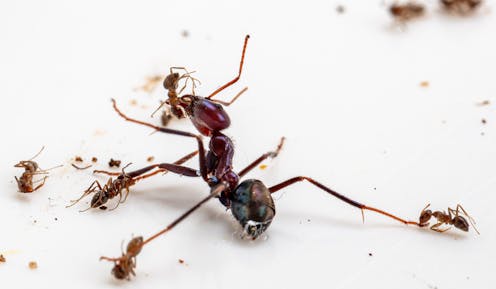
Humans are not the only animals that go to war. Ants do so too, and on a similarly catastrophic scale.
Battles play out daily – in human conflicts, among animals in nature, and across the virtual worlds of video games. How these battles progress depends on the combatants involved and what their battlefields are like.
In a new study published in PNAS today, we used mathematical models on video game simulations to test how battlefield dynamics change warfare outcomes. We then confirmed these concepts in the real world – using ant battles.
The mathematics of a battle
Despite the horror of war, it occupies a prominent place in public imagination. In the early 1900s, English engineer Frederick William Lanchester developed a mathematical model that described the outcome of battles as dependent on the individual strength of each soldier in opposing armies, and on the size of each army.
To this day, Lanchester’s laws remain valuable tools for evaluating battles. Investing in a few strong soldiers should be more effective when battles resemble a series of one-on-one duels. On the other hand, investing in large armies should be more effective when they can surround their enemies and concentrate their attacks.
Later research by evolutionary biologists Nigel Franks and Lucas Partridge revealed it’s not just the soldiers. The complexity of the battlefield itself can also tip the balance in favour of one strategy over another.
When fighting in tunnels, alleyways, or difficult terrain, it’s harder for large armies to surround their opponents, so small forces of strong or savvy soldiers can succeed. Such tactics are the basis for the story of Spartans holding off hundreds of thousands of Persian soldiers at the Battle of Thermopylae in 480 BCE.
Age of Empires II versus ants
In our study, we first used the video game Age of Empires II to assess the importance of battlefield complexity.
This game allows players to arrange different soldier types, build maps and fight against computer-driven enemies. In featureless battlefields, small armies of strong infantry units (Teutonic Knights) could defeat up to 50 weaker units (Two-Handed Swordsmen), but no more.
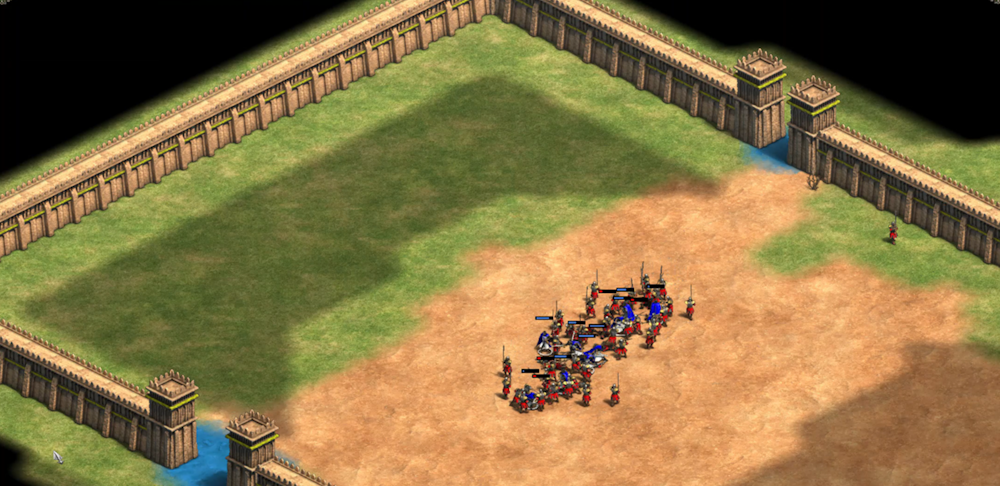
However, in complex battlefields, nine Knights could slay up to 70 Swordsmen. We found that video game wars, even though not explicitly programmed to do so, clearly followed Lanchester’s laws. But how relevant are these laws to real-world battles?
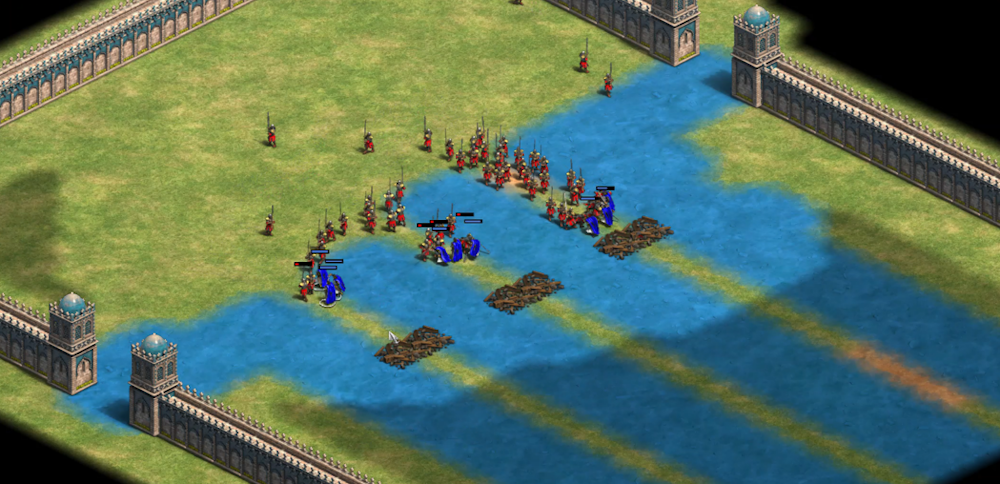 In a complex battlefield, the same army of Swordsmen are unable to surround the Knights, and are instead funnelled between barriers of water. Now, the Knights have fewer Swordsmen to face at any one time.
Age of Empires II
In a complex battlefield, the same army of Swordsmen are unable to surround the Knights, and are instead funnelled between barriers of water. Now, the Knights have fewer Swordsmen to face at any one time.
Age of Empires II
Most animals do not engage in warfare on the same scale as humans. This is because there’s no evolutionary incentive in risking their lives for a cause in which they don’t necessarily have a direct stake.
Social insects such as ants are an exception, because through warfare, the evolutionary future of the sterile worker ants who do the fighting is invested in the greater good of the colony.
Testing Lanchester’s laws required two ant species that clearly differed in their fighting prowess. Our first combatant was the Australian meat ant, Iridomyrmex purpureus. These large and beautiful ants, with their conspicuous gravelly nests, are familiar to many people in regional Australia as they are dominant in undisturbed or remnant bushland habitats.
As their enemies, we selected the notorious Argentine ant, Linepithema humile. These aggressive invasive ants are comparatively tiny but live in extremely large, hyper-cooperative colonies.
Because of the size difference, meat ants always defeat Argentine ants in one-on-one duels. We formed small armies of 20 meat ants, and opposed them in the lab to increasingly large armies of up to 200 Argentine ants.
These battles took place either in simple arenas (featureless plastic containers) or complex arenas (the same containers with narrow wooden strips glued to the floor).
As predicted by Lanchester’s laws and by our video gaming, fewer large meat ants died in battle in complex arenas compared to simple ones.
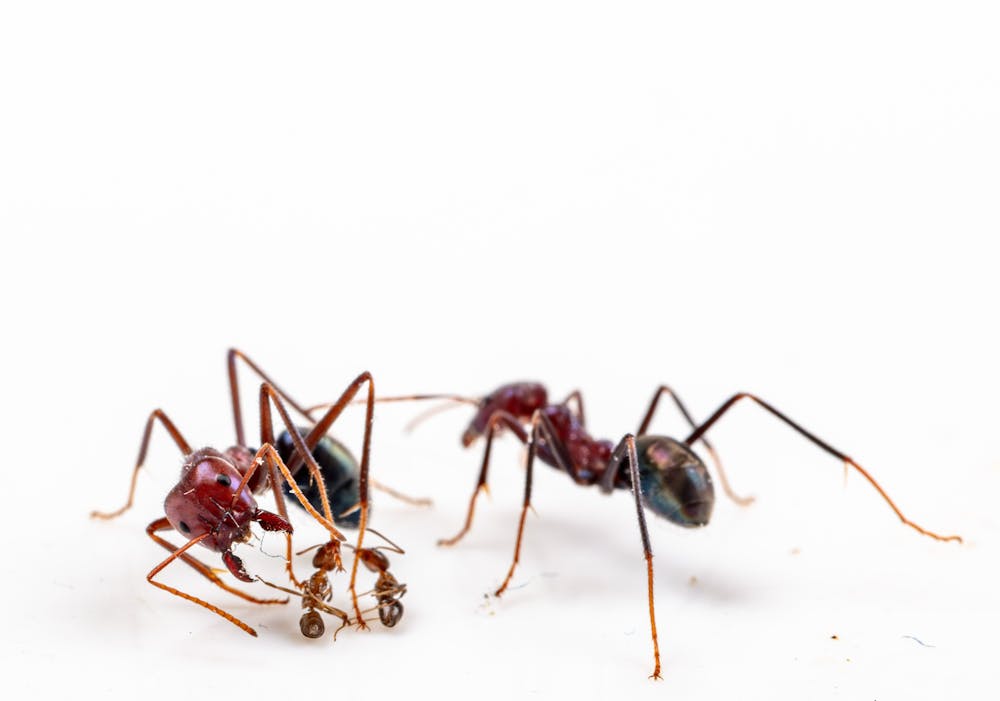 A meat ant grapples with two smaller Argentine ant adversaries, while a fellow meat ant watches on.
Bruce Webber, CC BY-SA
A meat ant grapples with two smaller Argentine ant adversaries, while a fellow meat ant watches on.
Bruce Webber, CC BY-SA
Understanding ant invasions
Experiments like this can inform us about the dynamics between native and non-native invasive ants. Non-native invasive ants are some of the worst pests on the planet, costing the global economy tens of billions of dollars per year. Ecosystem managers are keenly interested in new ways to manipulate the competitive success of these invaders.
One of the unifying features of non-native invasive ants is that, like our Argentine ants, they are generally individually smaller than non-invasive species in the areas they invade, while living in extremely large colonies. It has also been observed that non-native invasives are particularly dominant in disturbed environments.
While there are many possible reasons for this, disturbed environments are often simplified at ground level, with the removal of undergrowth and natural debris creating open battlefields.
The fact that small but numerous non-native invasive ants are more successful against their large native competitors in simplified environments makes sense, in light of our experimental study of ant warfare.
It also suggests that adding ground-level complexity, such as natural debris, may tip the balance in favour of larger native species. Just like for humans (and in computer games), the outcome of ant wars depends on the nature of the battlefield.
Read more: How to know if we’re winning the war on Australia’s fire ant invasion, and what to do if we aren't
Authors: Samuel Lymbery, Postdoctoral Fellow in Biosecurity, Murdoch University

















