

how teachers are navigating climate change in the classroom
- Written by Kim Beasy, Lecturer in Curriculum and Pedagogy, University of Tasmania
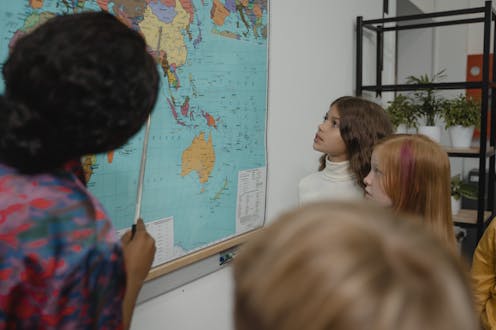
Climate change education is increasingly seen as an essential part of schooling.
The main international test of 15-year-olds’ progress (which Australia participates in) has just announced the next round of testing will include environmental knowledge alongside English, maths and science literacy.
Australia’s national curriculum (updated last year under the Morrison government) barely mentions climate change. But as a signatory to the United Nations Sustainable Development Goals and Paris Agreement, we have committed to develop climate change education policies.
Regardless of what policies or curricula say, our climate is changing. As scientists keep reminding us, urgent action is required.
In our new research, we interviewed nine primary and high school teachers about how they include climate change in their teaching.
We found teachers are becoming the bearers of bad news in the classroom as young people learn about the climate crisis, and they need better training and more support.
Read more: How well does the new Australian Curriculum prepare young people for climate change?
‘I wouldn’t say I’m a scientist’
Climate change is a complex social, political, economic and environmental problem. But it is often presented as an issue that requires scientific interpretation and technological solutions.
This means teachers of non-science subjects may feel out of their depth trying to teach it. A number of teachers expressed a lack of confidence speaking in depth about climate change. As one told us:
I am definitely not weak, but I wouldn’t say I’m like a scientist.
But teachers who felt confident with the scientific “facts” of climate change, often felt less equipped to respond to student enquiries about social and emotional dimensions of climate change. This included feelings of sadness or feeling unsupported by older generations.
‘What can the world do?’
Teachers emphasised the importance of moving between the local and global, and individual and societal scales of climate problems and solutions. They described this as a way to support constructive conversations and positive feelings.
As one teacher told us:
Instead of the children feeling like they have the weight of what can they do as individuals, which we’ve discussed […] we’re going to talk about ‘what can the world do?’ As a global citizen, what can everybody do? And working together as a bigger part of the whole, so they’re not feeling that weight on their own shoulders as much, but more what the world is doing [through] solutions-based technology.
Teachers spoke of the importance of pre-designed learning units, the role of community experts and videos and podcasts to engage students and support teachers. As one teacher explained the value of a guest speaker:
I think the kids after a while get a little bit, ‘You’re [a teacher] just a piece of the furniture,’ and they don’t always switch on and listen to you.
‘I try and speak hopefully’
Teachers also talked about the challenge of finding materials that present the “right amount of information that will prompt action as opposed to feeling sad”.
Teachers said they had to be very tuned in to the mood of the class.
If they’re starting to ask questions that potentially sound worried or concerned, that’s usually an indicator that you might need to soften what you’ve delivered.
Teachers in our study were doing their very best to maintain a hopeful and positive message for students, but this often conflicted with their own feelings. As one teacher told us:
Personally, what I have to do is to try and make sure that I speak hopefully, even though it is not hopeful in my opinion […] I try and use language that will encourage students to feel empowered and want to make a change and fight for action […] as opposed to just knowing for the sake of knowing and then feeling sad about it.
Another teacher spoke of the need to be sensitive when talking about looming environmental disasters.
I tend to be very gentle and very careful or I’m very focused on hope.
What is needed?
Teachers need professional development to support their understandings of different aspects of climate change, from the scientific to the economic and social.
Uncertainty over how to talk to children about climate change in a way that is honest but remains hopeful rather than overwhelming is an ongoing challenge for teachers and parents alike.
Students need opportunities to talk about the future in ways that empower them to ask questions and get involved. This can be done via programs such as Curious Climate Schools a free resource, which we have developed for schools in Tasmania.
Specific professional learning is also needed to ensure teachers are able to support themselves and their students in grappling with the emotions that can surface when learning about climate change.
In schools, we need teaching about climate change to be integrated across science and humanities subjects. Climate change needs to be better represented across the curriculum so that teachers have more opportunities to include it in their very busy timetables. Finally, we need innovation from policy makers and school leadership so crucial climate change education is consistently available for all students.
Dr Gabi Mocatta, Dr Rachel Kelly, Charlotte Jones and Deniz Yildiz contributed to the research on which this article is based.
Read more: How should we teach climate change in schools? It starts with 'turbo charging' teacher education
Authors: Kim Beasy, Lecturer in Curriculum and Pedagogy, University of Tasmania

















