

from ancient pollinators to whistling wonders
- Written by: Mark Stevens, Adjunct Associate Professor, University of Adelaide
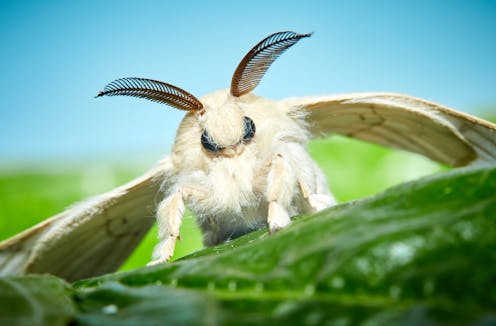
When you think of moths, do you see holes in your clothes, pests in the pantry, or pesky insects drawn to night lights spoiling your social BBQ? Or worse, do you have an irrational fear of moths? (That’s called mottephobia).
Would it surprise you to learn moths are not the poor cousin of butterflies? They’re incredibly diverse and deserve a second chance.
There are about 160,000 species of moths known to science. Compare that to 17,500 species of butterflies.
Moths vary enormously in their size, what they like to eat, how they reproduce and how they live their lives.
Read more: Newly discovered moth is enigmatic evolutionary wonder
Life arising from biological soup
Remember the story of The Very Hungry Caterpillar? The life cycle begins with a little egg that hatches into a caterpillar, eats its way through a rainbow of food and then builds a cocoon for a complete transformation into a beautiful butterfly.
This is complete metamorphosis, where the structure of the caterpillar dissolves into a biological soup and then into an adult that looks nothing like the original.

 Pale triangle butterfly metamorphosis sequence, from cocoon to adult butterfly.
James Dorey, Author provided (no reuse)
Are butterflies just ‘flamboyant’ moths?
There’s a long-standing argument among scientists over whether butterflies are really colourful, flashy moths.
A few defining features separate moths from butterflies. Moths have larger “scales”, giving them more stocky, furry-looking bodies. Moths also have eyes suited for night vision and exhibit wing coupling, where the fore- and hind-wings join as a single wing for flight. Then there’s the colour palette.
But these features actually don’t separate all moths from butterflies, just night-flyers (nocturnal) from day-flyers.
Butterflies should perhaps be considered as a group of day-flying “flamboyant” moths. The opposite is also true, we have moths that fly during the day, just a “wannabee” butterfly perhaps.
There are 125 families of moths and just six families of butterflies. The newest moth family was discovered in 2015.
The Hedylidae family is commonly referred to as the moth-butterflies. They are dull coloured, fly at night, have bristly antenna and wing coupling (in most species). These are definitely moth features but their genetic code suggests they are most closely related to butterflies.
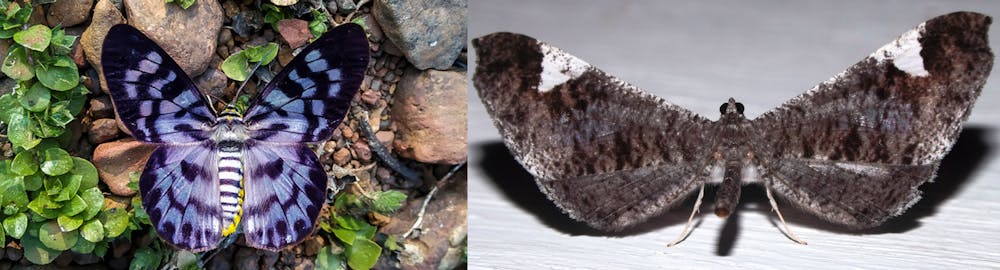 Left, the false tiger moth is a beautiful day-flying moth. Right, an American dull looking night-flying butterfly from the genus Macrosoma (family Hedylidae).
Nikhil Guhagarkar and Ian Peter Morton, Shutterstock.
Moths helped flowering plants evolve
One family still living today, the Micropteridae, has been pollinating flowers for millions of years. It’s likely to be one of only a few insects that pollinated the first flowers. This most ancient moth has been found preserved in amber from 125 million years ago. That makes moths twice as old as butterflies.
As adults, these moths have chewing mouthparts. Today they use these jaws to eat flower pollen. This suggests these ancient moths contributed to the success of the first flowering plants.
Most moths and butterflies have sucking mouthparts for drinking nectar. They have a tube-like proboscis that curls up to sit just under their head. This can be uncurled to probe flowers.
This means moths are not only the night-shift pollinator, they’re also more efficient than the daytime bee pollinators we hear most about.
 Pale brown hawk moth with its proboscis fully extended, feeding on a flower.
James Dorey, Author provided (no reuse)
The big and small of it
The smaller moths are commonly grouped as “microlepidoptera”, but not necessarily related to each other. The smallest has a wingspan of only about 2.6mm.
The largest moth is the Hercules moth from northern Queensland in Australia with a wingspan of 361mm.
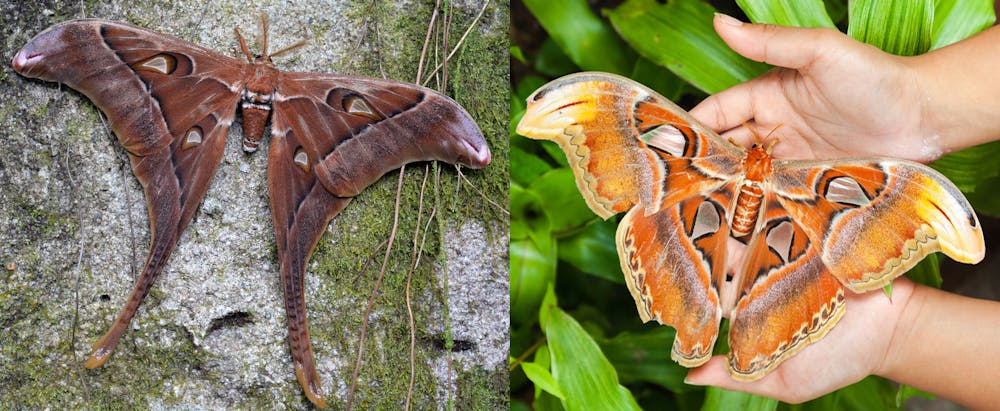 The Hercules moth (Coscinocera hercules), endemic to New Guinea and northern Australia, is claimed to be the world’s largest moth (left), but the atlas moth (genus attacus) also vying for that title (right).
ChameleonsEye and Cocos.Bounty, Shutterstock
The family Hepialidae, commonly known in Australia as rain, ghost, splendid or swift moths, are among the heaviest of all moths with a wingspan of 250mm and weigh 35 grams.
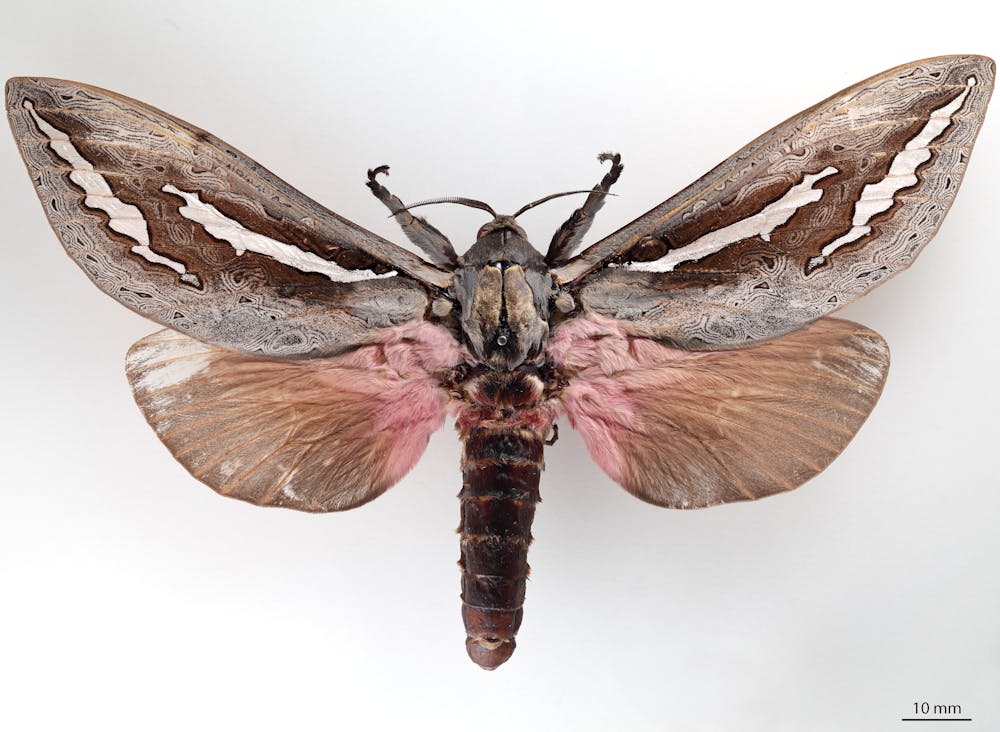 Among heaviest moths, the species Abantiades hydrographus is endemic to Western Australia and a member of the hepialidae family.
Michael Moore
They are considered an old group as they have no proboscis (mouth parts).
The moths emerge in huge numbers and mate almost immediately after hatching. The females then fly through the woodland dropping eggs randomly as they go.
One common species is thought to hold the world record for the number of eggs carried at around 44,000.
Although most species of Hepialidae are cryptically camouflaged, most adult moths do not live longer than a single day as they are a great food source for bats, birds and other animals. The caterpillar growing phase may take many years in the ground and yet the adults only live for around a single day.
Some moths can hear
That’s right, some moths can hear sound. But moth “ears” (tympanic organs) are not on their heads. Some groups have only two such organs but others have four, located at the bases of their legs on the body (thorax) of the animal.
These organs can help the moths detect bats, who hunt moths at night, so it is no surprise that three of the largest moths all have tympanic organs. One study also suggests the exaggerated hindwings of silk moths evolved to mess with bat sonar.
Although most moths use chemicals and pheromones to attract a mate, whistling moths use sound. The males fly around (during the day) and are thought, as they fly, to rub a scaleless ribbed area of the wing against a body protrusion making what sounds like a high pitched whistle. The females hear this noise and fly towards it.
There may be up to a million moth species on the planet and many moth species are yet to be discovered.
So next time you’re out for a walk, or spending time in your garden, day or night, look out for moths. They’re truly remarkable creatures. And perhaps you could discover a new species?
And regarding this recent tweet about a “frothy moth”: this moth belongs to the genus ‘Amerila’ (in the family Erebidae, subfamily Arctiinae) and could be ‘Amerila crokeri’ . They are known to produce the froth as a defence mechanism.
Acknowledgement: This article was coauthored with Michael Moore, Honorary Researcher at the South Australian Museum.
Authors: Mark Stevens, Adjunct Associate Professor, University of Adelaide


















