

Nearly 500,000 Australian kids go to after school care – it needs to be more than a babysitting service
- Written by Alyssa Clare Milton, Senior Research Fellow, University of Sydney
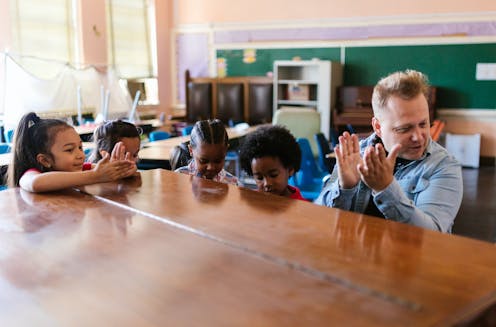
Outside school hours care – also known as “school-aged care”, “OOSH” or “afters” – is booming.
As of 2020, it was the fastest-growing childcare sector in Australia. As of 2022, it catered to 486,310 primary school children.
Enrolments have surged by 111% over the past 20 years, as more mothers have worked as they raise their children.
However, there is a lack of consistency in quality. About 14% of services fall short of the national quality standards for these services, and only 11% are exceeding them.
Our new research shows how designing activities with children and their communities can help improve the quality of these services.
What is outside school hours care?
School hours tend to be between about 8.45am and 3.15pm, meaning many families need extra care for their children. For many, outside school hours care is an essential service.
Services run before school, after school and during school holidays. Often they are located on school grounds.
There are nearly 5,000 such services around Australia, each with individual working hours and fees. The average cost as of 2021 was A$7.85 per hour, and many families qualify for government childcare subsidies to reduce this rate.
Children are usually given food, and choose between planned and spontaneous activities such as games, crafts, reading and self-directed play. But it can also involve extracurricular activities in STEM (such as work with LEGO or computing), dance, drama, music and sport.
Read more: As fees keep climbing, this is why competition isn’t enough to deliver cheaper childcare
Why quality is important
Services are usually delivered by not-for-profit organisations and private companies, but can also be run by parents via a school’s P&C committee.
All providers must be approved by the Australian Children’s Education and Care Quality Authority. High-quality services see staff reflecting on how to improve what they do and having meaningful engagement with families and the wider community.
Since students can potentially spend more than 10,000 hours in outside school hours care throughout their primary years, this is a big opportunity to support Australian children.
A 2021 Griffith University report for the New South Wales Department of Education emphasised how these services should be “more than just convenient care”. They have potential to be a significant part of children’s education and development beyond formal schooling.
Our program
Since 2016, the University of Sydney’s Brain and Mind Centre and not-for-profit service provider Uniting NSW/ACT have been researching how children’s wellbeing can be supported through outside school hours care.
Together with children and their communities, we have co-designed the “Connect Promote and Protect Program”. This encourages children, their educators and volunteers to create activities that broaden their experiences, promote social connections, and enhance their wellbeing.
Involving children in this way is not a new idea. The United Nations has long viewed children as competent humans with the right to contribute to decisions that affect their lives. The national framework for school-age care also notes the importance of listening to children.
In our program, children are given opportunities to generate ideas via voting, surveys, small group workshops and conversations. Then they decide on an activity and can help run it.
The activities have ranged from a robotics program, to knitting beanies for people experiencing homelessness, drama sessions to build confidence in acting and public speaking, and lawn bowls at a local club to improve coordination skills and community connections.
Services are provided with training and resources, and typically run the program one day a week for two terms. It is designed so there are no extra costs for families.
Read more: Fewer than 1 in 5 students who are behind in Year 3 catch up and stay caught up
Our new study
Our new study evaluated our program in five services in public and private primary schools across Sydney.
For example, one service chose a “woodwork cafe” to develop woodworking skills. Trained volunteers from the local community supported children in building their own chicken coop at the after-school site.
A volunteer brought a chicken for an initial visit so children could interact with and learn about chickens before baby chickens arrived. Another family provided two baby chickens and an incubator for hatchlings.
The process was documented with updates and photos, enhancing children’s and their family’s engagement and excitement. This also included information on how pets can promote wellbeing, and links to community resources about children’s wellbeing.
As one child told us:
when you do this activity everyone is running to do it.
An increase in kindness
Four services in our study collected quantitative data. After the program – which required group work and cooperation – we found children across these four services showed an increase in kindness, and there was a reduction in problems such as bullying.
This was measured by the standard “strengths and difficulties questionnaire” used by psychologists and educators. For example, at the start of the program, 55.6% of children had the highest possible score for prosocial behaviours (doing something to benefit someone else), which increased to 71.6% after the program.
Educators told us about children working together and helping each other. One parent observed children “being patient to hear each one out as well”. Another educator explained how they saw children taking ownership and “really speaking up”. They added:
We’ve really seen that change in dynamic of that communication now [of children saying] ‘Hey, this is my [service]. This is the program that I want to do’.
The also spoke of seeing better engagement from children who did not usually participate in activities. One service manager said high-quality after-school programs could “capture” children who were facing issues with regular school:
we can create a space in an [after-school service] that supports […] and engages those children. It gives them a sense of belonging [so] they know that they matter.
Educator benefits
Educators also reported a greater sense of community and wellbeing at work. This is important, as staff satisfaction and wellbeing is a crucial element of a high-quality program. We know staff turnover and churn in the sector is high.
Educators in our study spoke of how the process of co-design with children helped them develop new ways of engaging with children. As one educator educator reported:
I really connected in a different way for the first time.
Beyond babysitting
Our research underscores the need to ensure services are more than just a convenience or a place to babysit children while their parents finish work.
Government and policymakers need to invest more heavily in these services, so training and programs can be delivered to promote the wellbeing of children, educators and their wider communities — ultimately enhancing the quality of these essential services.
Authors: Alyssa Clare Milton, Senior Research Fellow, University of Sydney

















