

how seismic surveys can harm marine life
- Written by: Ryan Day, Senior research fellow, University of Tasmania
Woodside Energy this week announced it would start seismic testing for its Scarborough gas project off Australia’s west coast, before reversing the decision in the face of a legal challenge from Traditional Owners.
Seismic testing is highly controversial in marine environments. The federal regulator (the National Offshore Petroleum Safety and Environmental Management Authority) is currently examining a proposal for seismic testing in the Otway Basin in Bass Strait, which conservationists say has attracted more than 30,000 public submissions.
Seismic testing is also mooted as part of the “PEP11” (Petroleum Exploration Permit 11) off the coast of New South Wales, from Manly to Newcastle.
As marine biologists with research expertise in this field, here we give a roundup of the latest evidence on the effects of seismic surveys. It shows there are many potential harms to marine life, and many unanswered questions.
The Australian Marine Conservation Society wants to stop seismic surveys.Read more: Underwater noise is a threat to marine life
What are seismic surveys?
Marine seismic surveys are used to search for oil and gas, places to stash greenhouse gases, and potential locations for wind farms.
The surveys use air guns to generate sound signals. These sound signals are intense (loud, at high decibel levels) and “impulsive” (sharp, like a balloon popping). In the open ocean, sound waves can be detected thousands of kilometres from the source.
The sound can penetrate more than ten kilometres into the earth beneath the seafloor. The way the signals reflect off different layers of the seabed can identify geological structures, including those that contain mineral deposits such as oil and gas. The sound signals bounce back to acoustic receivers (hydrophones) towed behind the survey vessel on cables known as streamers.
During a survey, sound signals are generated every four to ten seconds, 24 hours a day, seven days a week. Surveys can last for weeks or months, and cover thousands of square kilometres of ocean. The proposal to study the Otway Basin, for example, covers 45,000 square km.
Seismic surveys and marine life
The ability to fully examine the effects of seismic surveys in mammals is limited, because invasive methods are not logistically possible or ethically acceptable.
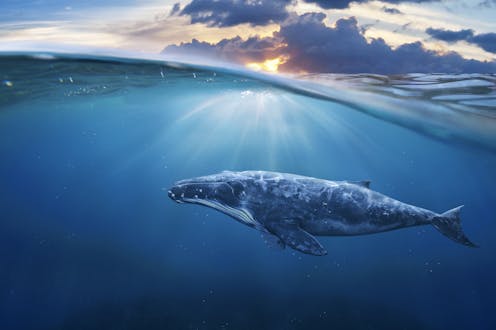
But there is a long history of research on whales and dolphins, given their reliance on sound to communicate, find food and navigate.
Observations of marine mammals show intense sound signals such as those from seismic surveys can affect hearing ability, either temporarily or permanently, depending on the intensity, range and duration of exposure.
Noise pollution can mask communications, causing whales either to sing more loudly or to stop singing altogether, which can affect social structure and interaction. Seismic surveys can also alter the presence and abundance of marine mammal prey.
Offshore Seismic Surveys at Woodside.What about fish?
Fish also show a range of responses to seismic testing. Some fish exhibit physical damage to hearing organs and signs of stress.
Fish behaviour may also change. Some leave regular feeding or breeding areas, which raises concerns over effects to fishing grounds or impacts on important prey species. It’s also uncertain whether the fish will be able to find suitable alternative habitats if they are displaced in the long term.
Others may “habituate” or become accustomed to exposure, raising the risk of more extensive damage by spending more time in the survey area.
Scallops, lobsters and plankton
Despite invertebrates making up around 92% of marine species, the impact of marine noise on these creatures has only recently been studied. This has shown a potential for harm.
In the valuable southern rock lobster fishery, off the coasts of Victoria, South Australia and Tasmania, seismic air gun exposure damaged the sensory organ that provides a sense of gravity and balance, similar to the human inner ear. Affected lobsters also had impaired ability to right themselves when placed upside down, a reflex that underpins important behaviours such as escaping predators.
Scallops showed more severe impacts, with up to four times higher death rates and a range of other sub-lethal effects including altered behaviour, impaired physiology and a disrupted immune system. As this animal already suffers high levels of mortality naturally and due to fishery activity, this extra pressure could be of considerable concern.
Invertebrates also make up a large proportion of the zooplankton community, a broad group of very small animals carried by ocean currents. They are food for a wide range of marine life, from other zooplankton to small fish and whales.
In the first experimental exposure to a seismic air gun, a large proportion of zooplankton died. Overall abundance decreased significantly, at distances up to 1.2km from the air gun.
Confirming this result, another recent study of zooplankton found exposure to seismic air guns 50 metres away resulted in increased mortality immediately after exposure. The plankton continued to die off or suffer impaired development for several days. These effects, particularly in the case of exposure that is repeated over the course of months within a single area, have the potential to severely impact the plankton populations that underpin marine food webs.
Read more: Australian humpback whales are singing less and fighting more. Should we be worried?
Difficulties in predicting impacts
While the handful of available studies shows exposure to seismic surveys can harm animals, our ability to understand or predict what happens in the wild is still very limited.
Part of the problem is conflicting results. For example, in one case, seismic survey exposure had no impact on the types of fish found in an area or their behaviour. And a separate study of scallops found no mortality after seismic exposure. These studies conflict with the results we described earlier, which happens commonly in science and highlights the need for ever more detailed research.
Only a few animal species have so far been investigated, making it hard to tell how other animals might be affected by seismic testing. There are also limitations to the methods of studies that reduce our ability to understand the real-world impacts, such as housing animals in captivity after exposure.
Sound behaves very differently in water than in air. Water is more dense, allowing sound to travel faster, farther and with less of a drop in intensity. Comparisons between the “loudness” of sounds in air and water are not straightforward.
While mounting evidence shows seismic surveys can harm a range of marine animals, there is so much still to learn.
Authors: Ryan Day, Senior research fellow, University of Tasmania


















