

Under 'open skies', the market, not the minister, would decide how often airlines could fly into Australia
- Written by Ian Douglas, Honorary Senior Lecturer, UNSW Aviation and Fellow of the University of Wollongong, UNSW Sydney
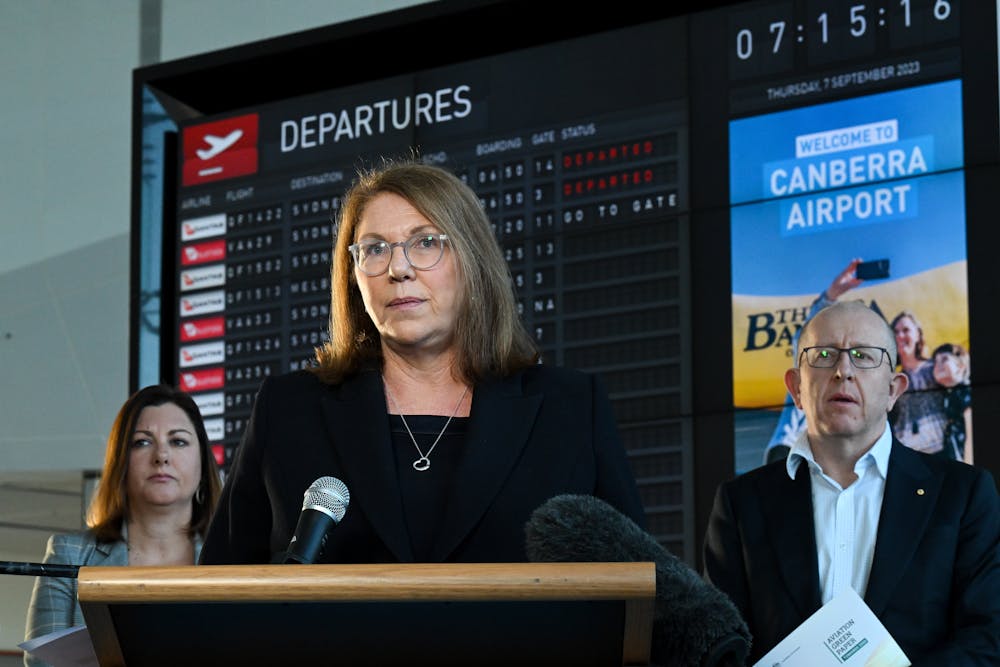
Federal Transport Minister Catherine King has offered several explanations for the decision to deny the Qatari government’s request to fly extra flights into Sydney, Melbourne, Brisbane and Perth.
None of them amounts to a clear rationale for the decision, which has been criticised by airlines, airports, tourism bodies consumer advocates and state governments.
The big question is why such decisions are even up to the minister, rather than being left to the market.
It stems from an outdated international treaty on commercial aviation, from a time when national security was the prime concern. There is, however, a workaround, which other nations have been using, known as open-skies agreements.
An outdated convention
King’s right to rule on international flights is based on the Convention on International Civil Aviation, signed in December 1944 in Chicago – and hence known as the Chicago Convention.
Representatives from 54 nations attended the convention. All agreed they should have sovereignty over the airspace above their territory. The resulting framework prohibited international commercial flights unless expressly permitted. Thus, for an airline to fly internationally there must first be a government-level agreement to permit it.
For example, no Australian airline can operate scheduled commercial services or even sell codeshare flights to the Maldives, because Australia has no air service agreement with the South Asian archipelago.
While the level of demand today may not justify direct services, the framework effectively ensures there never will be that demand.
Turning to open-skies deals
Changing this bilateral-treaty system has proven difficult. Many countries have, since the 1990s, taken the next best approach: open-skies agreements.
An open-skies agreement is a deal between two or more nations that allows for unlimited commercial services without the need for explicit ministerial approval.
Nations can still intervene, so sovereignty is preserved, and intervention is typically limited to safety and security grounds.
The United States has open-skies agreements with more than 100 nations, including the United Arab Emirates and Qatar. Singapore has open-skies agreements with more than 60 nations. Canada has open-skies agreements with 23 nations.
The US, Singapore and New Zealand are parties to an eight-nation multilateral open-skies agreement (the Multilateral Agreement on the Liberalization of International Air Transportation), which does not include Australia.
Australia has open-skies agreements with just seven nations: China, India, Japan, New Zealand, Singapore (which is why Singapore Airlines is expanding services to Australia without controversy), the US and the United Kingdom. This makes Australia a relative outlier among developed nations.
The federal government’s Aviation Green Paper 2023 spends only 2 of 224 pages discussing international aviation competition. It proposes no change in approach.
Redundant rationale
Because Australia is separated by great distances from major population centres, governments historically wanted to ensure Australia had air services that were secure, reliable and economically viable.
However, aviation has moved on. The emergence of major hubs, first in South-East Asia, then in the Middle East, altered the structure of international aviation.
Treaties that Australia negotiated long ago have become redundant. Direct flights by Australian or European airlines are largely uncompetitive against midpoint hubs, where the carriers connect more than 50 cities in Europe to Australian gateways.
Non-stop flights to other regions are now widely available, and are offered by an increasing number of airlines from various countries. There is enough redundancy in the system that if one or more airlines stopped serving Australia, the security and reliability of air services would still be maintained.
Open skies in Australia’s national interest
Australia would experience a net benefit from more international flights. As an island nation, aviation is essential for two of our largest export industries: education and tourism. The persistence of demand for air travel despite record high fares illustrates this.
Australian carriers have not flagged meaningful international service expansion beyond pre-COVID levels. Indeed, they have consistently neglected to use existing traffic rights to major markets such as Malaysia. The introduction of low-cost services, such as 67 weekly flights by the Air Asia group, from such markets has demonstrated that new air services stimulate new demand and do not necessarily harm incumbent operators AirAsia Xpanding Services To China And Australia.
Protecting a stagnant Australian-based international operation is unnecessary and even harmful to the broader economy.
It’s also in Australia’s national interest to ensure adherence to international obligations and adoption of values that Australia promotes. As a nation that has long espoused liberal economic values, it’s in Australia’s interest to commit to healthy competition in the aviation industry and reduce arbitrary decision-making.
Read more: Grattan: Albanese's government has questions to answer on competition
A key obligation of signatories to the Chicago Convention is to ensure civil aviation is used for purposes consistent with the convention’s aims. One aim is that “international air transport services may be established on the basis of equality of opportunity”.
Protecting the profit of Australian airlines, when no such reason has been cited in other similar cases, risks breaching this obligation. The inability of Australia’s transport minister to provide a clear rationale for the decision is precisely why the decision is best left to the market.
Authors: Ian Douglas, Honorary Senior Lecturer, UNSW Aviation and Fellow of the University of Wollongong, UNSW Sydney

















