

'It's not fair!' Kids grumble and complain for a reason, here's how to handle it
- Written by Marg Rogers, Senior Lecturer, Early Childhood Education, University of New England
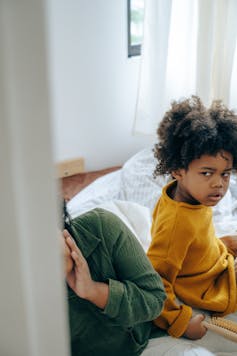
Parents have no doubt heard all the classic grumbles from children and teenagers. From “It’s not fair!” to “Not spinach again!” and our personal favourite, “Why do I have to do all the work?”
All children are prone to being disgruntled and complaining in certain situations. But frequent grumbling can stretch adults’ patience and make them see their kids as ungrateful and unappreciative.
If children are grumbling, they are likely doing it for a good reason. So it is important not to just dismiss it outright. It is also important for kids learn to express themselves in more helpful ways.
Learning how to respectfully express dissatisfaction and call out unfairness can support a child’s mental health, foster respectful relationships at school, and a positive transition into adulthood.
So, how can we support children to have a voice, while turning their grumbles into more respectful communication?
Why are kids grumbling?
Grumbling, whingeing and complaining behaviour is annoying but it means something – children are doing it to communicate. Children are hardwired from birth to cry to get their parent’s attention.
As they grow up, children’s crying often develops into whining and grumbling. This generally reduces with age – although, when stressed, adults can still grumble and cry!
To help reduce grumbling, start by observing the patterns and triggers. Does it happen at a particular time of day or around a particular activity?
Children may grumble because they are trying to share their perspective, express a frustration, or address a perceived unfairness. Children may also grumble to seek attention from an adult, or to test limits and boundaries.
In younger children, grumbling may mean they are tired, hungry, disappointed, frustrated or overwhelmed. They might be responding to changes in their lives, such as a change at school or something different in a parent’s work routine.
In older children, grumbling may also be linked to fatigue, stress and boredom. Teenage grumbling can be particularly aggravating if it is accompanied by eye-rolling or shoulder shrugging – which can really push a parent’s buttons.
What is good communication?A whingey kid is annoying … but
It can be hard to empathise with grumbling. Adults may question the child’s reason to be upset, feel a problem has been wildly exaggerated, that a child is trying to avoid a job or is just being plain irritating.
Because grumbling is so annoying, especially if it is frequent and done in a whingey voice, adults may be inclined to make it go away by giving in to the child.
The inadvertent long-term effect of this strategy is to teach children their needs will be met through grumbling.
In moments of exasperation, instead of responding crossly or giving in, try and give yourself a break and step away. When feeling calmer, think about what your child is actually trying to say.
Read more: Stressed about managing your child's behaviour? Here are four things every parent should know
Model positive communication
Adult-child and adult-teen communication can be tricky, especially if adults focus on the negative tone rather than the message behind. it. But adults can break this cycle.
The key is to listen calmly. Avoid being dismissive, raising your voice, or labelling children as “whingers”.
Give your full attention, nod to show you are listening and check you understand their concerns and opinions (even if you don’t agree).
Listening in this way helps children feel valued, eventually reducing grumbles.
Here’s how you can respond
Having listened – and heard – try to formulate a reasonable response, prompting the child to find a potential solution. This is showing your child how to communicate constructively.
For example, a child might say, “I’m alwaaaaays emptying the bins”. This might mean, “I don’t think the jobs are fairly distributed”, or “I’m getting bored doing the same job”. So adults could ask, “How can the jobs be allocated in a fairer way?” This supports independence and problem solving.
A child might also say, “It took me ages to clean that up”. This might mean, “I want to be thanked and acknowledged”. So you might respond by saying how much better the area looks and thank them for their time and effort.
Or you might hear, “Having those chairs in the hallway is dumb”. This might actually mean “I’ve got some ideas about how we organise our house”.
Parents could say they are interested in alternative ideas, but only if they are expressed with respect. Once they speak politely, if a small change is reasonable, you could ask the child to help adjust the space using a mix of both of your ideas (teaching teamwork). This helps them learn they have a right to be heard, but it is their responsibility to speak politely.
Parents could also say something like, “It’s tricky, but using kind words means people are more likely to listen and respond to you”.
Read more: 'Just leave me alone!' Why staying connected to your teenager is tricky but important
Times and places
It’s not possible for adults to respond reasonably to every random grumble. We can teach children and teenagers there are times and places to raise complaints and concerns.
For example, your child might say, “We never get enough TV before dinner” right as you are taking the roast out of the oven. In response, you could say, “I can see this issue is really important to you” (acknowledging their concerns). You could add, “It’s late, so let’s chat about this for ten minutes over breakfast tomorrow” (making a time and setting limits).
Grumbling is a fact of life with children. But shutting down grumbles without addressing the underlying cause is likely to provoke more grumbles, and do little to teach children about useful communication.
However hard it may be for a tired, harassed parent, taking the time to deal with complaints and whinges constructively can be beneficial in the long run.
Authors: Marg Rogers, Senior Lecturer, Early Childhood Education, University of New England

















