

A memoir of sleeplessness posits making peace with our ruptured nights – but risks becoming an exhausting read
- Written by Liz Evans, Writer, Author, Journalist, Associate Lecturer in English & Writing:, University of Tasmania
My relationship with sleep is fraught. For me, the journey towards sleep is a precarious one, relying on a shifting portfolio of mental states, and an irritating need for silence.
When I finally sink into oblivion, my rest can be shattered by the sound of my partner breathing, or a hoon tearing down the road at the top of our driveway. Once broken, sleep lies around me in sharp, little pieces, jabbing with the promise of a difficult day ahead.
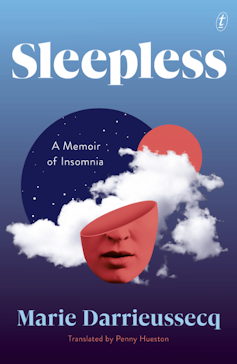
Review: Sleepless: A Memoir of Insomnia – Marie Darrieussecq (Text Publishing)
When did this start? Was it the heated anxiety of menopause, the interrupted nights of early motherhood, the wide-awake longing for home after moving halfway round the world? When did sleep become so elusive?
I became sensitive to noise in London. I was a music journalist in the 1990s, but sometimes even I needed to sleep and this could be hard with paper-thin walls and drunken neighbours. But did the trouble start even earlier, in adolescence or childhood, I wonder, remembering the volatility in my first home. Did I ever sleep like a baby, even when I was one?
In her new book, Sleepless: A Memoir of Insomnia, French writer Marie Darrieussecq embarks on a similar investigation into her own struggle with sleep. Through a hybrid of personal narrative and meditative essays, Darrieussecq contemplates the curse of insomnia with unusual scope. But while she writes like a dream, her work is thrown out of joint by its ambitious scale. Her exhaustive project risks becoming an exhausting read.
Beginning with a tour of literary perspectives and a brief history of barbiturates, Darrieussecq examines the connection between creativity and hyper-vigilance.
Proust and Kafka lead the canon here, and the stories of addiction to Veronal (a powerful barbiturate) and accidental overdose are both fascinating and shocking. But the references rush in thick and fast, and I struggle to keep pace.
Read more: How do I stop my mind racing and get some sleep?
A global industry
The hunt for sleep has become a global industry. Psychologists, doctors, yoga teachers, meditation and breath-work practitioners ply us with sleep apps, mindfulness routines, prescription drugs and natural remedies. Columns and articles clog up the media with tips on How To Sleep, recycling age-old advice in jazzed-up terminology.
At least we have something to occupy us in the small hours.
Herbal teas and melatonin help me drift off, but when I wake up at 2am or 3am, resignation and a book work best. According to my London herbalist, the trick is to break the pattern. With this in mind, he once prescribed me datura a potentially deadly narcotic. Entranced, I left his basement practice with strict instructions and a tiny dark glass bottle. I felt like Alice in Wonderland. It worked, but only for a while.

Perhaps my own struggles with sleep are why no matter how much I appreciate the scholarship of Darrieussecq’s impressive project, I’m most interested in her personal quest. Her desperate encounters with pharmacology, alcohol, and eventually a somnologist (sleep psychiatrist) are the ones that resonate. The love and torture of childbirth and breastfeeding, the problem of the study-bedroom, the relentlessness of the 4.04am waking hour, all have me bristling with recognition and relief.
I Google one of the alluring sleep aids she describes, I’m curious about the sleep test, a polysomnographic examination which involves being fitted with a network of electrodes by a sleep technician, and I’m moved by her account of her addiction to sleeping pills. But these personal vignettes are brief. She opens up pockets of her life, only to shut them back down again, leaving me intrigued and a little dissatisfied.
I want to know more about her childhood, about being born in the years after her brother who did not survive. I wonder if her mother was unable to sleep, due to grief and fear of losing another baby. There doesn’t seem to be an endpoint to this story, which I don’t mind at all because that’s the whole point with insomnia. But I would like to know what happened in the beginning.
A trained psychoanalyst, Darrieussecq is understandably careful. When she walls off her narrative, it’s with a firmness you might expect from someone whose work depends on boundaries. As a qualified psychotherapist myself, I appreciate and respect her need for containment. But as a reader, I prefer it when she’s visible.
Read more: Explainer: what's the link between insomnia and mental illness?
Eluding the page
 Dancing on and off the page, appearing, disappearing, and re-emerging throughout her book, Darrieussecq spins a heady web. Intoxicating and disorientating, her style works perfectly when she writes about the spiralling anxiety of insomnia, and the dizzy voids of sleeplessness. It lets her capture the internal cacophony, the sense of isolation and the tide of dread that destabilises those of us who battle for sleep.
Elsewhere this fragmented approach threatens to collapse the insomniac’s voice into a guidebook to sleeplessness. Depending on what you want from a memoir, maybe this doesn’t matter. Darrieussecq’s writing is faultless, however you look at it. But the question of structure is worth considering.
Memoirs have enjoyed increasing popularity for the last 20 years or so, and there are many ways to write one. Essentially, a good memoir takes us out of ourselves while inviting valuable connection with the author. When countered with intellectual ideas and reflections, memoir can offer valuable, wider context for personal stories, but achieving this balance is a delicate act.
With this in mind, the strongest sections of Sleepless are when Darrieussecq positions herself within a manageable network of references, and keeps herself clearly in the picture.
She does this when investigating the ruptured sleep of the homeless, politicising insomnia, but personalising the narrative with recollections of restless nights in hotels. And again, when she considers the impact of social inequity and modern technologies on our ability – as well as our basic human right – to sleep, while charting her adventures in Southern Cameroon. She had gone there to solve her writer’s block, to finish a novel about a woman who follows her lover into the Congo, but the inspiration she found in the forest was marred by sleeplessness.
These personal snippets add a necessary touch of individualism to this impressive enquiry. Engaging, brave and funny, they render Darrieussecq’s dazzling treatise into something more relatable.
Read more:
Having trouble sleeping? Here's the science on 3 traditional bedtime remedies
Insomnia vs creativity
On finishing Darrieussecq’s book, I return to the beginning, to where she writes of the hunt for the killer of sleep, and states a brutal truth: Nothing prevents the insomniac from not sleeping. There is a mythological quality to these words that bears little relationship to the more familiar grind and drudgery of not sleeping. But Sleepless is an attempt to coax something meaningful from long, empty wide-awake nights.
So, how do you make sense of insomnia? How do you reconcile yourself to lying awake night after night, within the threat of tomorrow’s awful haze? Despite her tiring search, Darrieussecq claims no answers, but by the end of her book, she’s stopped fighting for sleep.
Instead, she settles on changing her perspective of insomnia altogether. Turning back to Kafka and Virginia Woolf, she weaves in the rhythms of nature, drawing on the cycles of plants and planets, animals and trees to reimagine a new relationship with shadows. In this way, she hopes to “find insomnia without fatigue”, and to try and find a way of remembering “nights as a dimension of days”.
Dancing on and off the page, appearing, disappearing, and re-emerging throughout her book, Darrieussecq spins a heady web. Intoxicating and disorientating, her style works perfectly when she writes about the spiralling anxiety of insomnia, and the dizzy voids of sleeplessness. It lets her capture the internal cacophony, the sense of isolation and the tide of dread that destabilises those of us who battle for sleep.
Elsewhere this fragmented approach threatens to collapse the insomniac’s voice into a guidebook to sleeplessness. Depending on what you want from a memoir, maybe this doesn’t matter. Darrieussecq’s writing is faultless, however you look at it. But the question of structure is worth considering.
Memoirs have enjoyed increasing popularity for the last 20 years or so, and there are many ways to write one. Essentially, a good memoir takes us out of ourselves while inviting valuable connection with the author. When countered with intellectual ideas and reflections, memoir can offer valuable, wider context for personal stories, but achieving this balance is a delicate act.
With this in mind, the strongest sections of Sleepless are when Darrieussecq positions herself within a manageable network of references, and keeps herself clearly in the picture.
She does this when investigating the ruptured sleep of the homeless, politicising insomnia, but personalising the narrative with recollections of restless nights in hotels. And again, when she considers the impact of social inequity and modern technologies on our ability – as well as our basic human right – to sleep, while charting her adventures in Southern Cameroon. She had gone there to solve her writer’s block, to finish a novel about a woman who follows her lover into the Congo, but the inspiration she found in the forest was marred by sleeplessness.
These personal snippets add a necessary touch of individualism to this impressive enquiry. Engaging, brave and funny, they render Darrieussecq’s dazzling treatise into something more relatable.
Read more:
Having trouble sleeping? Here's the science on 3 traditional bedtime remedies
Insomnia vs creativity
On finishing Darrieussecq’s book, I return to the beginning, to where she writes of the hunt for the killer of sleep, and states a brutal truth: Nothing prevents the insomniac from not sleeping. There is a mythological quality to these words that bears little relationship to the more familiar grind and drudgery of not sleeping. But Sleepless is an attempt to coax something meaningful from long, empty wide-awake nights.
So, how do you make sense of insomnia? How do you reconcile yourself to lying awake night after night, within the threat of tomorrow’s awful haze? Despite her tiring search, Darrieussecq claims no answers, but by the end of her book, she’s stopped fighting for sleep.
Instead, she settles on changing her perspective of insomnia altogether. Turning back to Kafka and Virginia Woolf, she weaves in the rhythms of nature, drawing on the cycles of plants and planets, animals and trees to reimagine a new relationship with shadows. In this way, she hopes to “find insomnia without fatigue”, and to try and find a way of remembering “nights as a dimension of days”.
 Should insomniacs try to remember nights as a dimension of days?
Photo by Arzu Sendag on Unsplash
It’s a beautiful move, and typical of the psychoanalytic mind which enjoys finding new angles on questions far more than contriving neat answers. So while I don’t feel I’ve got a better grasp on who my narrator is, when I finish her book, I am refreshed. I have a different way of relating to the night.
This morning, I woke at 3am. My mind was quietly busy, rustling away in the pre-dawn hours with songs of work and murmuring concerns about unfinished tasks. So I rose and settled by the fire with my books, returning to bed two hours later with a hot water bottle, looking forward to the task that prodded me awake.
We may not be able to cure our insomnia, but, heeding the final chapter of Darrieussecq’s book we might be able to make peace with it. Consenting to a creative impulse at an unsociable hour might sound impractical, but I’ve had a productive day. And who knows, I may even sleep tonight.
Authors: Liz Evans, Writer, Author, Journalist, Associate Lecturer in English & Writing:, University of Tasmania
Should insomniacs try to remember nights as a dimension of days?
Photo by Arzu Sendag on Unsplash
It’s a beautiful move, and typical of the psychoanalytic mind which enjoys finding new angles on questions far more than contriving neat answers. So while I don’t feel I’ve got a better grasp on who my narrator is, when I finish her book, I am refreshed. I have a different way of relating to the night.
This morning, I woke at 3am. My mind was quietly busy, rustling away in the pre-dawn hours with songs of work and murmuring concerns about unfinished tasks. So I rose and settled by the fire with my books, returning to bed two hours later with a hot water bottle, looking forward to the task that prodded me awake.
We may not be able to cure our insomnia, but, heeding the final chapter of Darrieussecq’s book we might be able to make peace with it. Consenting to a creative impulse at an unsociable hour might sound impractical, but I’ve had a productive day. And who knows, I may even sleep tonight.
Authors: Liz Evans, Writer, Author, Journalist, Associate Lecturer in English & Writing:, University of Tasmania 
















