

iPhone switching to USB-C is a win for consumers and the environment – but to what extent?
- Written by Tyrone Berger, Lecturer in Law, Deakin Law School, Deakin University
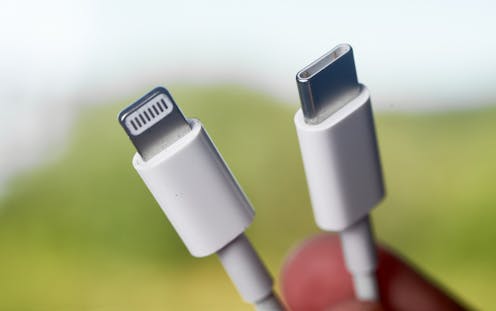
This week, technology news has been abuzz as Apple introduced its latest iPhones into the market. Among the usual new feature announcements, one stunning change has stood out in particular. The long-standing rumours are true – the new iPhone 15 series has USB-C standard charging ports.
The ditching of Apple’s proprietary Lightning port, which was first introduced in 2012, means iPhone users will finally be able to recharge their phones with the same chargers they use for other devices.
But what does this major change really mean for Apple, consumers and the environment?
Apple marched to its own beat until now
Since the inception of Apple, the company has been well known to develop various proprietary connectors in lieu of adopting tech standards used elsewhere in the industry.
As one of the major players in the mobile market, the iconic brand has relied on the loyalty of its customers, dictating they have no choice but to use Apple’s proprietary cabling and charging technologies to run their products. As a result, they could retain control of their product ecosystem.
Meanwhile, there is also the USB (Universal Serial Bus), an industry standard designed to standardise the many connections we need on personal computers – to plug in a keyboard or a mouse, for example. The group that develops and maintains the standard includes more than 700 tech companies, including Apple, Microsoft and Samsung. USB-C is the latest iteration of this widely accepted standard.
Read more: What is USB-C? A computer engineer explains the one device connector to rule them all
Even while maintaining proprietary standards, in recent years Apple has also rolled out USB-C ports on several of its products, most notably all Macs and several iPads.
However, when the European Union proposed in 2020 that all consumer devices should use a universal standard charger, Apple hit back with claims a single connector standard would stifle innovation and create further electronic waste or e-waste.
The EU demands USB-C
It is now apparent Apple lost that battle. The iPhone 15 switch to USB-C comes less than a year after the EU passed legislation to require all smartphones, tablets, digital cameras and other small devices to support USB-C by the end of 2024.
The rules also impose a requirement for “fast charging”, to ensure devices can be charged at the same speed no matter which charger is used.
The purpose behind the move is to mandate a single standardised port so consumers don’t need to carry different cables for different devices. It also means fewer cables need to be manufactured and supplied with new products, thus reducing the e-waste created by discarded electronic goods.
Given the size of the EU market, the new rules may lead to other countries introducing similar legislation. Some exceptions will exist for devices that are too small to have a USB-C port, such as smart watches or health monitors.
Apple also has a history of removing popular ports, such as when it removed the headphone jack from the iPhone 7. However, it’s too early to know whether the USB-C port on the iPhone could suffer the same fate in favour of wireless charging in the future.
Read more: Apple's iPhone 12 comes without a charger: a smart waste-reduction move, or clever cash grab?
How much of an e-waste savings is it, really?
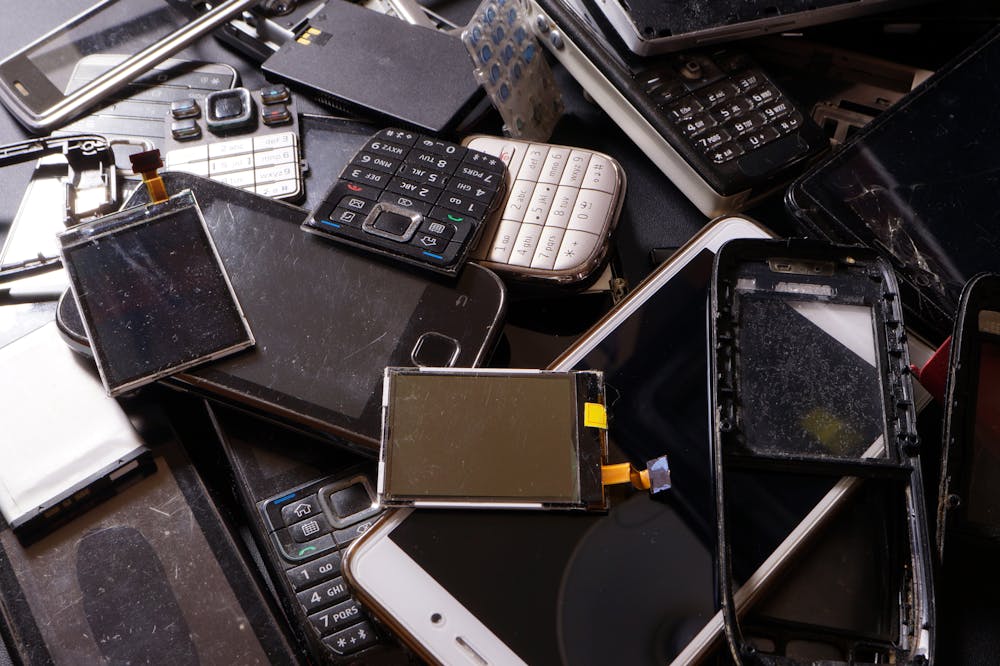
E-waste is one of the fastest growing waste streams globally. This is due to the shortened lifespan of our electronic devices, limited repair options and growing consumer demand for the newest high-tech products.
The EU’s decision to demand USB-C is part of a greater effort to tackle e-waste. Ironically, it could generate more e-waste in the short term as individuals phase out their Lightning cables and old iPhones. However, the EU claims the new regulation could save almost 1,000 tonnes of e-waste annually.
On the grand scale, that’s actually not much, considering Europe generated 12 million tonnes of e-waste in 2019.
The inclusion of a USB-C port probably will not be enough of an incentive for people to upgrade to the iPhone 15, but the move by Apple could in fact be more attractive for those consumers who have been resistant to the iPhone in the past over its charging limitations.
Since there are more than one billion iPhones and iPads with Lightning ports in the world right now, you’re likely to find Lightning cables and accessories for a few years to come.
Depending on how long you’re planning on keeping your current iPhone, chances are Lightning chargers will be more difficult to find in the not-too-distant future.
What can you do about e-waste?
If you’ve switched to a new device with a different charging port, it renders your old collection of proprietary charging cables virtually useless. So, what should you do when it’s time to clean out the drawer full of old devices and cables?
In Australia, there is a National Television and Computer Recycling Scheme (NTCRS) to give “Australian households and small businesses free access to industry-funded collection and recycling services”, but the drop-off points may not be nearby.
In addition to the NTCRS, many state and local governments have their own recycling schemes or collection services. For example, the City of Sydney Council provides a free collection of all e-waste at recycling stations for residents.
Officeworks have also been recycling e-waste with their “Bring It Back” policy, which provides consumers with the opportunity to drop off devices and cables at their stores. Other organisations like MobileMuster offer a similar service where they will recycle mobile phones, chargers and accessories at no cost.
Read more: If you buy it, why can't you fix it? Here's why we still don't have the 'right to repair'
Authors: Tyrone Berger, Lecturer in Law, Deakin Law School, Deakin University

















