

here’s how to get the UN Sustainable Development Goals back on track
- Written by: Cameron Allen, Research Fellow, Monash University
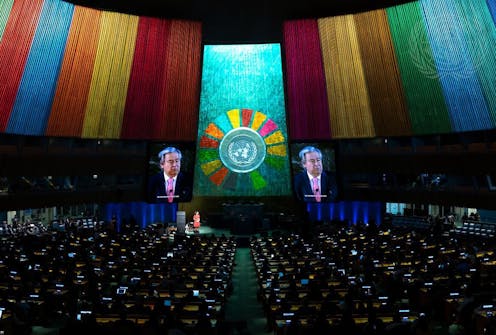
This week world leaders are gathering at the United Nations (UN) headquarters in New York to review progress against the Sustainable Development Goals. We’re halfway between when the goals were set in 2015 and when they need to be met in 2030.
As authors of a global UN report on the goals, we have a message to share. Currently, the world is not on track to achieve any of the 17 goals.
There is much at stake. Failing to achieve the goals would mean by the end of the decade, 600 million people will be living in extreme poverty. More than 80 million children and young people will not be in school. Humanity will overshoot the Paris climate agreement’s 1.5℃ “safe” guardrail on average global temperature rise. And, at the current rate, it will take 300 years to attain gender equality.
But there is hope. With decisive action, we can shift the dial towards a fairer, more sustainable and prosperous world by 2030.
Read more: We modelled 4 scenarios for Australia's future. Economic growth alone can't deliver the goods
What does the research say?
The set of 17 universal goals agreed in 2015 aim to end poverty, improve health and education, and reduce inequality – while tackling climate change and preserving our oceans and forests. Each of the goals are broken down into targets.
Every four years, the UN Secretary-General appoints an independent group of 15 international scientists to assess progress against these goals and recommend how to move forwards. We were among the authors of the latest Global Sustainable Development Report published late last week.
To provide a snapshot of progress, we reviewed 36 targets. We found only two were on track (on access to mobile networks and internet usage) and 14 showed fair progress. Twelve showed limited or no progress – including around poverty, safe drinking water and ecosystem conservation.
Worryingly, eight targets were assessed as still going backwards. These included reducing greenhouse-gas emissions and fossil fuel subsidies, preventing species extinction and ensuring sustainable fish stocks.
Hear from some of the scientists behind the Global Sustainable Development Report 2023.What is holding us back?
Recent studies have identified feasible and cost-effective global and national pathways to accelerate progress on the goals.
Unfortunately, in many developing countries, insufficient financial resources and weak governance hinder progress. In other cases, existing investments in fossil fuels have generated strong resistance from powerful vested interests. Achieving some goals, such as responsible consumption and production, will also require big, unpopular changes in habits and lifestyles, which are very ingrained.
To accelerate progress on the goals, targets must be fully integrated by government and business at all levels into core decision making, budgeting and planning processes. We need to identify and prioritise those areas that lag furthest behind. To be effective, we also need to uncover and address the root causes of inadequate outcomes, which lie in our institutions and governance systems.
Accountability also remains weak. The goals are not legally binding and even though countries have expressed their support, this has often failed to translate into policy and investments. In practice, the targets are often “painted on” to existing strategies without redesigning norms and structures to deliver improved outcomes.
If the world is to accelerate progress on the goals, governments need to play a more active part, by setting targets, stimulating innovation, shaping markets, and regulating business.
We call on policymakers to develop tailored action plans to accelerate progress on the goals in the remaining years to 2030, including measures to improve accountability.
Scientists have a major role to play too. As we argued in Nature, scientists can help us redesign institutions, systems and practices. By studying ways to strengthen governance and build momentum for tough but transformative reforms, research can overcome resistance to change, and manage negative side-effects.
What does it mean for Australia?
Australia tends to perform poorly on the goals when compared to our peers in the OECD (Organisation for Economic Co-operation and Development), ranking 40th in the world in 2023. Our best-performing goals include health and education, while progress lags on environmental goals, economic inequality and cost-of-living pressures.
While some environment agencies, businesses and local groups have embraced the goals, Australia’s poor performance is symptomatic of limited traction and commitment at the centre of government.
Here, the goals are often seen as an international development issue rather than central to domestic policy efforts. We lack a high-level statement or any strategy or action plan for the goals. There is no lead unit or coordination mechanism in place and no reference to the goals in the federal budget. One promising development, a national Sustainable Development Goal monitoring portal, hasn’t been updated in five years.
The best performing countries have taken concrete steps to mainstream the targets and ensure accountability:
Denmark requires new government bills to be screened and assessed for their impacts on the goals
Finland has taken steps to place sustainable development and people’s wellbeing at the heart of policy and decision making. A sustainable development commission, annual citizens’ panel on sustainable development and national audits provide increased accountability
Wales requires public bodies to use sustainable development as a guiding principle reflecting the values and aspirations of the Welsh people.
Australia’s first wellbeing framework is an important step forward. The framework of 50 indicators has considerable overlap with the goals, despite notable exceptions such as the lack of a poverty indicator or any specific targets or benchmarks.
Start lifting our game
As we’ve learned through our own research, little will change if such promising initiatives remain box-ticking exercises that fail to reorient our societies and economies towards sustainable development.
To achieve real change, indicator frameworks need to be translated into timebound targets that clearly set the agreed direction and level of ambition. These targets must be embedded in the core decision-making processes of government and business.
Remember the goals are not a set of technical targets and indicators. They are the outcomes each of us want for our society and the world we live in.
While we are behind at halftime, the game is not over. It is up to us to lift our performance and turn the score around.
Authors: Cameron Allen, Research Fellow, Monash University


















