

Global corporate power is 'out of control', but reports of democracy’s death are greatly exaggerated
- Written by Carl Rhodes, Professor of Organization Studies, University of Technology Sydney
The past 40 years have seen massive expansion of the dominance of large corporations in the global economy. A wave of neoliberal reforms spread internationally from the 1980s with the promise that deregulated markets would unleash the animal spirits of private enterprise, bringing a new era of growth and prosperity.
Corporations were touted as the heroes of the neoliberal dream, casting off the shackles of staid state bureaucracy as they leapt forward into a future where there was no alternative to unfettered global capitalism.
So what happened?
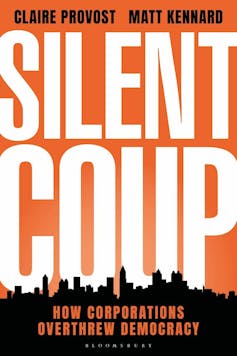
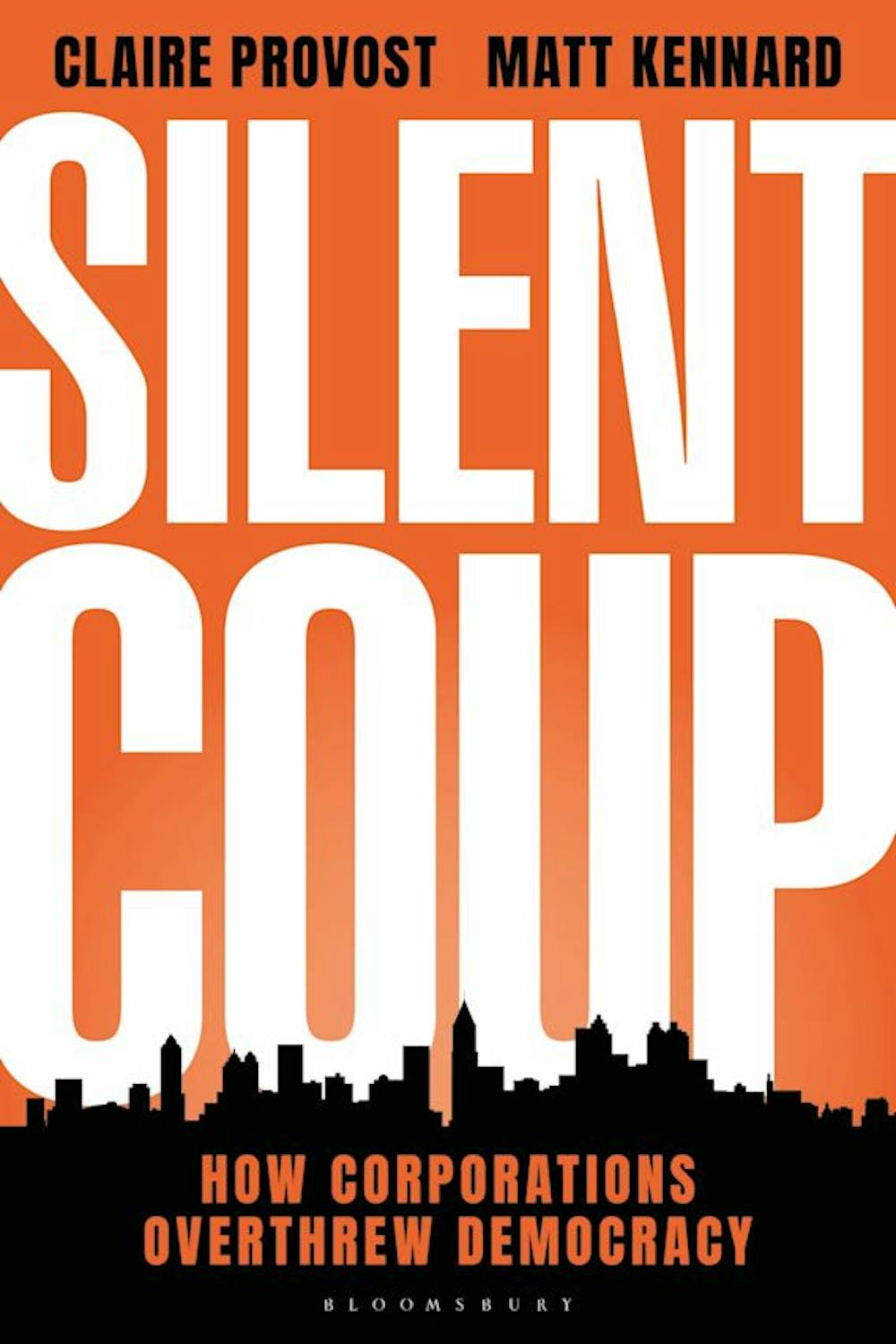
Review: Silent Coup: How Corporations Overthrew Democracy – Claire Provost and Matt Kennard (Bloomsbury)
The dream of popular capitalism
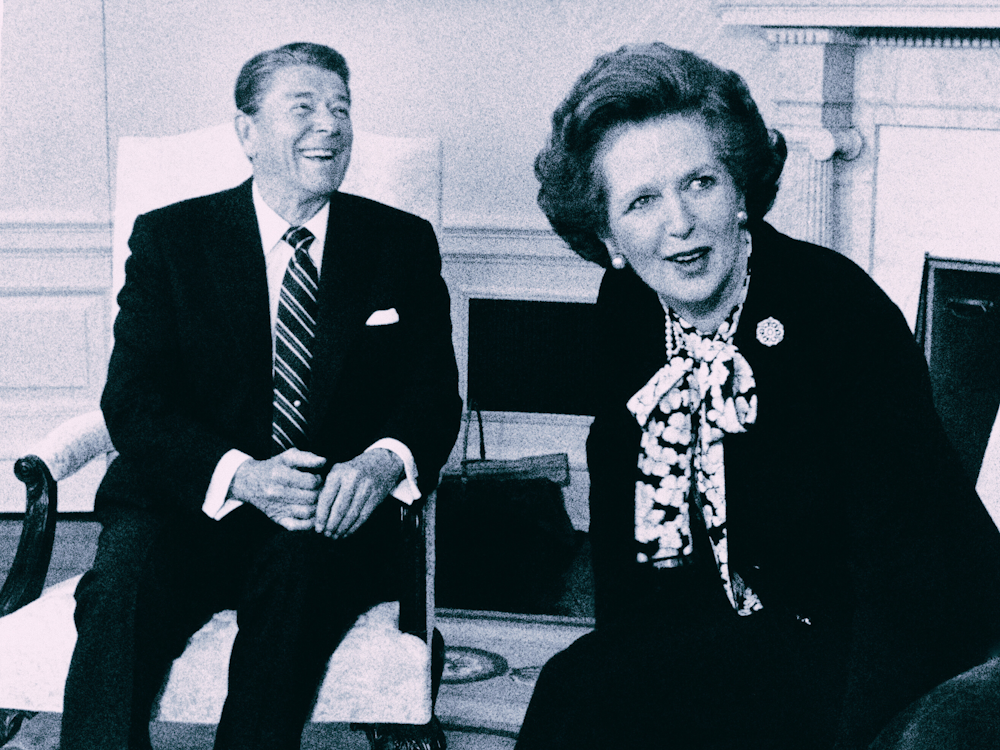
In the late 1970s, Margaret Thatcher championed “popular capitalism” as a means to deliver “renewed material prosperity, […] individual freedom, human dignity and to a more just, more honest society”.
Ronald Reagan promised that cutting the taxes of corporations and the wealthy would create a new era of economic prosperity for all. This was dubbed “trickle-down economics”.
As leaders in the 1980s of the United Kingdom and United States, respectively, Thatcher and Reagan were harbingers of major changes to the global economic order. By 1989, what came to be known as the Washington Consensus was firmly established as the dominant policy position of the International Monetary Fund (IMF). This prompted a wave of structural reforms to economies across the developing world, lest they lose access to IMF dollars.
The “consensus”, for rich and poor nations alike, was that privatisation of state enterprises, liberalisation of markets, corporate deregulation, reduced taxation and the general withdrawal of government from economic affairs were the only ways to secure global economic growth.
A dream that did not come true
Journalists Claire Provost and Matt Kennard’s Silent Coup: How Corporations Overthrew Democracy charts what has become of the corporate-led global prosperity that was promised in the 1980s.
Their assessment is grim and hopeless. Instead of shared progress arriving on the wings of an ever-empowered capitalism, what we got was a massive grab for power and money by the corporations that were supposed to save the world.
The book asserts that corporations have staged nothing less than a political coup d’état: a deliberate and successful attempt to usurp the power of nation states and establish themselves as rulers of the world. By its own account, Silent Coup provides a
guide to the rise of supranational corporate empires that now dictate how resources are allocated, how territories are governed, how justice is defined and who’s safe.
Provost and Kennard chart four ways this corporate political revolution has been achieved. These involve the international legal system, the international aid and development system, the corporate acquisition of territory, and the growth of private corporate armies. It all amounts to an undermining of democracy by ever-growing corporate empires.
The first part of Silent Coup, “Corporate Justice”, examines the international treaties that have been established across the world by countries wishing to increase corporate foreign investment. These treaties give corporations legal authority to sue nation states in international tribunals if their investments are jeopardised.
The book illustrates the power shift this entails with precisely documented examples from around the globe, from El Salvador to South Africa to Germany. In El Salvador, for example, the Canadian mining company Pacific Rim sued the government – unsuccessfully, in the end – for blocking it from opening a particular gold mine. Pacific Rim claimed the government’s actions, while legal, caused it to have lost “future profits”.
Provost and Kennard portray the system as being “out of control”. Investor trade arbitrations have turned the tables of power. The popular sovereignty of democratic nations, they argue, has been ceded to the private economic interest of the world’s corporations.
 Silent Coup then delves into the domination of international aid by large corporations. By way of example, Provost and Kennard report on the G8 initiative called New Alliance for Food Security and Nutrition, designed to reduce poverty and grow agriculture in Africa. In practice, this was implemented through changes to tax and agriculture laws designed to boost the profits of private agribusiness.
Government aid, in today’s world, is no longer positioned as reparation or generosity; wealthy countries now want a return on their investment. Projects that create trade and wealth opportunities for corporations are prioritised. This means, in effect, that aid is increasingly used to benefit big business as much as it ostensibly claims to be funding economic development.
A section on “Corporate Utopias” takes aim at Special Economic Zones established within countries to give corporations preferential tax rates and more relaxed regulations. Some of these zones are even exempt from labour laws and protections.
There are 3,500 such zones across the globe, from Myanmar and Shenzhen to Ireland and the UK, employing 66 million generally low-paid workers. Unfettered, union-free, government-backed worker exploitation, the authors argue, runs rampant amid this epidemic of “sweatshop globalisation”.
The final section of Silent Coup, “Corporate Armies”, reports how corporations are engaging in military and police-like activities to protect their premises, transportation and logistics in places such as occupied Palestine, Columbia and Honduras.
One example discussed is fruit company Chiquita, which the US Department of Justice found guilty of funding and arming known terrorists to protect its presence in the banana-growing regions of Columbia. Elsewhere, corporations are making profits from running immigration detention centres and prisons.
In today’s world, corporations control armed forces at a level hitherto the exclusive realm of nation-states.
Read more:
'Greed is amoral': how Wall Street supermen cashed in on pandemic misery and chaos
The horror of the new world order
Silent Coup paints a horrifying picture of a new world order in which power has been ripped from the hands of sovereign governments and placed in the hands of private corporations. The investigative journalism that underpins the book is harrowing reading, even for people well versed in the exploitative machinations of corporations and the deleterious effect they can have on people, politics and planet.
Amid the intrigue and suspense that characterises the writing of this book, there is an unnerving and unspoken undercurrent. The book quivers with a feeling that there is no hope. The air of hopelessness starts with the subtitle: How Corporations Overthrew Democracy. It is over, the authors aver; democracy has been defeated.
Silent Coup then delves into the domination of international aid by large corporations. By way of example, Provost and Kennard report on the G8 initiative called New Alliance for Food Security and Nutrition, designed to reduce poverty and grow agriculture in Africa. In practice, this was implemented through changes to tax and agriculture laws designed to boost the profits of private agribusiness.
Government aid, in today’s world, is no longer positioned as reparation or generosity; wealthy countries now want a return on their investment. Projects that create trade and wealth opportunities for corporations are prioritised. This means, in effect, that aid is increasingly used to benefit big business as much as it ostensibly claims to be funding economic development.
A section on “Corporate Utopias” takes aim at Special Economic Zones established within countries to give corporations preferential tax rates and more relaxed regulations. Some of these zones are even exempt from labour laws and protections.
There are 3,500 such zones across the globe, from Myanmar and Shenzhen to Ireland and the UK, employing 66 million generally low-paid workers. Unfettered, union-free, government-backed worker exploitation, the authors argue, runs rampant amid this epidemic of “sweatshop globalisation”.
The final section of Silent Coup, “Corporate Armies”, reports how corporations are engaging in military and police-like activities to protect their premises, transportation and logistics in places such as occupied Palestine, Columbia and Honduras.
One example discussed is fruit company Chiquita, which the US Department of Justice found guilty of funding and arming known terrorists to protect its presence in the banana-growing regions of Columbia. Elsewhere, corporations are making profits from running immigration detention centres and prisons.
In today’s world, corporations control armed forces at a level hitherto the exclusive realm of nation-states.
Read more:
'Greed is amoral': how Wall Street supermen cashed in on pandemic misery and chaos
The horror of the new world order
Silent Coup paints a horrifying picture of a new world order in which power has been ripped from the hands of sovereign governments and placed in the hands of private corporations. The investigative journalism that underpins the book is harrowing reading, even for people well versed in the exploitative machinations of corporations and the deleterious effect they can have on people, politics and planet.
Amid the intrigue and suspense that characterises the writing of this book, there is an unnerving and unspoken undercurrent. The book quivers with a feeling that there is no hope. The air of hopelessness starts with the subtitle: How Corporations Overthrew Democracy. It is over, the authors aver; democracy has been defeated.
 Matt Kennard.
Bloomsbury Publishing
Democracy is under attack, to be sure. But reports of its death are greatly exaggerated, if not irresponsible. That is not to say democracy is not wounded – Silent Coup provides meticulously researched and detailed case studies of just how out of control the political clout of corporations has become. But does that mean we give up hope in the promise of democracy under the guise of a dramatic clickbait headline?
This reviewer says no.
The drama of Silent Coup is, in many parts, unwarranted and misleading. This is not helped by the use of a first-person narrative that, throughout the book, characterises the authors as the protagonists. They are the ones who can reveal the secrets of the corporate revolution that has happened behind all of our backs. They are the fearless and intrepid journalists who have ventured into the big bad corporate world, returning with tales of their amazing adventures.
The rhetorical flair distracts from the real issues. What Provost and Kennard report is important, and reflects some of the most pressing political challenges of our time. But while their discoveries may have been revelations to them, these matters were hardly secrets and their journalistic exploits are not what is important.
Matt Kennard.
Bloomsbury Publishing
Democracy is under attack, to be sure. But reports of its death are greatly exaggerated, if not irresponsible. That is not to say democracy is not wounded – Silent Coup provides meticulously researched and detailed case studies of just how out of control the political clout of corporations has become. But does that mean we give up hope in the promise of democracy under the guise of a dramatic clickbait headline?
This reviewer says no.
The drama of Silent Coup is, in many parts, unwarranted and misleading. This is not helped by the use of a first-person narrative that, throughout the book, characterises the authors as the protagonists. They are the ones who can reveal the secrets of the corporate revolution that has happened behind all of our backs. They are the fearless and intrepid journalists who have ventured into the big bad corporate world, returning with tales of their amazing adventures.
The rhetorical flair distracts from the real issues. What Provost and Kennard report is important, and reflects some of the most pressing political challenges of our time. But while their discoveries may have been revelations to them, these matters were hardly secrets and their journalistic exploits are not what is important.
 Claire Provost.
Bloomsbury Publishing
The problem is not that nobody knows about the growing global corporatocracy; it is that nobody seems to have the will or ability to stop it.
It is only in the book’s epilogue that a glimmer of hope shines through. Provost and Kennard gesture to a few examples of people resisting corporate power in the name of democracy, but little detail is provided. Perhaps this will be a sequel.
Democracy still means something. It means a promise of equality, liberty and solidarity among citizens. It means retaining the primacy of popular sovereignty – the rule of the people – instead of political power residing with a minority class of plutocrats. It means believing in the possibility of shared prosperity.
It is only with hope that we can retain the political will to continue the democratic promise, and to retain and strengthen the practices, institutions and ways of life that enable that promise. Political change does not come from resigning ourselves to a fate beyond our control, but from daring to dream of a better future. This is where the book fails.
It is not too late. Don’t give up.
Authors: Carl Rhodes, Professor of Organization Studies, University of Technology Sydney
Claire Provost.
Bloomsbury Publishing
The problem is not that nobody knows about the growing global corporatocracy; it is that nobody seems to have the will or ability to stop it.
It is only in the book’s epilogue that a glimmer of hope shines through. Provost and Kennard gesture to a few examples of people resisting corporate power in the name of democracy, but little detail is provided. Perhaps this will be a sequel.
Democracy still means something. It means a promise of equality, liberty and solidarity among citizens. It means retaining the primacy of popular sovereignty – the rule of the people – instead of political power residing with a minority class of plutocrats. It means believing in the possibility of shared prosperity.
It is only with hope that we can retain the political will to continue the democratic promise, and to retain and strengthen the practices, institutions and ways of life that enable that promise. Political change does not come from resigning ourselves to a fate beyond our control, but from daring to dream of a better future. This is where the book fails.
It is not too late. Don’t give up.
Authors: Carl Rhodes, Professor of Organization Studies, University of Technology Sydney 
















