

NASA just brought back the largest-ever asteroid sample
- Written by Eleanor K. Sansom, Research Associate, Curtin University
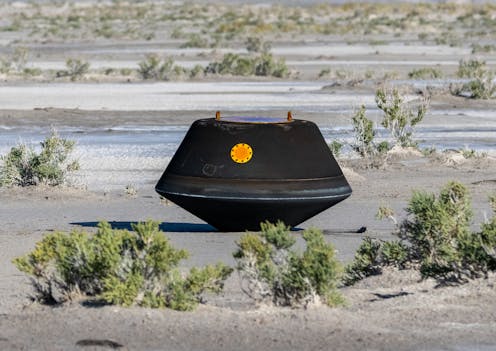
After a journey of billions of kilometres, NASA’s OSIRIS-REx mission has culminated in a small black capsule blazing through the sky before touching down in the Utah desert.
Inside is likely to be the largest ever sample of dust and rock returned from an asteroid. Extracted and brought back with great technical ingenuity from an asteroid called Bennu, scientists will now study in search of clues about the origins of the Solar System and life itself.
The seven-year mission took OSIRIS-REx to a near-Earth carbon-rich asteroid, which it orbited for two and a half years, mapping its surface and measuring properties such as its density and spin. This “rubble pile” asteroid also has a (very) small chance of one day impacting Earth, so getting intricate measurements of its orbit and other dynamics was also a mission goal.
The origins of the Solar System – and life
Most asteroids are the rocky leftovers of failed planets and destructive collisions in the early Solar System, orbiting in a belt between Mars and Jupiter. They vary drastically in size, shape and composition, and finding out what they are made of can help us learn more about how the planets formed.
These primitive bodies – some more than 4.5 billion years old – can also shed light on the origins of life, because they tell us about the distribution of water, minerals and other elements such as carbon.
There is also an element of self-interest in studying these asteroids, to understand the risk they may pose if they are heading Earth’s way.
Read more: Our Solar System is filled with asteroids that are particularly hard to destroy, new study finds
Using telescopes on Earth, we can get a rough idea of what an asteroid’s surface is made of. However, to do an in-depth chemical analysis we need to get hold of some actual samples.
Most of the asteroid samples we have are meteorites – lumps of space rock that have crashed into Earth. There are more than 70,000 meteorites in collections around the world, but we know the origins of less than 0.1% of them.
What’s more, we know the samples we have are not very representative of the kinds of asteroids in space. Part of the reason for this is that some kinds of asteroids are better than others at surviving the fiery descent through the atmosphere.
But some meteorites don’t appear to correspond to any known type of asteroid. So where do they come from?
Using dedicated camera networks such as Australia’s Desert Fireball Network we can observe incoming asteroids, recover meteorite samples and track their paths back through space to determine their origins. This process can deliver relatively uncontaminated samples to the lab.
Even still, linking a meteorite to a known parent asteroid, or even a type of asteroid observed via telescope, is very difficult.
Bringing pieces of space back to Earth
Sample return missions are the gold standard for analysing the makeup of extraterrestrial bodies. They can bring pieces from a different planet or asteroid back to Earth to study.
The first such mission was to the Moon, bringing back lunar samples for analysis. We learned the Moon was made from the same material as the Earth, and that it likely formed from the orbiting debris after a giant impact.
Sample return missions are technically very challenging. Not only does a spacecraft have to travel hundreds of millions of kilometres from Earth, but it has to match speed with the target (not just zoom past), find a safe landing site, touch down to collect a sample (without crashing), stow the sample in a sealed capsule, take off again, and return to Earth. Much of this process needs to be autonomous, as the time delay for communications with Earth is too long for remote control.
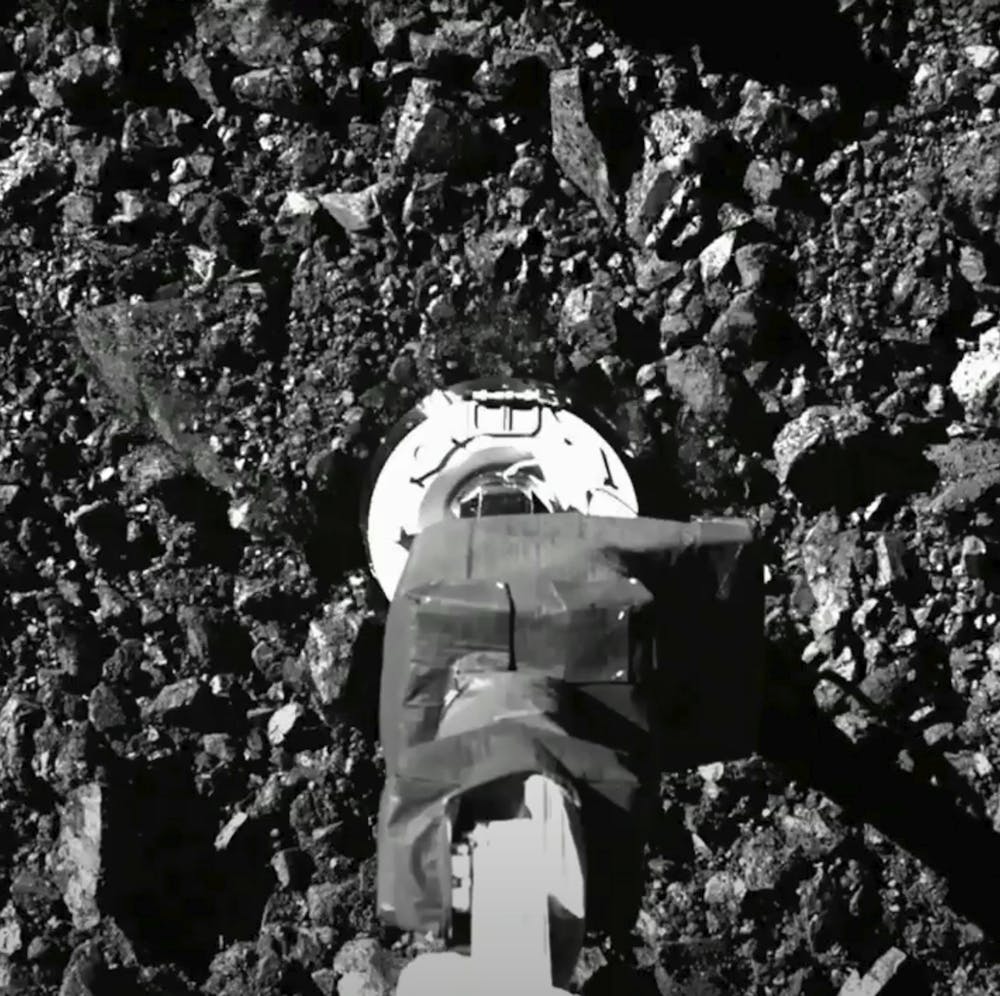
Other than the lunar samples returned by the Apollo missions, OSIRIS-REx is the fourth mission to return extraterrestrial material back to Earth.
NASA’s Stardust mission, launched in 1999, returned microscopic samples from the trail of comet Wild-2. The Hayabusa mission, launched in 2003 by the Japanese space agency, JAXA, returned less than 1 milligram from asteroid Itokawa. JAXA’s Hayabusa2 (launched 2014) returned 5.4 grams of sample from asteroid Ryugu.
NASA estimates OSIRIS-REx has brought back around 250 grams from asteroid Bennu, by far the largest sample yet recovered. We will know for sure once the sample is carefully examined at Johnson Space Centre over the coming days.
The sound of fireballs
We and our colleagues at Curtin University are heavily involved in the global effort to find out what asteroids are really made of, having participated in or analysed samples from all of these sample return missions and leading the Global Fireball Observatory.
There are six OSIRIS-REx mission scientists from Curtin (including one of us – Nick Timms), and they will be among those receiving the first wave of samples in the coming weeks.
The re-entry of the capsule also had its own incredible science value. It was essentially a human-made fireball.
Read more: The Hayabusa2 spacecraft is about to drop a chunk of asteroid in the Australian outback
Fireballs, or really bright shooting stars from large space rocks, are quite rare and impossible to predict. This is why we use dedicated camera networks to observe large areas of sky (The Desert Fireball Network observes nearly three million square kilometres of Australian skies every night).
When objects from outer space enter the atmosphere, travelling much faster than the speed of sound, they ignite the air to create a fireball and also trigger other less-studied phenomena such as shockwaves – which can be hazardous.
 In 2013, a meteor exploded in a spectacular fireball over the Russian city of Chelyabinsk, breaking windows and causing injuries.
AP
In 2013, a meteor exploded in a spectacular fireball over the Russian city of Chelyabinsk, breaking windows and causing injuries.
AP
A sample return is a great opportunity to set out seismic sensors and other instruments to analyse the shockwave, which can tell us more about the physics of re-entry and why some meteorites survive while others don’t make it. This was done for the Hayabusa2 sample return in 2020, and researchers from Sandia Labs and the University of Southern Queensland had detectors set up in Utah for the OSIRIS-REx return.
What’s next?
Like Hayabusa2, the OSIRIS-REx spacecraft itself isn’t finished yet. Both of these spacecraft dropped their precious samples to Earth and have continued on with the aim of future asteroid fly-bys.
The mission, now renamed “OSIRIS-APEX”, has already begun to redirect itself towards an asteroid called Apophis, which it will intercept not long after the asteroid zooms past Earth in April 2029.
Authors: Eleanor K. Sansom, Research Associate, Curtin University

















