

a law expert ranks legal dramas by their accuracy
- Written by Dale Mitchell, Lecturer in Law, University of the Sunshine Coast
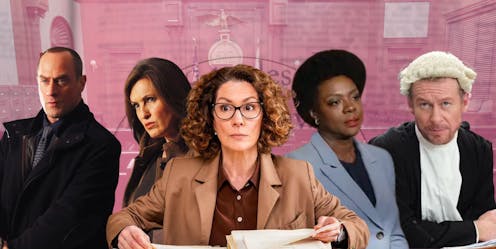
From Elle Woods in Legally Blonde to Jennifer Walters in She-Hulk, Atticus Finch in To Kill a Mockingbird to Denny Crane in Boston Legal, our popular culture is often where we first see and witness legal practice.
Sometimes this comes via the silver screen, other times television. But it would be wrong to think that all we see on legal television shows is accurate – even when it claims to capture reality.
Most legal dramas are terrible at capturing the realities of law.
Not accurate: Law(less) and (dis)Order
Law and Order (1990-) innovated television drama by showcasing both the investigation of a crime by police, and then its prosecution in court. With its multiple spin-offs, including Law and Order: Special Victims Unit (1999-) and the shortlived Law and Order: Trial by Jury (2005-2006) (which had the best theme song of all the series), the Law and Order franchise is a televisual legal juggernaut.
As with most serials, Law and Order presents the criminal justice system as moving quicker than you can say dun dun. This couldn’t be further from the truth. The mean duration of criminal law matters in Australian higher courts was almost one year (50 weeks) across 2021-22.
While procedural rules in civil matters require courts to facilitate the “just and efficient resolution of disputes at minimum expense”, in criminal law, speed and efficiency must not be prioritised over accuracy: a person’s liberty is at stake.
Most criminal matters do not proceed to a full trial as an accused will often plead guilty to the charges. As a result, the matter proceeds to sentencing without prosecutors needing to prove the offence. The rates of this occurring are quite alarming. Data across 2021-22 reveals over 75% of defendants in Australian courts entered a guilty plea, and almost four in five criminal convictions (79%) resulted from a guilty plea.
Research suggests defendants plead guilty for a variety of reasons, including to avoid the cost of a trial and to receive a lesser sentence. Data from the United States suggests the pressures of the pandemic led to innocent people pleading guilty to crimes they didn’t commit.
If Law and Order was a more accurate reflection of criminal law, matters would proceed immediately to sentencing due to guilty pleas. And should an accused be found guilty, a chunk of their sentence would be reduced by time served awaiting trial.
Not accurate: Suits
Suits (2011-19) centres around law firm partner Harvey Specter (Gabriel Macht) and his mentorship of Mike Ross (Patrick Adams) – the “lawyer” who never graduated law school and provides legal advice thanks to his photographic memory.
This is, obviously, a brutal ethical breach for all involved, and clearly fraud. In Australia, law students who present themselves to be lawyers are subject to sanctions by the Legal Services Commission. They can cause harm to clients who have hired their services. And the Legal Admissions Board may deny their entry into the profession.
(Spoilers) Ross is eventually sentenced to two years in prison for this fraud, a similar sentence to a recent case in the United States, but he only serves three months before solving a crime and earning early release. More unrealistic than this early release is that Ross does fairly quickly thereafter gain admission to the profession, which seems unlikely to occur so soon after such an act of fraud.
While Suits has left its mark(le) on the popular imagination of law, it fails to address one of the primary duties of civil litigation: the duty of disclosure.
The MacGuffin-ing of law is common in TV serials. It’s the “smoking gun” found on the day of the trial, or for the lawyers in Suits, the random document which shows up during the trial to turn the case - dramatically presented by our protagonists as they flail into court armed with this data sans ethics.
This is not quite accurate.
In adversarial legal systems like Australia, New Zealand, the UK and the US, civil litigation rules require parties to disclose to one another all documents in their possession or control which are directly relevant to a matter in dispute.
This is a continuing duty, so if you discover such a document at any time during the case, it must be disclosed. While exceptions based on various privileges may apply, this essentially means civil litigation must be run in an “all cards on the table” manner. Randomly producing undisclosed material at trial requires the leave of the court and may result in orders of contempt and cost penalties.
It’s not like the lawyers of Suits have ever really been concerned about ethics, though.
Not accurate: How to Get Away with Murder(ing rules of evidence)
While most lawyers would support making it a criminal offence to critique Viola Davis, How to Get Away with Murder (2014-20) presents one of the most common offences within legal dramas: the haphazard approach to rules of evidence.
Annalise Keating (Davis) and her ragtag team of morally illiterate law students (although I never see them studying?!?!) manipulate people to obtain evidence and then dramatically prompt witnesses on the stand to read this information into the record, or otherwise “sneak” it into the trial.
This is not accurate. And it ignores the basic reality that so much of legal practice is about not just obtaining evidence, but ensuring that evidence is admissible in court.
One of the most important rules of evidence deals with hearsay evidence. A court cannot allow evidence to be considered if its reliability is unable to be interrogated. Witnesses can only present evidence that they saw, heard or perceived themselves. Unless an exception to the hearsay rule applies, such evidence would be inadmissible.
Like in Suits, these approaches to presenting evidence may have serious implications. This poor trial management results in delays to criminal trials..
Accurate: Fisk
Fisk (2021-) follows Helen Tudor-Fisk (Kitty Flanagan), an established contract lawyer whose personal dramas lead her to move to the boutique Melbourne probate law firm of Gruber and Gruber (played by Marty Sheargold and Julia Zamero).
Fisk excels in showing the importance of lawyer-client relations and the word-of-mouth that sustains much of small legal practice. It’s the anti-Suits, and Fisk is more powerful for it.
The discussions of wills and estates and most basic legal principles in Fisk are mostly sound – and the show doesn’t need to get into “legalese” as matters are resolved out-of-court.
This is a distinct reality of law: litigation is a last resort. Forms of alternative dispute resolution, including mediation, negotiation and conciliation, have become the primary way of resolving legal disputes.
Fuelled by legislative changes which require the exhaustion of alternative dispute resolution measures before proceeding to litigation, and a pursuit of reduced costs, the drama of trial is not something anyone should yearn for.
Accurate: Rake
Cleaver Greene, a character said to be loosely based on the career of a Sydney barrister, shows us the absolute madness of work as a “silk”. Rake excels at showing the reality of law. The show raises interesting and accurate questions of law (yes, it is true there is no explicit offence of cannibalism in New South Wales) and presents Australian court process accurately.
Thankfully, there’s not a gavel in sight. Australian courts do not use gavels, and their presence in legal dramas in Australian and UK courts shows a lack of attention to detail. The presence of the gavel as a symbol of justice is an entirely American invention.
Rake is accurate, in part, because the site of drama is rarely the courtroom, but rather Greene’s personal life. The accuracy of that element for law I will leave up to the jury. But with a 2014 study finding 35% of lawyers engaged in hazardous or harmful drinking and another showing high rates of anxiety and depression in the legal profession, the evidence is compelling.
Authors: Dale Mitchell, Lecturer in Law, University of the Sunshine Coast

















