Modern Australian
The Times

The Albanese government blew its shot at setting a historic new unemployment target

  • Written by Peter Martin, Visiting Fellow, Crawford School of Public Policy, Australian National University

The Albanese government blew its shot at setting a historic new unemployment target

Treasurer Jim Chalmers says the federal government’s employment white paper is “ambitious”. I’m not convinced.

A clearly ambitious statement would have specified a target for unemployment, ideally one that was a bit of a stretch.

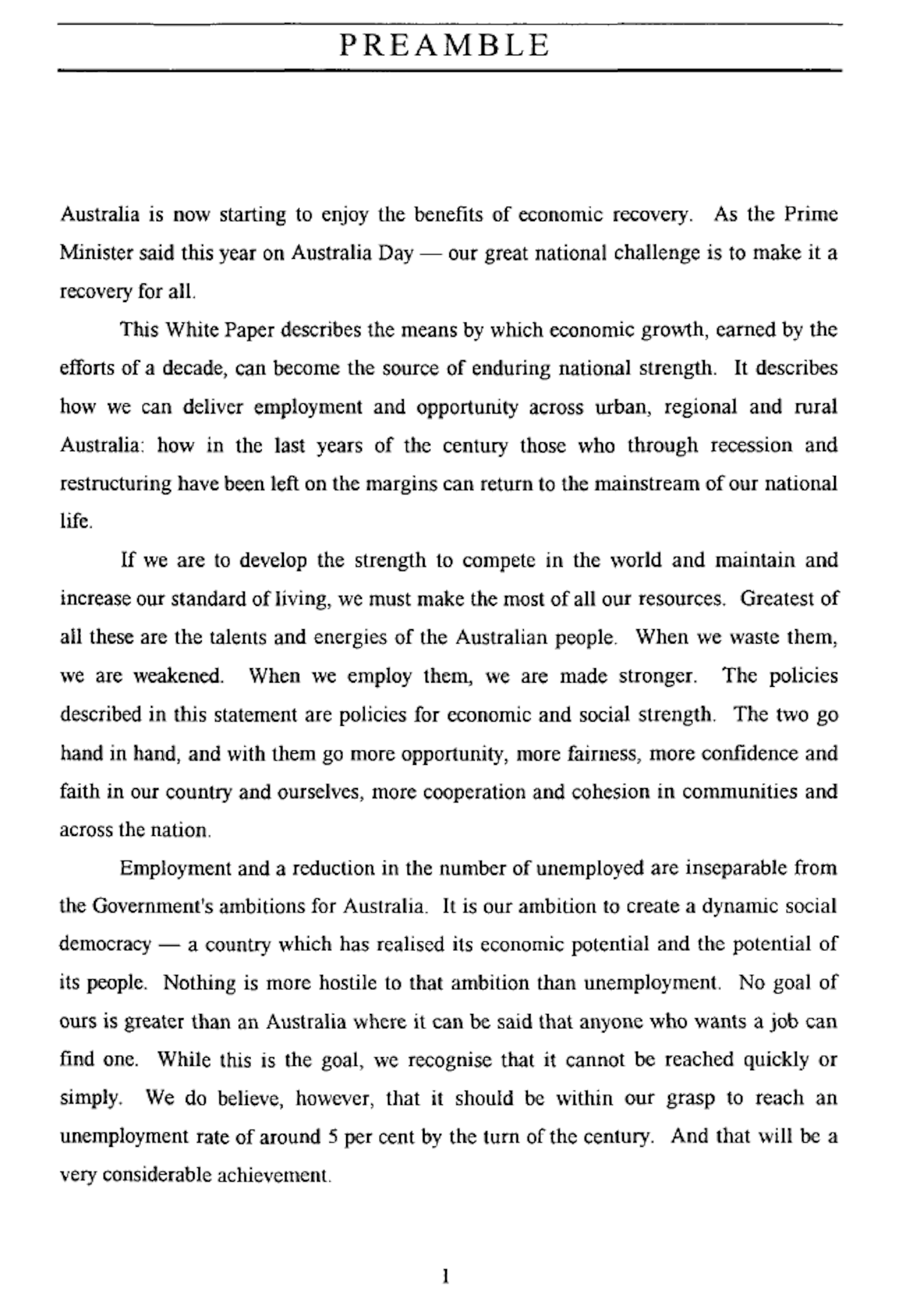
The Keating Labor government’s Working Nation statement did that in 1994. Released at a time when unemployment was almost 10%, it specified a target unemployment rate of 5% – an ambition that served as a beacon for decades.

That target certainly needs to be updated. Unemployment is now well below 5%, meaning “full employment” is now much less than 5%. Yet the Albanese government has passed up a historic opportunity to say how much less, which it could have done by setting its own target.

Setting our sights below 5%

The white paper released on Monday defines full employment as a state in which “everyone who wants a job should be able to find one without searching for too long”. That means our unemployment target ought to be somewhere between zero and 5%.

Of course, the unemployment rate can never be zero.

There will always be people out of work while they are moving between jobs, what the white paper calls “frictional” unemployment. That will also be true when Australia’s mix of employers changes – what the paper calls “structural” unemployment, as new industries requiring one sort of training replace old industries that required another.

The white paper says what matters in addition to unemployment (539,700 Australians) is “underemployment” in which people work fewer hours than they want (1 million) and “potential workers” who would like work but aren’t actively looking and so aren’t counted as unemployed (1.3 million).

I get that these things matter. I get that we need, in the words of the white paper, “a higher level of ambition than is implied by statistical measures”.

What gets measured gets done

But that higher level of ambition ought not replace targets.

If a target isn’t specific, it isn’t a target at all (or at best it’s a fuzzy target). That means it’s less likely to be aimed at and less likely to be hit.

That’s how it’s been with full employment itself. In 1996 Treasurer Peter Costello and the man he appointed Reserve Bank governor, Ian Macfarlane, signed what became the first Statement on the Conduct of Monetary Policy, an agreement that’s been updated six times.

As with all of the agreements since, that first statement set out an inflation target (“between 2% and 3%, on average, over the cycle”) but not an employment target – even though both are meant to be objectives under the Reserve Bank Act.

As a result, Governor Macfarlane was able to step down ten years later, secure in the knowledge that on average he had hit the middle of the target band: 2.5% inflation. His successor Glenn Stevens stepped down ten years further on, quietly boasting the same thing.

But neither could make any boast about hitting the employment target – because there wasn’t one.

How failing to set a target costs jobs

The governor who has just retired, Philip Lowe, looks like he’ll hit an inflation average of 2.8%, which is pretty low given how high inflation has been lately.

But an estimate by former Reserve Bank staffer Isaac Gross, prepared using the Reserve Bank’s own economic model, suggests that in doing so he kept unemployment a good deal higher than it needed to be between 2016 and 2019 – the equivalent of 270,000 people being out of work for one year.

Read more: The RBA's failure to cut rates faster may have cost 270,000 jobs

Lowe wasn’t held to account for the extra unemployed in the same way as he is being held to account for his performance on inflation. Why? Because he was never actually given an unemployment target.

I am quite prepared to acknowledge that other measures of employment matter, underemployment among them. But here’s the thing: they move in line with unemployment.

When Australia’s unemployment rate falls, Australia’s underemployment rate falls, almost in tandem.

It’s easy to see why. As employers find it hard to hire new workers, they get existing workers to put in more hours. And retirees and others who haven’t been looking for work begin putting themselves out there.

Australia’s participation rate measures the proportion of the population making itself available for work. As unemployment has fallen, it has climbed to an all-time high.

Our unemployment rate is a proxy for what matters

This makes the unemployment rate just about the perfect proxy for everything else about the labour market that matters, and just about the perfect number to target.

The Albanese government could have recognised that this week – setting a stretch target of 3% (or even 4%) as an aspiration. Even that would have been less “ambitious” than Keating choosing 5%, when the rate was twice as high.

2023 RBA Review Treasurer Chalmers says the government didn’t set a target because apparently the unemployment rate doesn’t capture “the full extent of spare capacity in our economy or the full potential of our workforce”. The saving grace is this government has a second chance at this. Chalmers is about to update the Reserve Bank’s statement of expectations, the one that until now hasn’t included a target for unemployment. It would be open to him to put a specific target in there – making the RBA as accountable as it is now on inflation. At the moment, it looks more likely Chalmers will adopt a recommendation of the independent review of the bank, which reported in March. That review recommended the bank be required to produce its own “best assessment of full employment at any point time”, including its estimate of the lowest rate of unemployment that can be sustained without accelerating inflation. It would be a small step forward. That full employment estimate would become a number to watch, in the same way as the bank’s performance on inflation is at the moment. But it still won’t be an official government target. The Albanese government had an opportunity to live up to its ambitious rhetoric – and it passed. Read more: 1 in 5 Australian workers is either underemployed or out of work: white paper Authors: Peter Martin, Visiting Fellow, Crawford School of Public Policy, Australian National University

Read more https://theconversation.com/the-albanese-government-blew-its-shot-at-setting-a-historic-new-unemployment-target-214357

Chatswood Tutoring And Its Role In Academic Achievement

Academic success often requires more than classroom attendance alone. Students face increasing expectations as they progress through school, particu...

Why Laser Hair Removal Treatments Continue Growing In Popularity

Managing unwanted hair can become time-consuming and frustrating for many people, especially when shaving, waxing, and other temporary methods requi...

Choosing the Right Devices for a Flexible Workplace

For IT leaders managing large fleets, the device layer is where workforce productivity and security policy meet. The shift towards flexible and hybrid...

How Business Advisory Services Help Companies Achieve Sustainable Growth

Every business owner aims to build a profitable and sustainable organisation. While dedication, innovation, and hard work are important, achieving l...

Why Body Contouring Has Become A Popular Cosmetic Treatment

Many people maintain healthy lifestyles through regular exercise and balanced eating habits but still struggle with stubborn areas of fat that are d...

How to Choose the Right POS Hardware for Your Business in Australia

A lot of Australian business owners spend weeks researching POS software but buy hardware almost as an afterthought. That's a mistake. The wrong har...

Why Material Handling Hose Is Critical for Industrial Efficiency

A high-performance material handling hose is an essential component in industries that transport abrasive, dry, or bulk materials on a daily basis...

How to Choose the Right Lawyer in Melbourne for Your Situation

Choosing legal support can feel difficult, especially when the stakes are personal or business-related. The right lawyer in Melbourne should underst...

Hoteliers Look to Clever Value Adds to Increase Revenue

The Australian hospitality industry is still in recovery mode after a notoriously rough patch in recent years. While there has been a post-COVID tra...

Moving to Queensland? Here’s How to Prep Your Car for the Big Move North

There’s no sign of the northern migration slowing down, with thousands of southerners fleeing from chaotic lifestyles and cooler climates for a brig...

Diesel Shortage to Impact Trades and Contractors

Strait of Hormuz blockage affecting all major parts of trades and construction Trades and construction across residential, commercial and industria...

Why Holiday Home Owners Turn to Rental Management Agents

The Allure — and the Reality — of Renting Out Your Property Owning a holiday home is a dream for many Australians. Whether it's a beachside sha...

Why Finding Reliable Doctors In Bundoora Is Important For Long-Term Health

Access to quality healthcare plays an important role in maintaining overall wellbeing and managing health concerns early. Trusted Doctors in Bundoor...

Understanding the Different Types of Car Services: Minor vs Major

When it comes to car maintenance, one of the most important things every vehicle owner should understand is the difference between a minor and a maj...

How Superannuation and TPD Insurance Work Together

Superannuation is an essential part of financial planning in Australia. It is designed to provide individuals with income during retirement, helping...

Tiny Towns funding granted for Mt Hotham and Mt Buller upgrades

Alpine Resorts Victoria (ARV) has welcomed funding support from the Victorian Government’s  Tiny Towns Fund, with both Mt Hotham and Mt Buller se...

Locksmith Services: Why Professional Security Solutions Matter More Than Ever

Security is a critical concern for homeowners, businesses, and vehicle owners alike. Whether it involves protecting a property, replacing damaged lo...

Why Tooth Fillings Are Important For Protecting Damaged Teeth

Cavities and minor tooth damage are common dental problems that can worsen if left untreated. Professional tooth fillings help restore damaged teeth, ...