

New study shows we can create value from food waste by turning it into a highly desirable material – nanocellulose
- Written by Alan Labas, Lecturer in Management, Federation University Australia
Food waste is a global problem with approximately 1.3 billion tonnes of food wasted each year throughout the food lifecycle – from the farm to food manufacturers and households.
Across the food supply chain, Australians waste around 7.6 million tonnes of food each year. This costs our economy approximately A$36.6 billion annually.
In a recent study published in Bioresource Technology Reports, we have found a way to use food waste for making a versatile material known as nanocellulose. In particular, we used acid whey – a significant dairy production waste material that it usually difficult to dispose of.
Mixing waste with bacteria
Nanocellulose is a biopolymer, which means it’s a naturally produced long chain of sugars. It has remarkable properties – bacterial nanocellulose is strong, chemically stable and biocompatible, meaning it’s not harmful to human cells. This makes it a highly marketable product with applications in packaging, wound treatments, drug delivery or food production.
The traditional approach for making nanocellulose can be expensive, uses large amounts of energy and takes a long time. Some types of nanocellulose production also use a chemical process that produces unwanted waste byproducts.
By contrast, our new approach uses just food waste and a symbiotic culture of bacteria and yeasts (SCOBY) – something you may be familiar with as a kombucha starter. Our process is low cost, consumes little energy and produces no waste.
Read more: What is kombucha and how do the health claims stack up?
We used a runny waste liquid known as acid whey from a local cheese manufacturer in Melbourne, Australia. In the dairy industry, acid whey is often disposed of as wastewater in large amounts (more than 100 million litres of acid whey are produced annually in Australia alone), despite it being rich in carbohydrates and proteins. This is because it’s hard to process into other products due to a high lactic acid content.
We heat-treated the liquid and supplemented it with sugar and yeast extract before adding the key ingredient, SCOBY (obtained commercially from a Melbourne-based kombucha company).
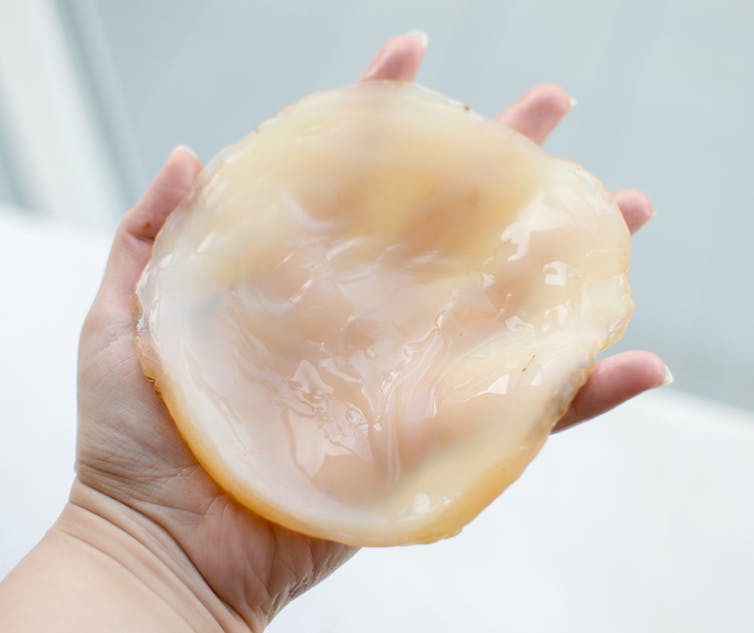
Over four days as our mixture fermented, the bacteria worked to create nanocellulose material which floated to the top. Lovers of home-brewed kombucha may actually be familiar with the raw nanocellulose material – it forms as a floating off-white structure called a pellicle. Some people already use this kombucha by-product as vegan leather.) A similar pellicle formed on our acid whey mixture.

A growing market
Demand for nanocellulose is growing worldwide. The global market was valued at US$0.4 billion in 2022 (A$0.6bn) and is expected to grow to US$2 billion by 2030 (A$3.1bn). Bacterial nanocellulose produced from food waste can help to satisfy this demand.
This growth is in part due to how we can use nanocellulose instead of petroleum-based and other non-renewable materials in things like packaging. Among its desirable properties, nanocellulose is also fully biodegradable.
Manufacturers around the globe are seeking sustainable sources of raw material for producing composite materials with various properties. Nanocellulose is easily customised in this way. For example, infusing nanocellulose with a compound called glycerol enhances its flexibility and makes it more pliant. As a food-safe material, we are now investigating nanocellulose as “smart” packaging by infusing nanocellulose with indicators that signal when food is no longer safe to eat.
Additionally, using a single source of food waste (such as acid whey in our example) means we can produce highly pure nanocellulose – ideal for biomedical applications, such as wound dressings, pharmaceutical compounding and cell cultures.
 An example of nanocellulose material that could be used for wound dressing.
Shutterstock
An example of nanocellulose material that could be used for wound dressing.
Shutterstock
Efficient circular economy
A circular economy attempts to minimise waste and extend the lifecycle of products for as long as possible. Our study demonstrates an efficient circular economy approach for upcycling a dairy industry waste product into sustainable nanocellulose.
Additionally, the sediment residue we produced has a high nutrient value and potentially has commercial value as a fertiliser or animal feed, while the liquid culture can be reused for the next batch.
Our study was limited to a single source of food waste within a laboratory environment. A future challenge will be taking this approach out of the lab and scaling it up for commercial use. This will involve a series of steps throughout the value chain from waste collection and transport through to commercial production.
We also hope to explore alternative mediums such as mixed food waste. More research also needs to be done on how nanocellulose can be most effectively customised for various applications, such as different types of food packaging.
Overall, our proof-of-concept study demonstrates potential for producing nanocellulose in a sustainable, environmentally sound manner – from food waste to significant value.
Read more: Explainer: What is a circular economy?
Authors: Alan Labas, Lecturer in Management, Federation University Australia

















