

Citizen scientists collect more nature data than ever, showing us where common and threatened species live
- Written by Erin Roger, Sector Lead, CSIRO
Citizen science isn’t new anymore. For decades, keen amateur naturalists have been gathering data about nature and the environment around them – and sharing it.
But what is new is the rate at which citizen scientists are collecting and sharing useful data. Last year, 10 million observations of species were collected. Our new research shows 9.6 million of those came from citizen scientists. It makes intuitive sense. There are only so many professional researchers. But nearly everyone now has a smartphone.
But if anyone can contribute data, how do you know it’s reliable? Was it really an antechinus, or was it a black rat? Despite the growing success in collecting data, there has long been scepticism over how reliable the data are when used to, say, estimate how abundant a threatened species is.
It turns out, citizen science is extremely useful – especially when paired with professionally collected data.
How did we test it?
It’s now much simpler and quicker to be a citizen scientist than it used to be. You might take a photo of an unusual mammal you spot at a campground, record your observations, and upload it to an app or website. This, in turn, has helped standardise the data and make it even more useful. Around Australia, thousands of people contribute regularly through platforms like iNaturalist, DigiVol, 1 Million Turtles, FrogID and Butterflies Australia.
When you upload your observation, it’s recorded in the database of the individual app. But data from all major citizen science apps is also shared with the Atlas of Living Australia, Australia’s largest open-source open-access biodiversity data repository.
That’s important, because it means we can aggregate sightings across every app to get a better sense of what’s happening to a species or ecosystem.
To tackle the question of data reliability, we looked at what proportion of total records added to the data repository came from citizen scientists.
Then we chose three common species – shingleback lizards, Peron’s tree frog, and the red-browed firetail finch – and compared citizen science observations with professionally recorded data across their distribution.
For the shingleback lizard (Tiliqua rugosa), the majority of locations where it was sighted came from professional projects such as government programs and museums, with only 18.5% of locations drawn largely from citizen science.

Peron’s tree-frog (Litoria peronii) had 33.5% of its locations mainly contributed by citizen scientists.
 Peron’s tree frog.
Author provided, CC BY-NC-ND
Peron’s tree frog.
Author provided, CC BY-NC-ND
But for the red-browed firetail (Neochmia temporalis), citizen science was the main contributor in over 86.5% of its locations.
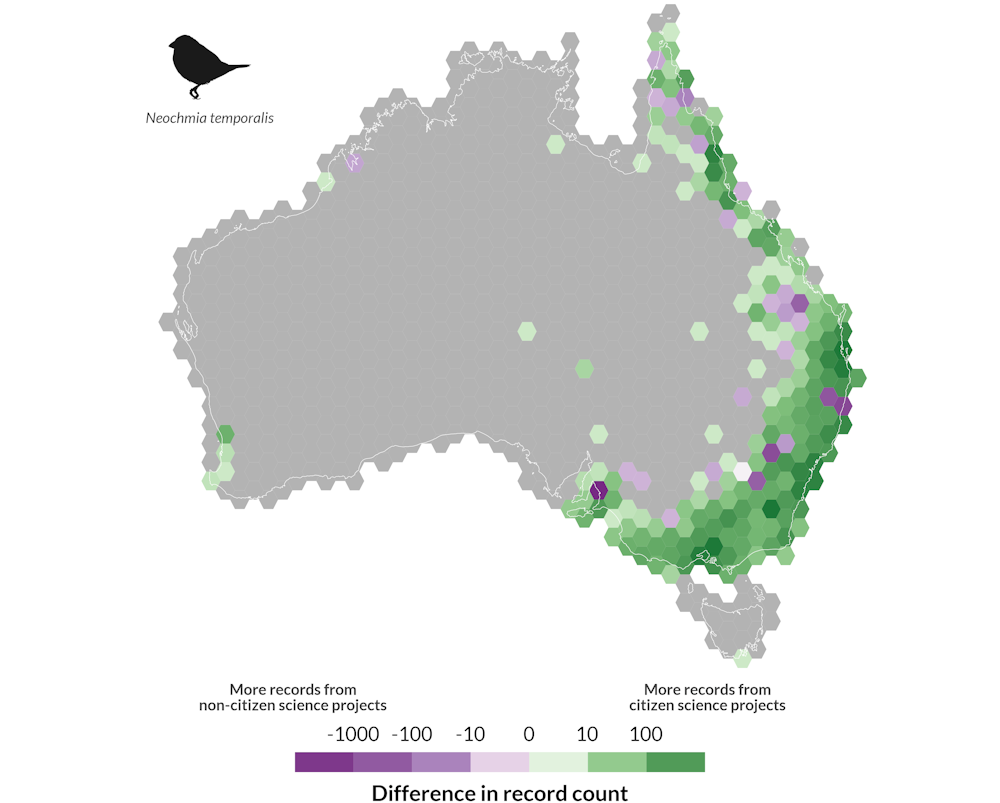 Red-browed firetail finch.
Author provided, CC BY-NC-ND
Red-browed firetail finch.
Author provided, CC BY-NC-ND
Why the difference? We believe it’s due to the impact of long-running citizen science projects driven by enthusiasts. Birders are a large enthusiast community, while people who go herping (looking for reptiles) are a smaller group.
As a reflection of community enthusiasm, birds make up nearly 50% of all species observation records in the Atlas of Living Australia, with the Australian magpie the most commonly recorded species.
Read more: From counting birds to speaking out: how citizen science leads us to ask crucial questions
What about rarely recorded species?
Next, we looked at several species with fewer than 1,000 records to find out whether citizen science contributes less data when species are less conspicuous.
In fact, the reverse was often true. For some rare species, citizen science is proving invaluable in ongoing monitoring.
Take the threatened black rockcod (Epinephelus daemelii), a large, territorial fish which been decimated by spearfishing and other pressures.
Here, citizen science proved its worth, adding 63% of observations. Most data came from a few high profile projects, such as annual reef and fish surveys.
 This map shows black rockcod observations by citizen scientists and non-citizen scientists.
Author provided, CC BY-NC-ND
This map shows black rockcod observations by citizen scientists and non-citizen scientists.
Author provided, CC BY-NC-ND
Citizen science is coming of age
For decades, citizen science has struggled to feed data into professional monitoring and conservation efforts.
But this is increasingly unfair. By combining citizen science data with professionally collected data, we can get the best of both worlds – a much richer picture of species’ distributions.
It’s only going to get better, as observation and citizen scientist numbers grow each year. There’s a large spectrum of projects, many with excellent data quality controls in place.
Citizen science has come a long way. The data created by keen amateurs is now of better quality, aided by new technologies and support from researchers.
Apps which add automatic time stamps, dates and locations make it much easier to validate observations.
This suggests there’s untapped potential for citizen science to contribute consistent data over significant parts of many species’ ranges, though the strength of this contribution will vary by species.
There’s still more to do to help citizen scientists contribute as usefully as they’d like to. For instance, observations tend to cluster in the regions around cities, because that’s where citizen scientists live. Citizen scientists can also favour larger, charismatic and brightly coloured species.
One method of improving collection could be to focus the interest of citizen scientists on a wider range of species.
For citizen scientists themselves, a big part of the appeal is the ability to create useful data to help the environment. Citizen scientist Jonathon Dashper, for instance, spends his spare time looking for frogs and recording fish. Why? He told us:
My drive to contribute to citizen science is to further my understanding of the natural world and contribute to decision making on environmental matters. Using citizen science platforms, I have been able to learn so much about harder-to-identify organisms.
Authors: Erin Roger, Sector Lead, CSIRO

















