

A search for links between two of the universe's most spectacular phenomena has come up empty – for now
- Written by Eric Howell, OzGrav Associate Investigator; Adjunct Research Fellow in Astrophysics, The University of Western Australia
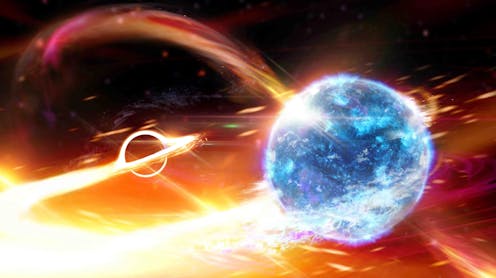
Every so often, astronomers glimpse an intense flash of radio waves from space – a flash that lasts only instants but puts out as much energy in a millisecond as the Sun does in a few years. The origin of these “fast radio bursts” is one of the greatest mysteries in astronomy today.
There is no shortage of ideas to explain the cause of the bursts: a catalogue of current theories shows more than 50 potential scenarios. You can take your pick from highly magnetised neutron stars, collisions of incredibly dense stars or many more extreme or exotic phenomena.
How can we figure out which theory is correct? One way is to look for more information about the bursts, using other channels: specifically, using ripples in the fabric of the universe called gravitational waves.
In a new study published in The Astrophysical Journal, we cross-referenced dozens of fast radio burst observations with data from gravitational wave telescopes to see if we could find any links.
Gravitational wave astronomy
If you think of telescopes, you probably think of ones that look for electromagnetic signals such as light, radio waves or x-rays. Lots of stars and other things in the cosmos produce these signals. But dust and gas abundant in the galaxies in which star systems reside can dim or block these signals.
Gravitational waves are different: they pass straight through matter, so nothing can really get in their way.
Astronomers have so far detected gravitational waves from colliding systems of compact stars such as black holes and neutron stars, as well as discovering the engines behind gamma-ray bursts.
We also have reason to think fast radio bursts may produce gravitational wave signals.
What produces fast radio bursts?
Some fast radio bursts have been seen to repeat, but most are seen as single events.
For the repeating bursts, a recent simultaneous observation of x-rays and a radio burst from a highly magnetised neutron star in our own Milky Way galaxy proves this type of star can produce fast radio bursts. No source has so far been identified for the non-repeaters.
Read more: A brief history: what we know so far about fast radio bursts across the universe
However, some theories involve astronomical objects and events we know produce strong gravitational waves. So if we have an idea of where in the sky a fast radio burst occurs, and when, we can do a targeted, sensitive search for gravitational waves over the same patch of sky.
The CHIME radio telescope
To look for new evidence on what causes fast radio bursts I co-led a targeted search using fast radio bursts detected by a radio telescope called CHIME in Canada.
As the CHIME/FRB project has detected hundreds of fast radio bursts, there’s a good chance of catching one close enough to Earth to be observed by a gravitational wave telescope. This is important as fast radio bursts are so bright they can be seen from billions of light years away – much farther than present gravitational wave observatories can see.
So what did we do and how did we do it? The project team gave us the data for a few hundred fast radio bursts. As much of this data is still not publicly available, we signed a special agreement that we would not share the details outside the search teams.
We then estimated the distance to each fast radio burst, and searched for gravitational wave data around the 40 closest events (which had evidence of being within gravitational wave detector range).
Our search team was a small group of scientists from the LIGO gravitational wave observatory in the United States, the Virgo observatory in Italy, and collaborators from the fast radio burst team CHIME/FRB.
We looked for gravitational wave signals around the sky position of each non-repeating fast radio burst around the time each occurred. For these non-repeaters, we did two kinds of search: one that looked for known gravitational wave signals, like those from colliding black holes or neutrons, and another that essentially looked for any burst of energy that was out of the ordinary.
For the repeating bursts, because we know that at least one such source is associated with a magnetised neutron star, we looked for the kind of gravitational wave signals we might expect from an isolated neutron star.
What did we find out?
Did we discover anything? Well, not this time.
It was not such a surprise, as we think fast radio bursts are much more common than detectable gravitational wave signals. In other words, gravitational wave sources would only account for a small fraction of fast radio bursts.
However, the closest fast radio burst in our sample was almost close enough for us to rule out the possibility it was caused by a collision between a neutron star and a black hole. Uncertainty in the distance to the burst means we can’t rule it out conclusively, but we are encourage by the fact the sensitive range of gravitational wave detectors is closing in on the distance to fast radio bursts.
What next?
Despite no definitive results this time, future searches could be a vital stepping stone to understanding fast radio bursts.
Gravitational wave detectors have become more sensitive than when we conducted this search, and will continue to improve in the coming years. This means they will allow a greater reach throughout the cosmos, so we can test a much larger sample of fast radio bursts.
We are also targeting future fast radio bursts from the known repeating source in our own galaxy mentioned above.
Eric Howell would like to acknowledge the contribution towards this work by the other FRB-GW search co-chair Ryan Fisher; the other members of the paper writing team Kara Merfeld, Iara Tosta e Melo, Michael Patel; and the CHIME/FRB collaborators Shriharsh Tendulkar, Mohit Bhardwaj, Andrew Zwaniga, Adam Dong and Victoria Kaspi. The LIGO-Virgo GW analysts included Michael Patel, Patrick Sutton, Teresa Slaven-Blair, Amin Boumerdassi, Grace Johns, Nathan Ormsby, Max Elias Trevor, Adrian Helmling-Cornell, Hannah Griggs, Brandon Piotrzkowski, Benjamin Mannix, Kaemon Watada, Jacob Buchanan; the LIGO-Virgo review team were Tito Dal Canton, Marco Drag, Om Sharan Salafia, Ronaldas Macas and Michal Was.
Authors: Eric Howell, OzGrav Associate Investigator; Adjunct Research Fellow in Astrophysics, The University of Western Australia

















