

Handkerchief or tissue? Which one's better for our health and the planet?
- Written by Mark Patrick Taylor, Chief Environmental Scientist, EPA Victoria; Honorary Professor, School of Natural Sciences, Macquarie University
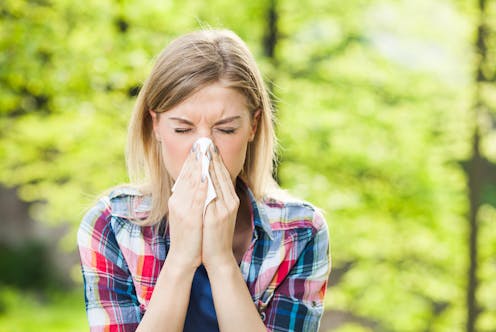
Maybe you have hay fever, COVID, a cold or the flu, and are reaching for a tissue or handkerchief.
But which one’s better at stopping infections spreading? Which has a smaller environmental impact? Is it the hanky, which has been with us since at least Roman times? Or the more recent and widely-used paper tissue?
You might be surprised at the results.
Read more: Health Check: what's the right way to blow your nose?
A short history of the handkerchief and tissue
Today, we think of hankies as something to wipe noses, and catch coughs and sneezes. But such a simple square of cloth has a complex history.
In the first century, the Romans used a sudarium (Latin for sweat cloth) to wipe off sweat, or to mask the mouth and face.
Over time, people have used what we now call a handkerchief or hanky, as a head covering, as a veil and for disguise, to clean hands, for wounds and to staunch blood.
Wealthy people have used them to signify class and manners, and for discretely wiping away phlegm rather than smearing snot on sleeves or down skirts. Royalty have used them to indicate wealth and power through their gifts of fine linen and silk handkerchiefs to favoured subjects. Henry VIII owned an extensive collection, some embossed with gold and silver.

Handkerchiefs have also been markers of love, fidelity and sexual preferences. In the late 19th century the “handkerchief code” was a system of colour coding and handkerchief placement used to indicate sexual preferences, which is still active in LGBTQ+ communities today.
We can trace the origins of paper tissue to China in the 2nd century BC. But it wasn’t until the 1920s that tissue as we know it today was developed to remove make-up and wipe runny noses from hay fever.
Read more: How do hay fever treatments actually work? And what's best for my symptoms?
So, which one is better for our health?
More than 100 years ago, a cloth hanky was considered a “little flag of Death” because of the germs it carried and how it contaminated pockets it was left in. Later, we were urged to use a hanky as “coughs and sneezes spread diseases”.
 This 1960s poster from New Zealand urges us to use a hanky.
Archives New Zealand, CC BY-SA
This 1960s poster from New Zealand urges us to use a hanky.
Archives New Zealand, CC BY-SA
Today, we know nasal secretions harbour cold-type viruses that can be transferred to a range of surfaces – hands, handkerchiefs, tissues, door knobs, keyboards – sometimes surviving long after the initial exposure.
So blowing your nose into a reusable cotton hanky, then touching another object, means these viruses can spread. Even if you put your cotton hanky in the wash immediately, you’d likely contaminate surfaces on the way, such as doorknobs, and use your infected hands to operate the washing machine.
Viruses don’t tend to survive so long on tissues. As long as you throw tissues away after using them, and don’t leave them lying around for others to pick up, the chance of passing germs to others from a used tissue is far lower.
Then there’s the question of whether hankies or tissues are effective barriers to coughing and respiratory spray.
Basic cloth coverings, such as handkerchiefs or bandannas, can catch sputum, as can tissues. But several studies have shown they do not effectively filter respiratory aerosols, or stop you inhaling pollutants, pathogens or small airborne particles.
Read more: We know hand dryers can circulate germs through the air. Why are they still used everywhere?
Which one is better for the planet?
 Surely, cotton hankies are better for the planet than tissues? Let’s see.
Shutterstock
Surely, cotton hankies are better for the planet than tissues? Let’s see.
Shutterstock
If you want to look at environmental considerations, US company Ecosystem Analytics compared resusable cotton hankies to disposable paper tissues using a lifecycle analysis. It considered four measures of environmental impacts associated with production, transport, use and disposal:
climate change (sum of greenhouse gases: carbon dioxide, methane, water vapour, nitrous oxide and CFCs)
ecosystem quality (chemical pollution of land and water)
human health (carcinogenic and non‐carcinogenic toxicity to humans)
resources (total energy requirements of non‐renewable energy and mineral extraction).
The verdict? Across the four measures, a cotton hanky had five to seven times greater impact than an equivalent tissue.
And, by far, the greatest impacts were related to the production of each of these products, rather than using or disposing of them.
If you’re still keen to use a cotton hanky, you could opt for organic cotton, which has a lower ecological footprint compared to standard cotton produced in the same location. But organic cotton production has lower yields than its conventional equivalent, meaning more land is needed to produce an equivalent amount, compounding the total environmental impact.
If you want to feel better about using tissues, ones made from recycled material may be a better option. Their manufacture leads to fewer greenhouse gas emissions compared with making regular tissues.
Read more: Sustainable shopping: for eco-friendly jeans, stop washing them so often
The verdict
Wiping our noses with paper tissues we dispose of properly after use (and don’t store in our pocket), made from recycled material, is preferable from both a health and environmental perspective.
But tissues don’t quite have the same panache as the historic and versatile cloth hanky.
Authors: Mark Patrick Taylor, Chief Environmental Scientist, EPA Victoria; Honorary Professor, School of Natural Sciences, Macquarie University

















