

Here's how to fix Australia's approach to soil carbon credits so they really count towards our climate goals
- Written by Aaron Simmons, Adjunct Senior Research Fellow, University of New England
Australia’s plan to achieve net zero greenhouse gas emissions by 2050 relies heavily on carbon credits.
These credits are awarded to projects that avoid the release of greenhouse gases or remove and “sequester” (store) carbon so it’s no longer warming the atmosphere.
Farmers can be awarded credits for increasing soil carbon content. The federal government or companies can then purchase these credits to offset their carbon emissions.
These credits must represent genuine carbon sequestration if they are to mitigate climate change.
As Australian agricultural and soil scientists, we have serious concerns about the way credits are awarded for soil carbon sequestration under the Australian carbon credit unit scheme. There are four main issues with the method that must be addressed as a matter of urgency.
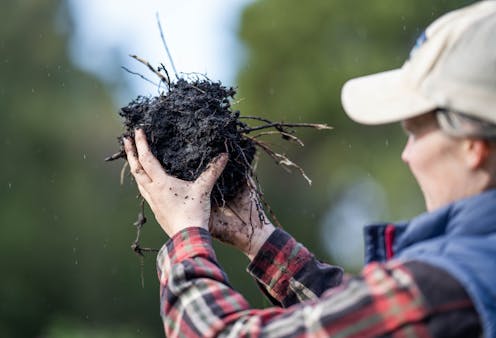
Soil organic carbon is the treasure beneath our feet (Food and Agriculture Organization of the United Nations)Understanding the carbon cycle
Much like water, carbon cycles through the environment, moving between plants, the earth and the atmosphere.
Plants take in carbon dioxide from the atmosphere as they grow. The carbon is stored in the plant tissue. When plants die, or drop leaves, this carbon-rich organic matter enters the soil. Then it decomposes, releasing carbon dioxide back into the atmosphere.
When carbon inputs from plants exceed losses from the decomposition of organic matter, the amount of soil carbon increases. That means soil organic carbon is more likely to increase during good seasons when there’s plenty of rainfall available to support plant growth – such as during the recent three-year period of consecutive La Niña events.

Increases need to be due to management
The recent tranche of credits awarded to soil carbon projects raises similar concerns to those that have been raised by experts about credits awarded to trees. Namely, carbon credits are being awarded for changes associated with seasonal conditions (changes that would have happened anyway) rather than human actions.
The current soil carbon method awards credits when an increase in soil organic carbon is detected between two points in time. This is problematic because it can award credits to projects that report increases during relatively wet periods.
This is the case for projects sampled in 2021, directly after a period where conditions were unusually favourable for plant growth. That means credits were awarded for sequestration that had more to do with the weather than good management.
Where crediting occurs due to seasonal conditions, the scheme is not providing any true (additional) climate change mitigation.
Soil carbon can be lost
Where soil carbon losses are greater than inputs, soil carbon stocks decline and sequestered carbon is released back to the atmosphere. The emissions can be rapid and considerable.
Furthermore, modelling indicates it’s likely soil carbon could be lost under the warmer and drier conditions of future climates.
Where a project loses soil carbon, the legislation does not require excess credits to be returned. Rather, a scheme-wide buffer generated from all sequestration projects covers such losses.
This approach is inequitable because all projects share the same burden of maintaining the buffer, irrespective of the risk of reversal of individual projects.
Overinflated sequestration rates
Based on a comprehensive global analysis, the number of carbon credits generated by some Australian projects appears unrealistically high. The most likely reason for these large values is high rainfall, but the way the method works makes it impossible to know for sure because the impacts of management are not identified.
This is not the first time a soil carbon project has made unrealistic claims.
In addition, one project saw 44% of the increase in soil carbon at depths below 30cm. This is an issue because published studies show soil carbon changes in deeper soil are relatively small and happen slowly. We are concerned the reported changes may have more to do with the way they were calculated.
Currently, data used to calculate credits are not released by the scheme regulator so cannot be scientifically verified. The release of data under strict non-disclosure arrangements would allow scientists to assess the implementation of the method. This would provide confidence credits generated represent real climate change mitigation.
Increased transparency was a key recommendation of the Chubb Review of Australian Carbon Credit Units in 2022.
Read more: Chubb review of Australia's carbon credit scheme falls short – and problems will continue to fester
Contributing to our emissions targets?
Australia’s emissions are reported annually to the United Nations in the national greenhouse gas inventory. These annual inventories show progress towards our declared emissions reduction targets.
The current inventory method used to account for changes in soil carbon uses coarse regional-level statistics. Changes to practices at farm level, such as grazing management, are not detected and will not be reflected in our national greenhouse gas accounts. Further, Australia reports changes in soil carbon for the top 30cm of the soil only whereas carbon credits are also awarded for changes that occur deeper in the soil.
This means some soil carbon credits the Australian government purchases do not count toward our emissions targets. It calls into question the effectiveness of using taxpayer funds to purchase soil carbon credits as a policy tool.
Getting it right
To address the issues we have identified, the measurement-based soil carbon method needs to be revised to only credit increases due to management. For instance, the Verra scheme in the international voluntary carbon market uses a method that minimises crediting for increases associated with rainfall.
To support revision of Australia’s scheme, scientists should be granted access to project data. Data could to be used to improve models in order to distinguish between climate and management effects. This would ensure the method is fit for purpose.
There also needs to be greater focus on monitoring changes in soil carbon. For a start, Australia’s Terrestrial Ecosystem Research Network should be extended to include agricultural land. This would provide data to increase transparency, independence and rigour of soil carbon estimates.
The revisions we propose would help ensure investment in carbon credits contributes to our national emissions reduction targets and addresses the urgent challenge of climate change.
Read more: A tonne of fossil carbon isn't the same as a tonne of new trees: why offsets can't save us
Authors: Aaron Simmons, Adjunct Senior Research Fellow, University of New England

















